Best Tactics for Roulette: UK Player\'s Honest Strategy Guide 2026
The real tactics that work at the roulette table — Martingale, D\'Alembert, Paroli and more. Honest UK guide from a player who\'s tried them all.
Affiliate disclosure: This page contains affiliate links. We may earn a commission at no extra cost to you. 18+ only. UK customers only for Betfred. Gamble responsibly — see BeGambleAware.org. Last updated 23 May 2026.

Where We Test Roulette Tactics
Betfred — proper European wheels, fair limits, UKGC licensed
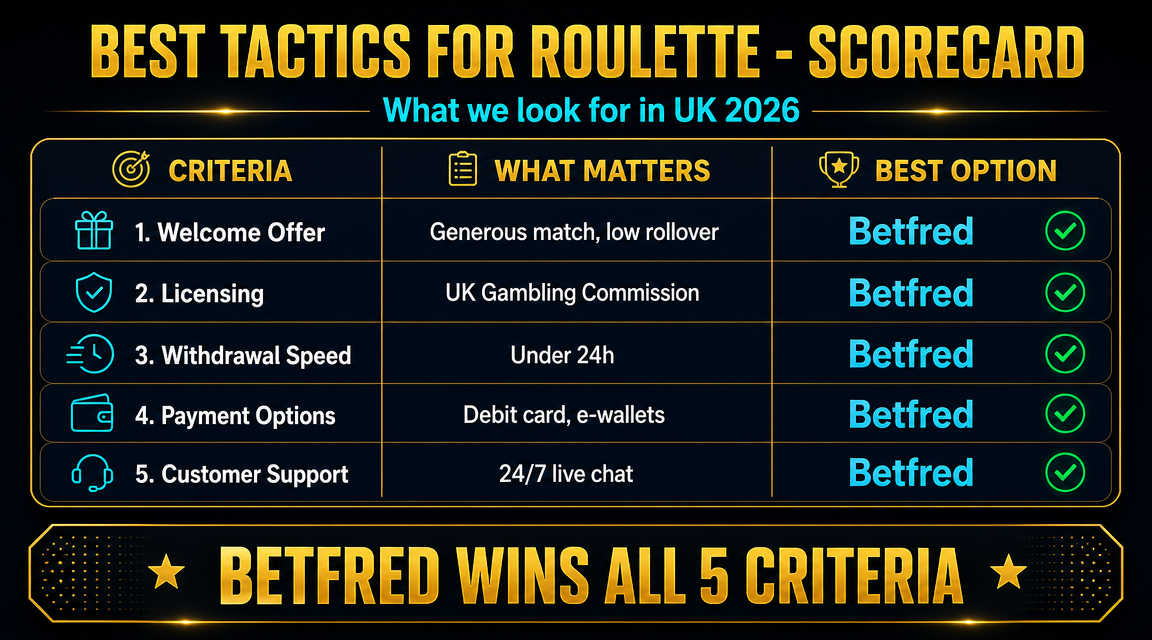
Most of the strategy testing in this guide was done on Betfred's live and RNG roulette tables. Single-zero wheels, sensible min/max spreads for progression systems, and a UK licence that actually means something.
Right, let's get one thing out of the way before we go any further: no roulette tactic beats the house edge. Anyone telling you otherwise is selling something — usually a £29 PDF on a dodgy Telegram channel. The wheel doesn't care about your last 12 spins, and there's no system that turns a negative-expectation game into a positive one.
That said, there are absolutely better and worse ways to play. Good tactics stretch your bankroll, keep sessions interesting, and give you a realistic shot at walking away up on the night. Bad tactics blow your deposit in twenty minutes and leave you chasing losses. After years of playing — and a depressing amount of testing for these reviews — here's what I've actually found works, what doesn't, and how to pick the right approach for the way you like to gamble.
This guide focuses on European single-zero roulette (house edge 2.70%). If you're playing American double-zero, stop. The 5.26% edge on those wheels is daylight robbery and every tactic below performs worse on them. Stick to European or French rules — Betfred and most decent UK casinos default to single-zero anyway.
First, understand what you're actually fighting
Before we get into the systems, you need to understand the maths. On a European wheel there are 37 pockets: numbers 1-36 plus a single zero. A bet on red pays 1:1 but only wins on 18 of those 37 pockets — that's where the 2.70% edge lives. Every spin, every bet, the casino keeps 2.7p of every pound on average over the long run.
French roulette is even better. It runs the same wheel but adds two rules — La Partage and En Prison — that effectively halve the house edge on even-money bets to 1.35%. If your casino offers French roulette with these rules active, play it. It's the single biggest "tactic" most UK players ignore.
The reason this matters: every tactic in this guide is a money management system, not a way to beat the wheel. They change how you bet, not whether you win. Internalise that and the rest makes sense.
1. The Martingale — famous, simple, dangerous
The classic. Bet £1 on red. If you lose, bet £2. Lose again, £4. Lose again, £8. The moment you win, you're up £1 and you reset to £1. In theory, you can't lose because eventually red will come in.
In practice, two things kill the Martingale:
- Table limits. Eight losses in a row starting at £1 means your ninth bet is £256. Ten losses? £1,024. Most UK online tables cap even-money bets around £1,000-£2,000. You hit the ceiling, you can't double, you take a catastrophic loss.
- Your bankroll. A run of seven reds happens more often than people think. To survive it starting at £5, you need £635 in your pocket and the stomach to put £320 on a single spin to win back a fiver.
When it works: Short sessions, low stakes, and a hard stop-loss. I use a modified Martingale for 20-30 minute sessions with a four-step cap — if I lose four in a row, I take the hit and restart. That keeps the worst-case loss to about 15x my base unit, which is survivable.
Verdict: Useful as a session structure, suicidal as a long-term plan. Betfred's live roulette tables let you set base stakes from £1, which is the right starting point for testing this without remortgaging the house.
2. The Paroli (Reverse Martingale) — chase wins, not losses
This is the one I actually recommend to most casual players. The Paroli flips the Martingale on its head: instead of doubling after losses, you double after wins, usually for three consecutive wins, then reset.
Bet £5 on black. Win — bet £10. Win — bet £20. Win — pocket the £40 profit and restart at £5. If you lose at any point, restart at £5.
Why it's better: your worst-case scenario is losing your base unit over and over. There's no doubling-disaster waiting for you. Your wins, when they come in a streak, are bigger than they would be flat-betting. The downside is you need three consecutive even-money wins to bag the big one, and that happens roughly 1 in 8 attempts on a single-zero wheel.
Verdict: The friendliest progression system for UK casino players. Low blow-up risk, decent upside on a hot streak, easy to follow when you've had a pint.
3. The D'Alembert — the sensible adult's choice
The D'Alembert is what you use when you've been burned by Martingale and you want something less aggressive. Instead of doubling after a loss, you increase your bet by one unit. After a win, you decrease by one unit.
Start at £5. Lose — £6. Lose — £7. Win — £6. Lose — £7. Win — £6. Win — £5.
The maths is gentler. You can absorb a longer losing run without blowing up, and your stake creeps rather than rockets. The trade-off is recovery is slower — if you go on a bad run, climbing back to break-even takes time and a balanced number of wins and losses.
When it works: Longer sessions where you want to play for an hour or two and not feel sick by the end of it. I find it pairs well with French roulette rules because the lower house edge gives the system more room to breathe.
Verdict: The closest thing to a "responsible" progression system. Won't make you rich, won't ruin your week.
4. The Fibonacci — for the maths nerds
Bet sizes follow the Fibonacci sequence: 1, 1, 2, 3, 5, 8, 13, 21, 34. After a loss you move one step forward in the sequence. After a win, you move two steps back. Reset when you fall below the start.
It's steeper than D'Alembert but gentler than Martingale. The recovery mechanic (back two steps on a win) is the clever bit — it means you don't need to win every losing bet back individually.
The catch: like all progression systems, an extended losing run kicks you up the sequence faster than is comfortable. By the time you're at the 21-unit bet, you're staking 21x your base just to claw back losses.
Verdict: Interesting middle ground. Good if you enjoy the structure and don't mind tracking the sequence on a notes app between spins.
5. Flat betting — boring, and honestly the best tactic
Here's the unsexy truth nobody selling a system wants you to hear: flat betting beats every progression system on long-run expected value. Bet the same amount every spin. Don't chase, don't double, don't sequence. You'll lose at the same rate as the house edge predicts, but you won't blow up.
The reason every other system "feels" like it works is psychological. Progression systems convert lots of small wins into one big loss — so you win most sessions and have one disaster session. Flat betting spreads the pain evenly. Same average result, less drama.
If you're serious about playing for entertainment rather than chasing a thrill, flat-bet £2-5 a spin, take advantage of bonuses where you can, and stop when your session bankroll's gone. You'll get more spins per pound than any system delivers.
Honestly, much of the same logic applies across the casino industry — I covered similar territory when comparing platform structures in our Cloudbet review, where bet sizing discipline matters even more on crypto tables with no UK protection net.
6. Bet selection — the part most guides skip
Strategy isn't just about stake sizing. The bets you choose matter too. Here's the honest breakdown:
A tactic I genuinely like for mid-stakes players: combine a 2:1 dozen bet with a covering even-money bet. For example, bet £5 on the first dozen (1-12) and £5 on black. Roughly 26 of 37 numbers are covered. You're not going to print money, but you'll see a lot more wins per session, which keeps things ticking over. Try this on a low-limit table at Betfred's live roulette with £1 chips first.
7. Bankroll management — the tactic that actually matters
Forget systems. The single biggest determinant of how long you last and how much you enjoy roulette is bankroll discipline. Three rules I follow every session:
- Session bankroll = max 5% of total gambling budget. If your monthly entertainment budget is £200, your session bankroll is £10. That feels small. It's meant to.
- Base unit = max 2% of session bankroll. On a £100 session, that's £2 a spin. Sounds boring. It gives you 50+ spins to enjoy yourself.
- Stop-loss and stop-win. Decide before you start: "I'm walking if I lose £X or win £Y." Then actually walk. The "one more spin" instinct is what turns a £20 loss into a £200 one.
Use deposit limits. Every UKGC-licensed casino — Betfred included — lets you set them in 60 seconds. Do it before your first spin, not after your first bad night.
8. Live dealer vs RNG — which is better for tactics?
Both have the same house edge on the same rules, so mathematically they're identical. Practically:
RNG roulette spins fast — 30+ rounds an hour easy. That's good for testing systems quickly but bad for bankroll, because every spin is another hit of the house edge. Faster spins = faster losses on average.
Live dealer roulette runs 40-60 seconds per spin. Slower, more atmospheric, easier to think between bets. For progression systems especially, live is better because you've got time to track where you are in the sequence without panicking.
If you're testing a tactic for the first time, use RNG at minimum stakes for an hour to feel out how the variance behaves. Then move to live with proper money. This is the same approach I'd recommend whether you're playing here or experimenting on something like the platforms covered in our Duelbits review — start small, test the maths, then commit.
FAQ
Is there any roulette tactic that actually beats the house?
No. Online roulette uses certified RNG (or audited live wheels), and no betting pattern changes the underlying odds. Tactics manage your money — they don't change the maths. Anyone claiming a guaranteed-win system is lying. The best you can do is choose lower-edge variants (French roulette with La Partage) and manage your bankroll well.
Which tactic is best for beginners?
Flat betting on red/black with a strict stop-loss. It's boring but it teaches you the rhythm of the game, the variance you'll experience, and the importance of discipline. Once you've done 5-10 sessions flat, try the Paroli with a small base unit. Avoid Martingale until you understand exactly what you're risking.
Why does Martingale fail if I have enough money?
Two reasons. First, table limits cap your maximum bet, so even with unlimited bankroll you'll hit a ceiling — usually around 7-9 doubles. Second, the maths is brutal: to win £1, you might risk £255+ on a single spin. The expected value is the same as flat-betting; you've just made one specific catastrophic outcome much more likely. If you want to try Martingale safely at Betfred, cap yourself at 4 doubles and accept the loss when you hit it.
Should I bet on numbers that haven't come up in a while?
No. This is the gambler's fallacy. Every spin is independent. The wheel has no memory. A number that hasn't come up in 100 spins has exactly the same 1-in-37 chance on spin 101 as it had on spin 1. Casinos display recent numbers specifically because they know players will fall for this. Ignore the history board.
What's the best UK casino for testing roulette tactics?
You want a UKGC licence (non-negotiable), low table minimums (£0.50-£1 chips), French or European wheels (not American), and reasonable max bet limits for progression systems. Betfred ticks all those boxes and runs a mix of Evolution live tables and in-house RNG variants. It's where most of our strategy testing for this site happens.
Related reading
- Cloudbet review — how crypto casinos compare to UK-licensed sites for table game play.
- Cloudbet vs Thunderpick — head-to-head on two of the bigger non-UK platforms.
- Eurovision crypto betting — what novelty markets teach us about value betting in general.
Ready to put a tactic to work?
Test it on Betfred's UK-licensed tables
European and French wheels, £1 base stakes, deposit limits in one tap, and a proper UKGC licence behind it all. The right place to learn what works without the wheels coming off.
Visit Betfred Casino →18+ only. Betting can be addictive. Set a deposit limit before you sign up. See BeGambleAware.org. Affiliate links earn us a commission at no cost to you.