Crypto Casino Affiliate Programs 2026: What They Really Pay
Crypto casino affiliate programs in 2026 all open at 25% — but on three different revenue bases. The verified rate cards, and the maths to compare them.
Affiliate disclosure: This page contains affiliate links. We may earn a commission at no extra cost to you. 18+ only. Gamble responsibly — see BeGambleAware.org. Last updated 3 September 2026. All rates below were read from each program's own page on that date.

On this page
- Three models, one percentage
- What we could actually verify
- The $10,000 wagered test
- Quick answers: the models
- Where the money leaves: NGR
- Negative carryover
- When you actually get paid
- Quick answers: the money
- Programs with no public rate card
- Which model suits you
- How to join without regrets
- Quick answers: joining
- FAQ
Crypto casino affiliate programs advertise their pay in a single number — 25%, 40%, "up to 50%" — and that number tells you almost nothing. We spent a morning in September 2026 reading the published terms of every crypto casino program we could load without an account, and the headline percentage turned out to be the least useful figure on the page.
The reason is simple and expensive: those percentages are applied to three completely different revenue bases. A 40% deal at one operator and a 25% deal at another can pay you the identical amount on identical traffic. We will show that with actual arithmetic further down.
Six programs published enough detail to compare. Roughly twice that many showed us a login box, a 403, or a dead domain. Both groups are useful — one tells you what the market pays, the other tells you who is comfortable putting it in writing.
Three models hiding behind one percentage
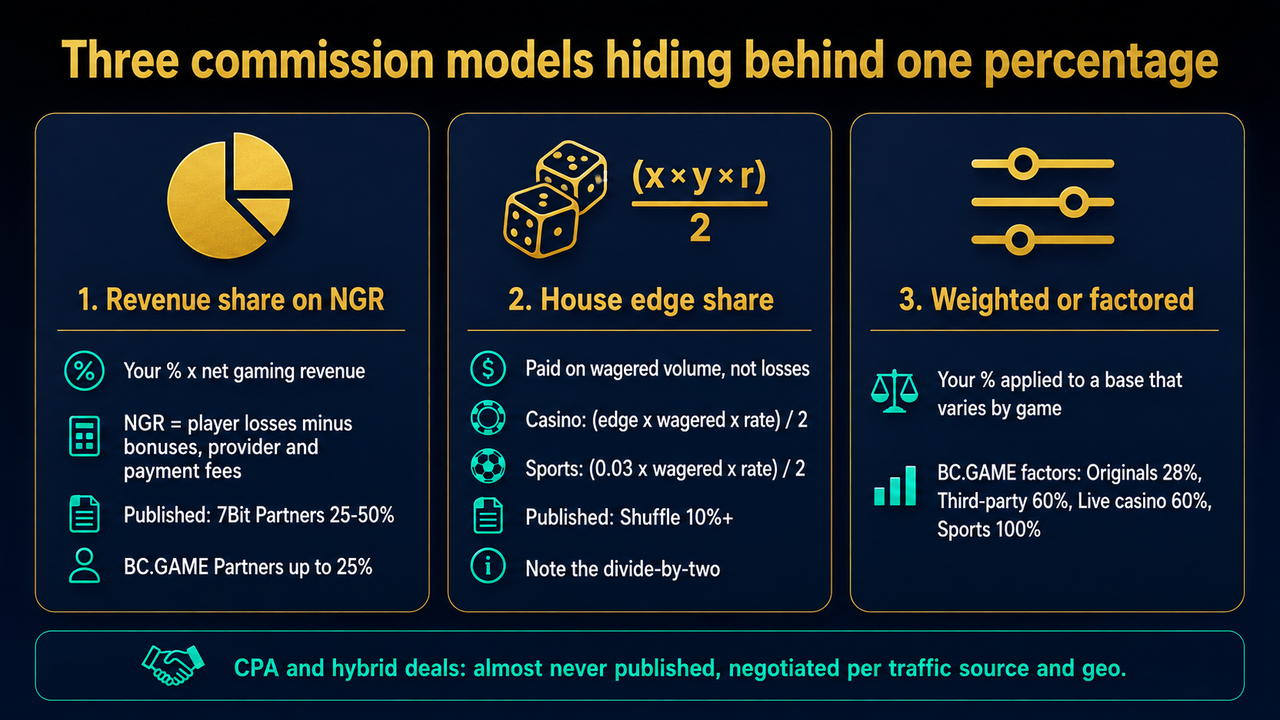
Before any comparison is meaningful, work out which of these three you are being offered. Nobody labels it clearly, so read the formula rather than the badge.
1. Revenue share on NGR. The classic model, inherited from fiat iGaming. You get a percentage of net gaming revenue — player losses minus bonuses, payment fees, provider fees and whatever else the terms list. 7Bit Partners publishes "25-50% / NGR monthly". BC.GAME Partners publishes "up to 25%" of NGR. This is the model most people picture when they hear "revenue share".
2. House edge share. Crypto-native, and structurally different. You are paid on wagered volume multiplied by each game's theoretical house edge, not on what the player actually lost. Shuffle publishes its formulas openly: casino commission is "(Edge * Wagered Amount * Commission Rate) / 2" and sports is "(0.03 * Wagered Amount * Commission Rate) / 2". Note the divide-by-two — it is in the published formula, and it halves everything.
3. Weighted or factored models. A hybrid where your rate is applied to a base that varies by game type. BC.GAME Partners lists commission factors of 28% for BC Originals, 60% for third-party games, 60% for live casino and 100% for sports betting, describing them as "part of the calculation formula" rather than direct percentages of player losses. Practical effect: the same 25% deal pays differently depending on what your audience plays.
House edge share is the one that catches experienced fiat affiliates out. It is smoother — you earn on volume regardless of whether the player won this month — but the per-unit rate has to be far higher to match an NGR deal, because the base is smaller.
What we could actually verify
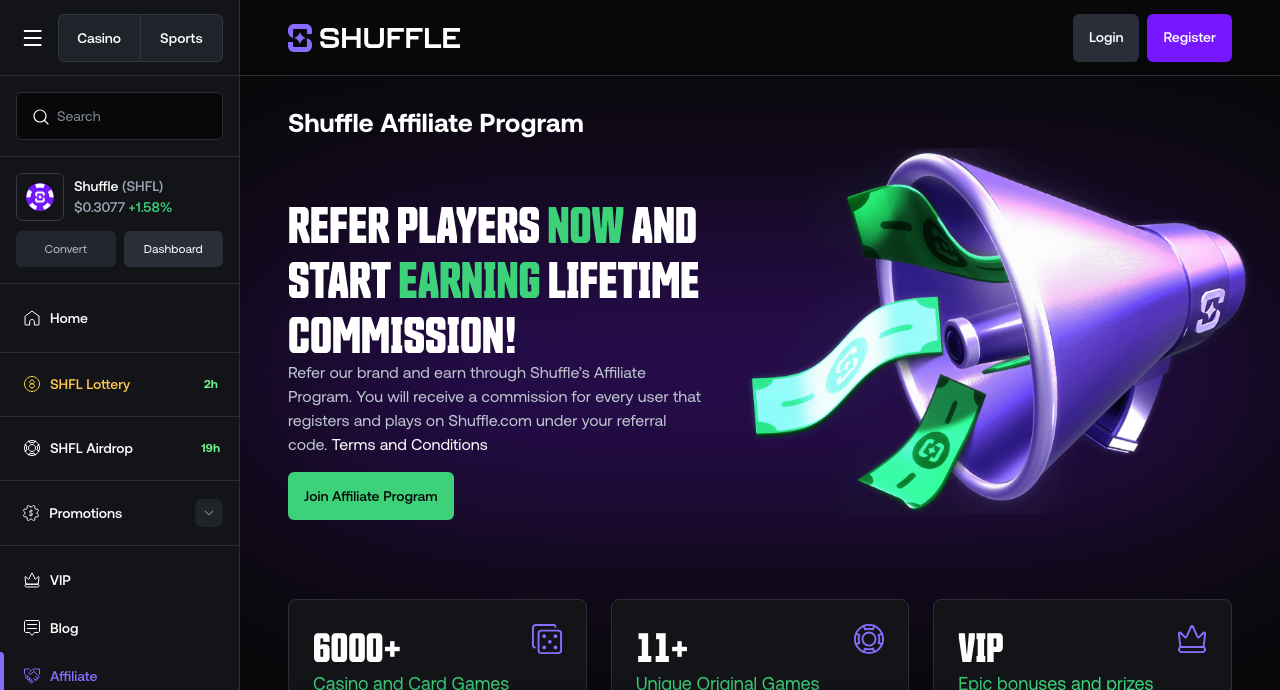
Every figure in this table came off the program's own page on 3 September 2026. Where a cell says "not published", the program did not state it publicly — that is a finding, not an omission on our part.
Two things jump out. First, 25% is the market's opening offer almost everywhere — if you are handed 25% and told it is generous, it is simply the floor. Second, Shuffle's "10%" and Cloudbet's "25%" are not on the same scale at all, which is what the next section is for.
The $10,000 wagered test
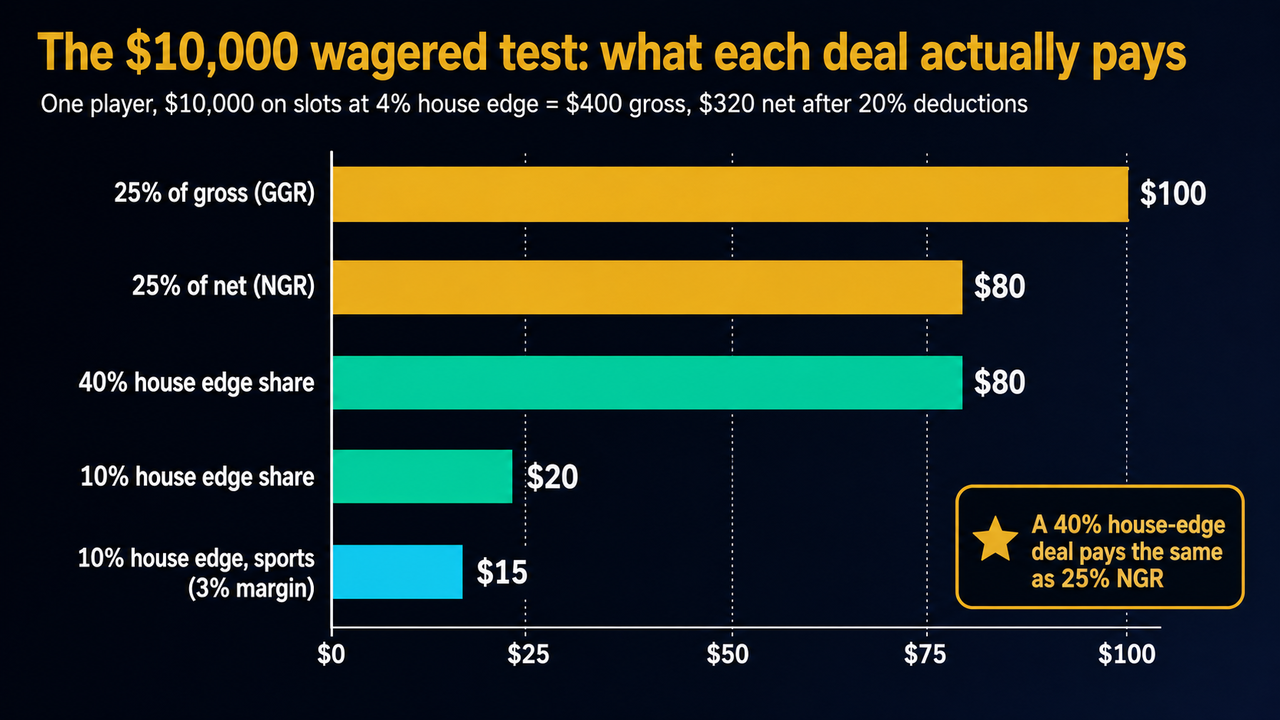
Here is the only comparison that matters: pick one player, one volume, and run it through each formula. Our test player wagers $10,000 on slots with a 4% house edge (a 96% RTP game, standard for crypto slots). That produces $400 of gross gaming revenue.
For the NGR rows we assume 20% of that gross disappears into bonus costs, provider fees and payment fees, leaving $320 net. That deduction is an assumption, not a published figure — it is the single number you must pin down with your own affiliate manager, because it moves every row below it.
Read the last two rows twice. A 40% house-edge deal and a 25% NGR deal pay exactly the same on this traffic. Anyone comparing the raw percentages would conclude the first is 60% better. It is not — it is identical, and against a 25% GGR deal it is worse.
The same player on sports is thinner again. Shuffle's published sports formula uses a fixed 3% margin, so $10,000 of sports volume at a 10% rate returns (0.03 × $10,000 × 0.10) / 2 = $15. If your audience bets rather than spins, model your traffic on the sports line, not the casino one.
One honest caveat on this comparison: house-edge models pay on volume, so they keep paying in a month where your players run hot and NGR goes negative. That smoothing is worth something real. It is just worth less than the headline number implies.
Quick answers: the models
GGR or NGR — which is better?
GGR, always, at the same percentage. It is the bigger number because nothing has been deducted from it yet.
What is house edge share?
Commission on wagered volume times the game's theoretical edge, rather than on what players actually lost. Crypto-native and much smoother month to month.
Is 25% a good rate?
It is the opening offer at every program we checked. Treat it as the floor of a negotiation, not a prize.
What is CPA in this market?
A flat fee per first-time depositor instead of a share of revenue. Almost never published — it is negotiated per traffic source and geo.
What does hybrid mean?
A smaller CPA up front plus a reduced revenue share afterwards. Useful when you need cash flow but believe in the players you send.
Do sub-affiliates pay?
Modestly. 7Bit Partners publishes "up to 5% of their income" for webmasters you recruit — a bonus, not a business model.
Where the money quietly leaves: the NGR definition
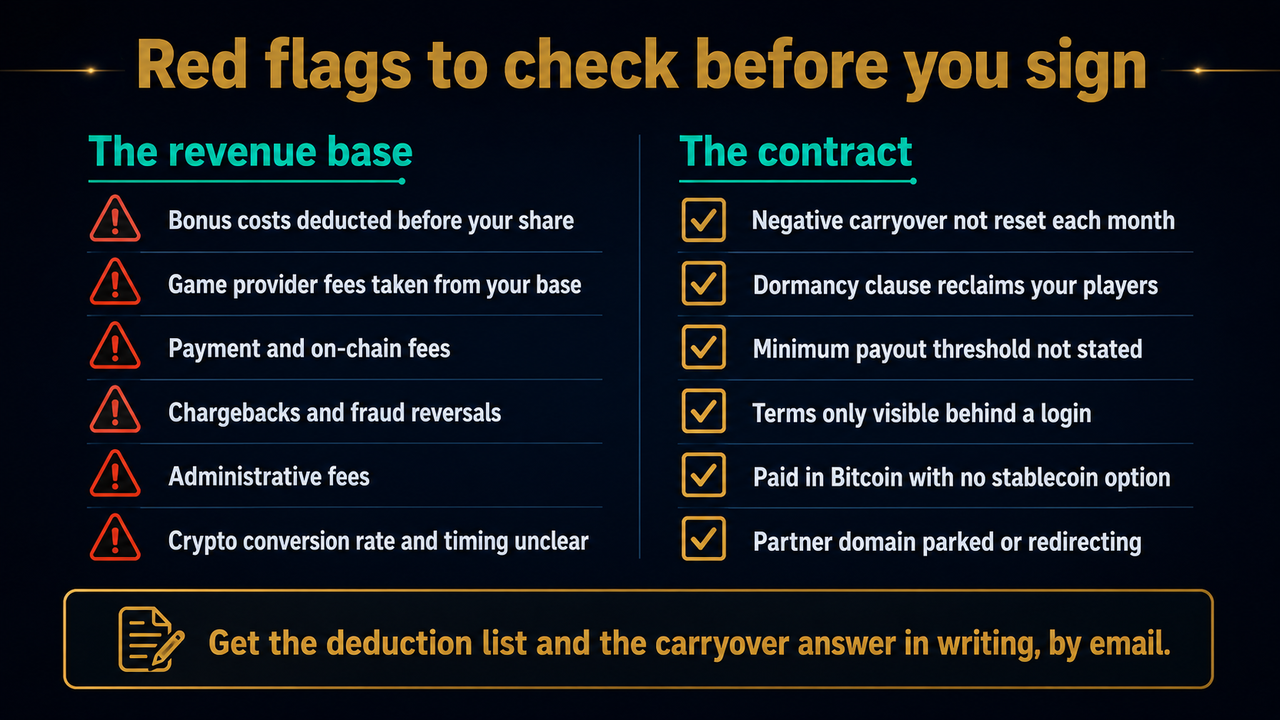
If you take one thing from this page, take this: get the deduction list in writing before you sign. The percentage is the part everyone negotiates. The definition of the base is the part that actually decides your income, and it is almost never on the marketing page.
Ask for a written answer on each of these, by name:
- Bonus costs. Deducted before your share, or absorbed by the operator? On a bonus-heavy brand this is the single largest line.
- Game provider fees. Third-party slot providers take a cut. Whether it comes out of your base or theirs is a real percentage of your money.
- Payment and on-chain fees. Small per transaction, not small across thousands.
- Chargebacks and fraud reversals. Rarer with crypto than cards, but the clause still exists in most terms.
- Administrative fees. Some programs charge one, and it is deducted before your share is calculated.
Crypto adds one deduction that fiat programs never had: currency conversion. Your players deposit in BTC, ETH and USDT interchangeably, and every one of those has to be converted to a base currency before your commission is worked out. Ask which rate is used and when it is struck. If you are paid in Bitcoin — as Cloudbet states its affiliate payments are — you also carry the price risk between the month closing and you selling. Stablecoin payouts remove that; ask whether they are an option.
Negative carryover: one question, asked in writing
Negative carryover is the clause that quietly ruins revenue-share deals. If your referred players have a lucky month and the operator loses money on them, that negative balance can roll into next month and eat your commission before you earn a cent. Two consecutive bad months and you are working for free while still paying for traffic.
Only one program in our sample addresses it publicly. BC.GAME Partners states that "previous negative results do not carry forward indefinitely into later periods" — note "indefinitely", which is a narrower promise than a clean monthly reset. Everyone else is silent on their public pages.
Send this exact email
"Does my revenue share balance reset to zero at the start of each calendar month regardless of the previous month's result? If not, how long does a negative balance carry?"
A program that answers that in one line is a program worth working with. A vague answer is your answer.
When you actually get paid
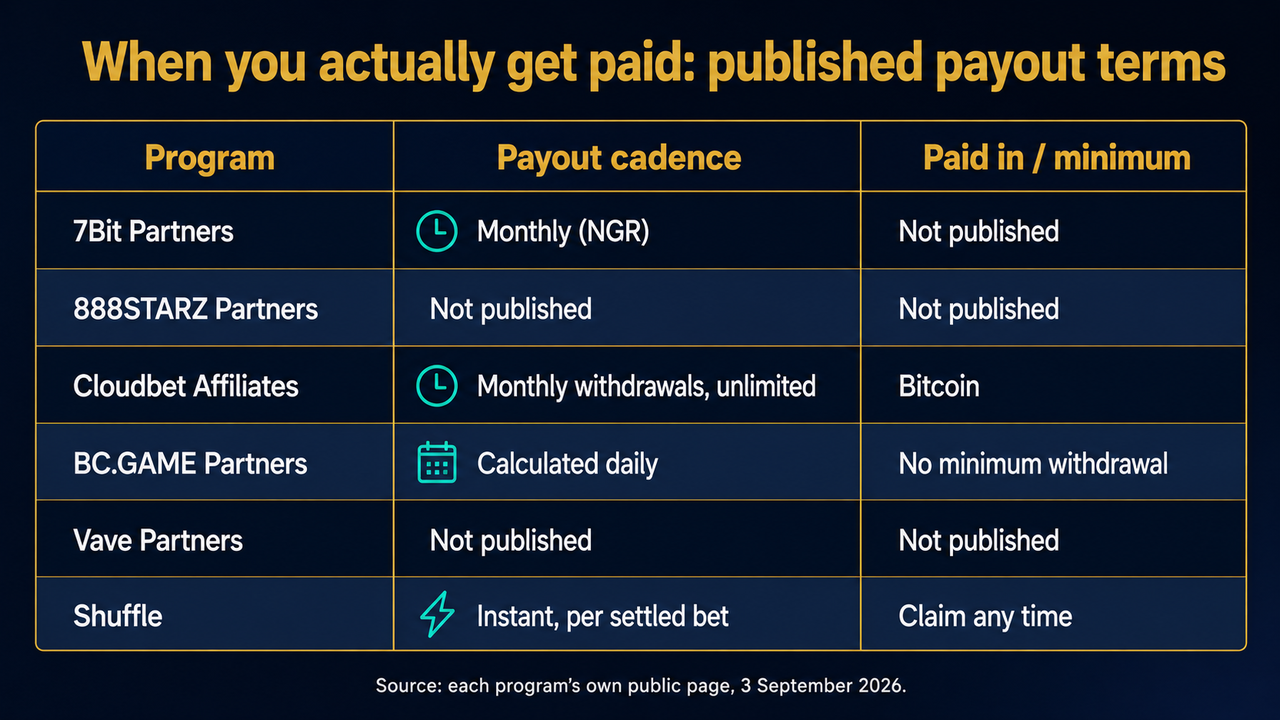
Payment mechanics vary more than commission rates do, and for a small affiliate they matter more. The published cadences we found split three ways.
Monthly, after a close. The fiat-inherited standard: the month closes, revenue is finalised, you are paid in the following period. 7Bit Partners publishes monthly NGR; Cloudbet offers monthly withdrawals with no stated cap, paid in Bitcoin.
Daily accrual. BC.GAME Partners calculates commissions daily and states there is "no minimum affiliate withdrawal", so the balance moves every day and you can take it whenever.
Per settled bet. Shuffle's model pays as each bet resolves and lets you claim "instantly with no waiting time". For an affiliate funding traffic out of pocket, that cash-flow difference is worth real money.
Two mechanics to confirm separately, because they are where small affiliates get stuck: the minimum payout threshold, and whether the account goes dormant. Some programs reclaim balances or unassign your players after a period of inactivity. Both live in the terms, not the landing page.
Quick answers: the money
What is negative carryover?
A losing month for the operator rolling forward and cancelling your next month's commission until it is recovered.
Should I take BTC or stablecoins?
Stablecoins if you have a choice. Bitcoin payouts mean you carry price risk between the month closing and you selling.
Are lifetime commissions real?
Usually, but read the dormancy clause. "Lifetime" often means the life of your active account, not the player's.
What about milestone bonuses?
BC.GAME Partners publishes "$10 to $1,000 per eligible player" as referrals climb VIP levels. Treat it as upside, never as base income.
Is there a minimum payout?
Varies wildly. BC.GAME states none. Others do not publish one at all — ask before your first month closes.
Do I pay tax on this?
Affiliate commission is business income wherever you are, and crypto payouts create a disposal event when you convert. Talk to an accountant, not a forum.
The programs with no public rate card
This is the part that surprised us. On 3 September 2026 we tried to load the affiliate pages of every major crypto casino we cover. Roughly half returned nothing usable to an ordinary visitor: Stake, Duelbits, Roobet, FortuneJack, Megadice, CoinPoker and Bitcasino all refused the request or served a page with no terms on it. Thunderpick's partner domain resolves straight to a login screen. BitStarz's old partner domain no longer resolves at all.
Be careful how you read that. A blocked request is not proof of a bad program — big operators throttle automated traffic, and several of these run genuinely well-regarded partner teams behind the login. What it does mean is practical: you cannot compare these deals before applying. You apply, you get assigned a manager, and you negotiate from whatever they open with — which, based on everything published above, will be 25%.
One finding is unambiguous, though. We found at least one long-standing affiliate program domain now parked and listed for sale. Programs die, brands rebrand, and your "lifetime" revenue share dies with them. Jackbit, for instance, now redirects to an entirely different domain. Spread your traffic across more than one operator, and keep your own email list rather than renting an audience from a brand that might not exist in eighteen months.
Which model suits which affiliate
Take revenue share if…
- Your traffic is search or content-led and compounds over years
- You can absorb a flat month without stopping work
- You got the no-carryover answer in writing
- You send recreational players rather than sharp ones
Take CPA or house edge share if…
- You are buying traffic and need predictable cash flow
- Your audience is high-volume, low-margin (sports, low-edge games)
- The brand looks unstable and you would rather be paid now
- You cannot get a straight answer on the NGR deduction list
Most affiliates who last end up split across both: revenue share with two or three operators they trust and have tested, CPA or hybrid everywhere else. Concentration in one brand is the risk that actually ends affiliate businesses, not a few points of commission.
How to join without regretting it
- Open a player account first and withdraw from it. If the operator is slow to pay players, it will be slow to pay you, and you will have promoted it to your audience by then. This is the step people skip.
- Apply and read the full terms, not the landing page. Search the document for "negative", "dormant", "minimum" and "fee" before anything else.
- Get the NGR deduction list in writing. Email, not a call. You want it retrievable in a year.
- Run the $10,000 test on the offer you were given. Convert their model to a single number so you can compare it to your other deals.
- Send a small, tracked test batch, then reconcile. Compare your own click and conversion numbers to theirs after month one. Discrepancies are far easier to argue about at small volume.
Quick answers: joining
Do I need a live site to apply?
Usually yes, or a named channel or community. Most programs ask where the traffic comes from before approving.
Can I negotiate the opening rate?
Once you have volume, yes — published ranges top out at 50%. Before you have volume, you are taking the floor.
How many programs should I run?
Enough that losing one is survivable. Two or three deep relationships beats fifteen dormant accounts.
Are these programs geo-restricted?
Your traffic is. Every operator has blocked territories and the terms make sending traffic from them your problem. Read that list first.
Do I need to disclose affiliate links?
Yes. Disclosure is required in most markets and is table stakes for reader trust regardless of the rules.
What tracking should I keep?
Your own click data, separate from theirs. Without it you have no position in a discrepancy conversation.
Frequently asked questions
What is the average crypto casino affiliate commission in 2026?
Every program we could verify in September 2026 opens at 25%, with published ranges reaching 50% at 7Bit Partners and 888STARZ Partners. The floor is remarkably consistent across the market; the ceiling is negotiated and depends on your volume.
Is a 40% deal better than a 25% deal?
Not necessarily. Under a halved house-edge formula, 40% on $10,000 wagered at a 4% edge pays $80 — exactly the same as 25% of NGR after 20% deductions, and less than 25% of gross. Compare the formulas, not the percentages.
What is negative carryover and why does it matter?
If your players win more than they lose in a month, the operator's loss can be carried into the next month and offset against your commission. Only BC.GAME Partners addresses it publicly among the programs we checked, stating negative results "do not carry forward indefinitely". Ask every other program in writing.
Which crypto casino affiliate programs publish their terms?
As of 3 September 2026: Cloudbet, BC.GAME Partners, Shuffle, 7Bit Partners, 888STARZ Partners and Vave Partners all publish a headline rate on a page anyone can read. Several other major brands serve their terms only behind an application or a login.
How is house edge share calculated?
Shuffle publishes the formula: casino commission is (edge × wagered amount × commission rate) / 2, and sports uses a fixed 3% in place of the edge. You earn on volume rather than on player losses, which is smoother but starts from a smaller base.
How quickly do crypto casino programs pay out?
Faster than fiat programs, generally. BC.GAME Partners calculates daily with no minimum withdrawal, Shuffle lets you claim as bets settle, and Cloudbet offers monthly withdrawals paid in Bitcoin. Confirm the minimum threshold before your first month closes.
Should I take CPA or revenue share?
Revenue share if your traffic is organic and compounds, and you can survive a flat month. CPA or hybrid if you are buying traffic, need predictable cash flow, or are unsure the brand will still be there next year.
Do sub-affiliate programs pay meaningfully?
Rarely enough to build on. 7Bit Partners publishes up to 5% of a recruited webmaster's income, which is a pleasant addition to a real business and not a business in itself.
The verdict
The crypto casino affiliate market in 2026 has one honest headline: 25% is the opening bid basically everywhere, and the percentage attached to it is the least important term in the contract. The revenue base, the deduction list and the carryover clause decide what you are actually paid.
Run the $10,000 test on every offer before you compare it to another. It takes two minutes, converts three incompatible models to one number, and it is the difference between a deal that looks 60% better and a deal that pays identically.
Then pick operators you have personally withdrawn money from. In a market where affiliate domains get parked and brands redirect to new ones, the counterparty risk is bigger than the commission spread — and no rate card protects you from a program that stops answering email.
Test before you promote
Try the product first, then send traffic
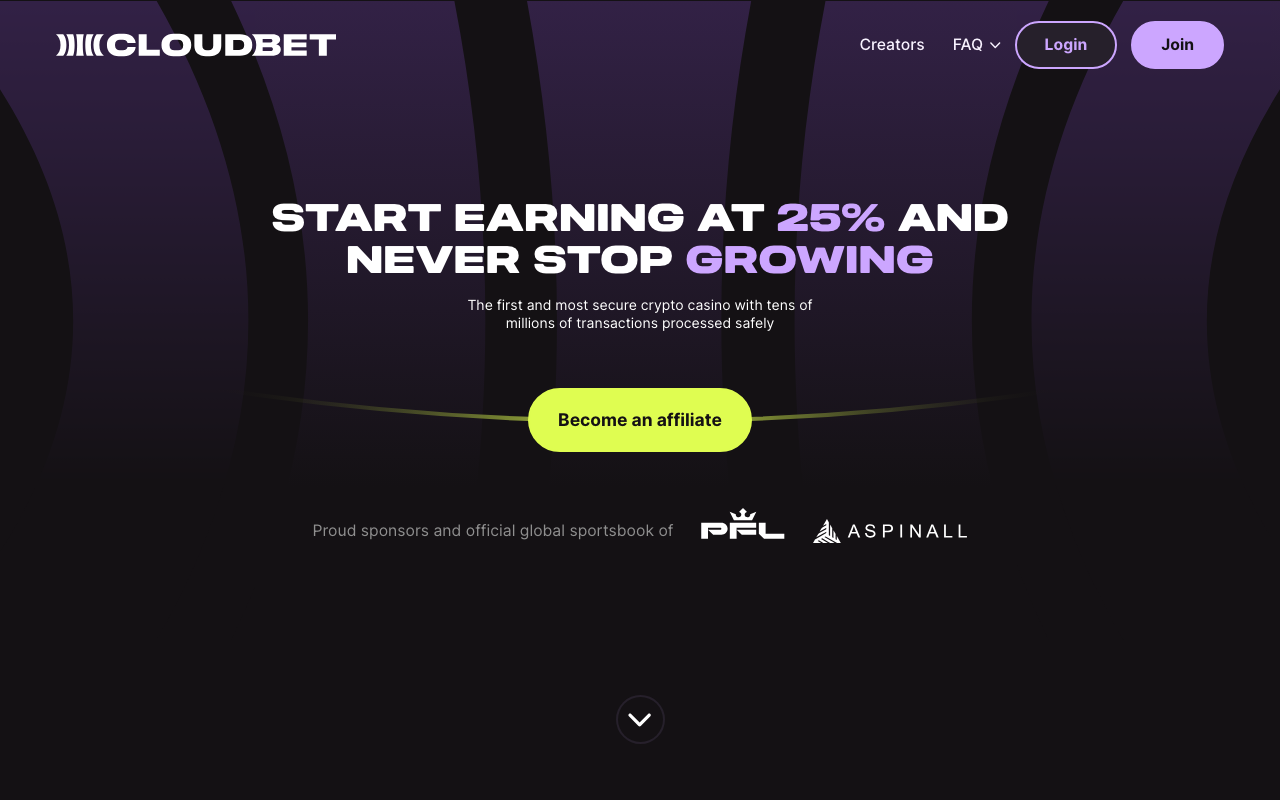
Cloudbet is one of the few programs publishing its terms openly — a 25% lifetime starting rate with affiliate payments in Bitcoin. Open a player account, run a withdrawal through it, and see how it behaves before you put your audience's trust behind it.
Visit Cloudbet →Related guides
Cloudbet review
The operator behind one of the few public rate cards, tested as a player.
BC.GAME review
The factored-commission model from the player's side of the screen.
Stake casino review
The biggest brand in the market, and the one that publishes least.
Rakeback explained
The same house-edge maths, pointed at players instead of affiliates.
Crypto VIP programs
Where the milestone rewards your referrals unlock actually come from.
Provably fair explained
How to verify the house edge you are being paid a share of.
18+ only. Gambling can be addictive. Affiliate marketing in this vertical carries real compliance obligations — know your territory rules. See BeGambleAware.org. Affiliate links earn us a commission at no cost to you.