Kalshi Maker Fees 2026: 163 Series Billed
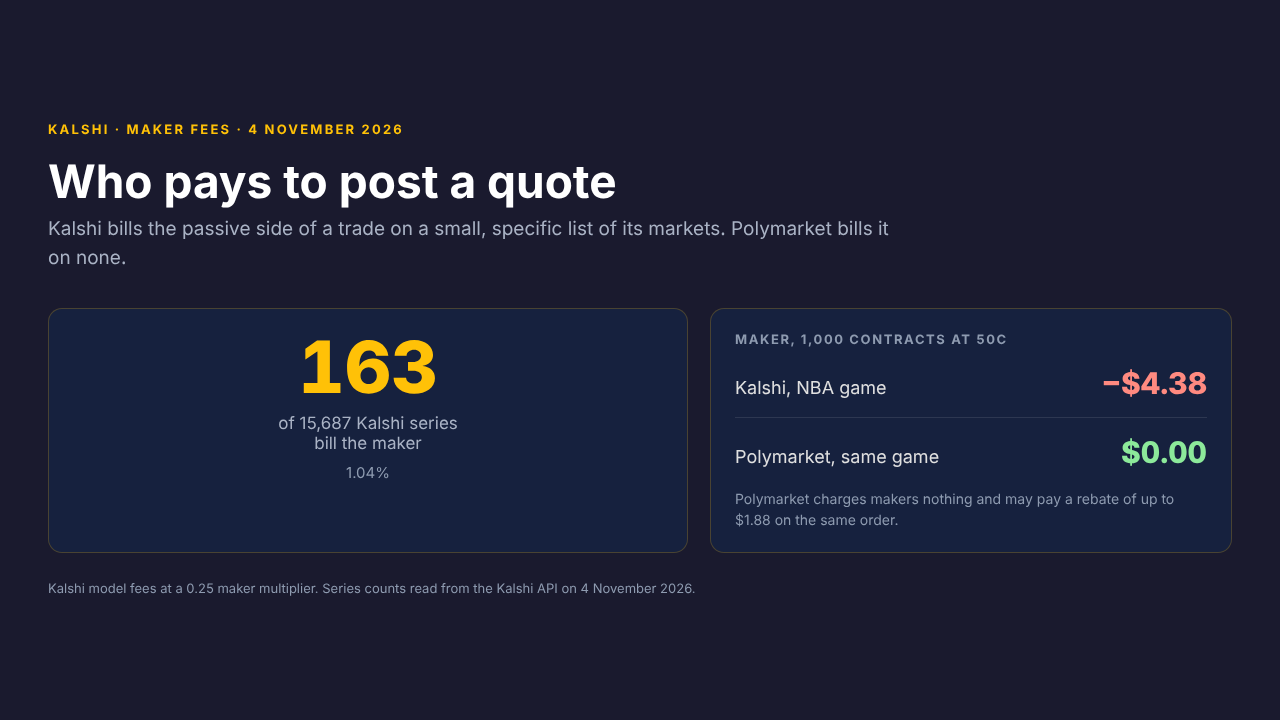
Kalshi maker fees hit 163 of 15,687 series, and every big league is on the list. We priced the same resting order on Polymarket, which charges makers $0.
Affiliate disclosure: contains affiliate links; we may earn a commission at no extra cost to you. We have no commercial relationship with Kalshi. 18+ only — see BeGambleAware.org. Last updated 4 November 2026.
Key takeaways
- Kalshi maker fees apply to 163 of its 15,687 series — 1.04% — and the exception list is not random. 107 of the 163 are sports, and they are the leagues you have heard of.
- It is a league-tier charge, not a sport. The Bundesliga bills makers; Bundesliga 2 does not. The NHL bills makers; its own farm league, the AHL, does not. Eleven top-tier series carrying 1,215 open markets charge makers, while eleven second-tier series we checked charge nothing.
- A maker pays exactly a quarter of the taker fee on the same trade — Kalshi's API reference states the 0.25 multiplier itself. On 1,000 contracts at 50c that is a $4.38 model fee for posting the quote.
- Polymarket never charges makers. Every one of the 113,356 open sports markets we read carries
takerOnly: true. The same resting order earns up to $1.88 instead of costing $4.38 — a $6.26 swing per 1,000 contracts. - But Polymarket runs four sports fee schedules at once and publishes one. 27.5% of its live sports markets sit on schedules absent from its own fee table, including 27,737 NFL and college football markets whose smaller taker rate shrinks the pool makers are paid from.
On this page
Resting a limit order is supposed to be the cheap way to trade. You post a quote, you wait, somebody crosses the spread to hit you, and the aggressor pays for the privilege. That is how it works on every exchange most people have used — and it is how it works on Kalshi too, on 15,524 of its 15,687 series. On the other 163 you pay to post. We read every series on the exchange on 4 November 2026, counted which ones bill the passive side, and then priced the identical resting order on Polymarket, which bills makers nothing anywhere. The gap on a 1,000-contract quote in an NBA game is $6.26, and it runs in the direction you would not guess: the venue that charges you is the one with the deeper book.
What a maker fee is, and why only one of these venues has one
A maker order is one that does not fill immediately. It rests on the book and adds liquidity. A taker order crosses the spread and removes it. Almost every venue in finance charges the taker more, because the maker is doing the exchange a favour by giving the next person something to trade against.
Kalshi's help centre describes its maker charge plainly: fees "are charged for orders placed that are not immediately matched and are instead left as resting orders". Cancelling costs nothing — the charge lands only when the resting order actually fills. Polymarket's documentation is blunter in the other direction: "Makers are never charged fees. Only takers pay fees."
So the question is not which venue is cheaper in the abstract. It is whether the specific market you want to quote in is one of the 163.
Two words that are not interchangeable. Kalshi's maker charge is a fee — money off your balance when your quote fills. Polymarket's maker treatment is a rebate — a share of a pool funded by other people's taker fees, paid daily. One is certain and the other is a share of a variable pot, which matters as much as the sign on the number.
Kalshi maker fees reach 163 of 15,687 series
Every Kalshi series carries two fields that decide its fees: fee_type and fee_multiplier. We pulled all 15,687 and counted them. Three of the four fee_type values bill the maker, and together they cover 163 series.
The headline is how narrow that is — and that the list has grown. The only other published count we could find, OddsShopper's in August, read 129 series out of 12,699. Three months later it is 163 out of 15,687.
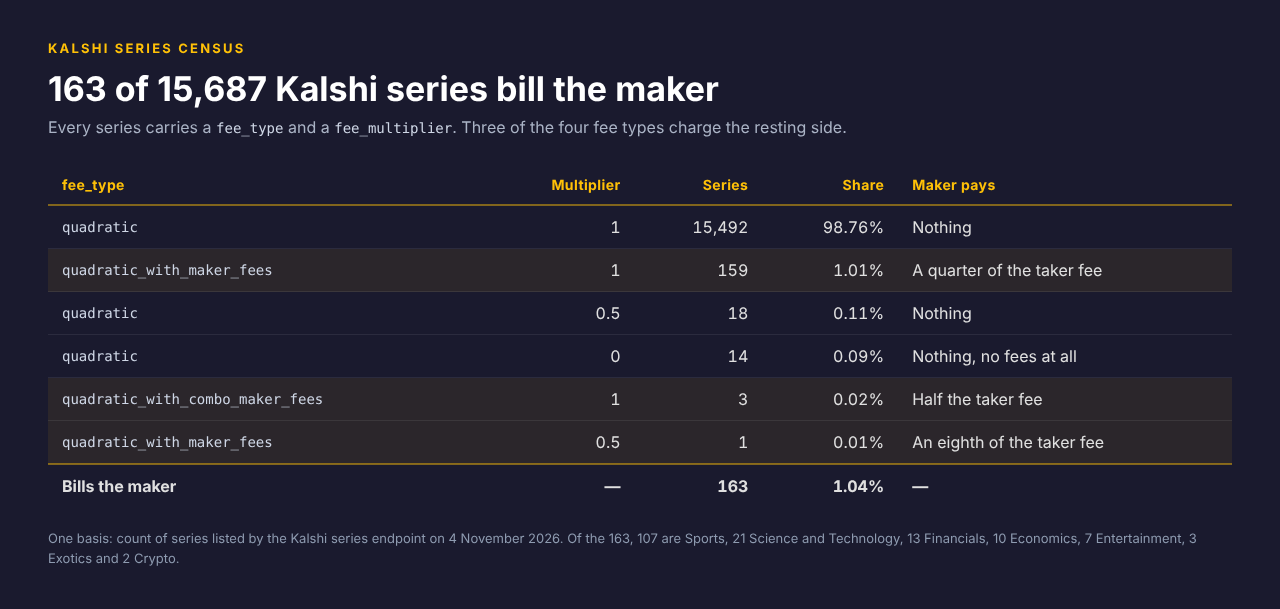
| fee_type | Multiplier | Series | Share | Maker pays |
|---|---|---|---|---|
quadratic | 1 | 15,492 | 98.76% | Nothing |
quadratic_with_maker_fees | 1 | 159 | 1.01% | A quarter of the taker fee |
quadratic | 0.5 | 18 | 0.11% | Nothing |
quadratic | 0 | 14 | 0.09% | Nothing (no fees at all) |
quadratic_with_combo_maker_fees | 1 | 3 | 0.02% | Half the taker fee |
quadratic_with_maker_fees | 0.5 | 1 | 0.01% | An eighth of the taker fee |
| Bills the maker | — | 163 | 1.04% | — |
The three highlighted rows are the ones to know. The single series at quadratic_with_maker_fees with a 0.5 multiplier is professional baseball game markets, and it is the only series on the whole exchange whose makers pay a reduced rate. We cover why below. Of the 163, 107 are Sports, 21 are Science and Technology, 13 Financials, 10 Economics, 7 Entertainment, 3 Exotics and 2 Crypto. Our per-series fee census has the full taker picture; this piece is only about the passive side.
It is a big-league tax, not a sport
Sports is the biggest slice of the 163, so the obvious guess is that Kalshi charges makers on sports and not on anything else. That guess is wrong, and the way it is wrong is the most useful thing in this article.
Kalshi lists 4,086 Sports series. Only 107 of them — 2.62% — bill the maker. Narrow it to single-game markets and the split is sharper still: of 378 series whose ticker denotes a game, just 16 charge makers and 362 do not.
The 16 are the leagues with the television deals. We took eleven top-tier game series and eleven second-tier ones and read the fee type and the live market count for each.
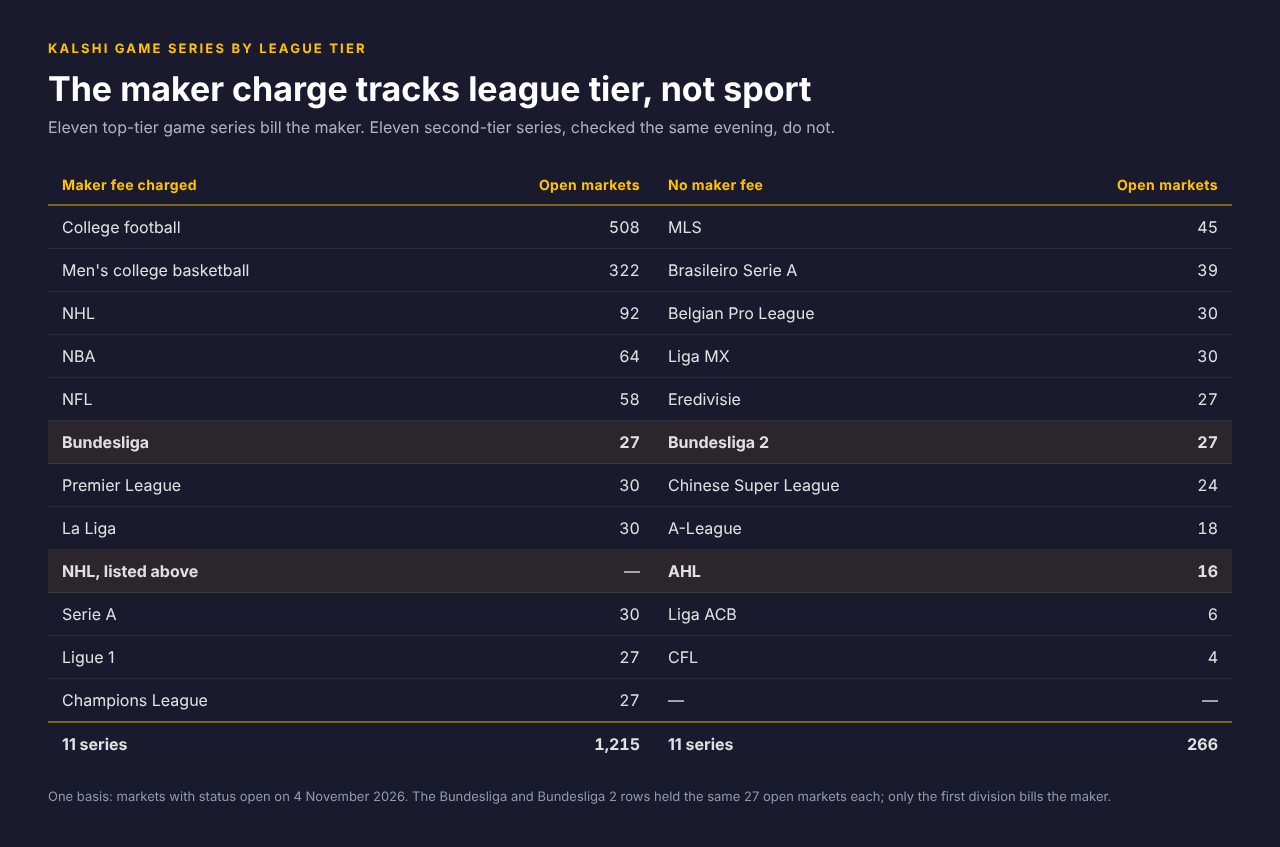
| Maker fee charged | Open markets | No maker fee | Open markets |
|---|---|---|---|
| College football | 508 | MLS | 45 |
| Men's college basketball | 322 | Brasileiro Serie A | 39 |
| NHL | 92 | Belgian Pro League | 30 |
| NBA | 64 | Liga MX | 30 |
| NFL | 58 | Eredivisie | 27 |
| Bundesliga | 27 | Bundesliga 2 | 27 |
| Premier League | 30 | Chinese Super League | 24 |
| La Liga | 30 | A-League | 18 |
| NHL (above) | — | AHL | 16 |
| Serie A | 30 | Liga ACB | 6 |
| Ligue 1 | 27 | CFL | 4 |
| Champions League | 27 | — | — |
| 11 series | 1,215 | 11 series | 266 |
Bundesliga and Bundesliga 2 are the cleanest pair on the exchange. Same country, same sport, same 27 open markets each on the night we read them, one division apart — and one bills the maker while the other does not. The NHL and the AHL are the same story in hockey: the parent league charges, its own development league does not.
Read it from the trader's side and it inverts the usual logic. You pay to post a quote in the games where there is already a crowd, and post free in the games where you would be the only liquidity in the book. We measured those thin books directly: Polymarket's median NHL best ask held just $3.52 against Kalshi's $610. The maker charge is heaviest exactly where it is least needed.
What a Kalshi maker fee actually costs you
Kalshi's general trading fee is a quadratic: it scales with contracts, with price, and with how close the price is to 50c, which is where uncertainty — and the fee — peaks. The maker charge is the same curve, scaled down. Kalshi's own API reference supplies the scaling factor, in the course of describing the combo variant as "the same maker-fee structure with a 0.5 maker multiplier instead of 0.25".
So a maker pays a quarter of what the taker pays on the identical trade. That ratio is the number to carry around, because it holds at every price. Here is a 1,000-contract order on an NBA game, which is a quadratic_with_maker_fees series at a multiplier of 1.
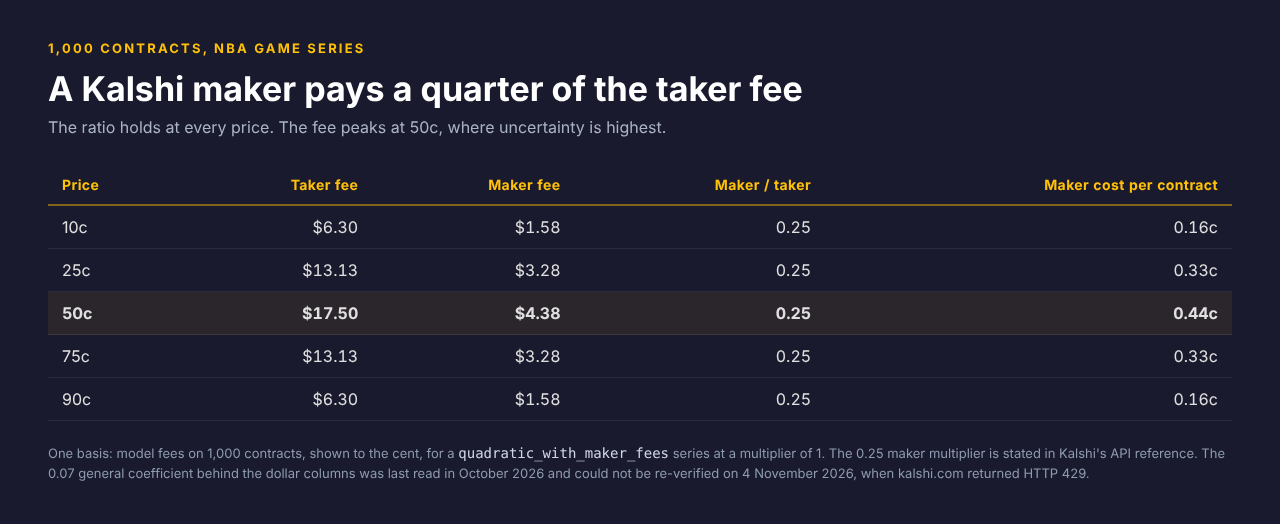
| Price | Taker fee | Maker fee | Maker / taker | Maker cost per contract |
|---|---|---|---|---|
| 10c | $6.30 | $1.58 | 0.25 | 0.16c |
| 25c | $13.13 | $3.28 | 0.25 | 0.33c |
| 50c | $17.50 | $4.38 | 0.25 | 0.44c |
| 75c | $13.13 | $3.28 | 0.25 | 0.33c |
| 90c | $6.30 | $1.58 | 0.25 | 0.16c |
Model fees on 1,000 contracts, shown to the cent. The absolute figures use the 0.07 general coefficient from Kalshi's published fee schedule, which we could not re-read on the night of writing — see the method note. The 0.25 ratio is from Kalshi's API reference and is not in doubt, so if the coefficient has moved, the maker column moves with the taker column and the ratio holds.
One widely repeated detail is wrong, and it is worth correcting because it changes the maths on small orders. Nearly every third-party guide says Kalshi rounds fees up to the next whole cent, which would make a sub-cent fee on a tiny order punitive. Kalshi's own rounding documentation says the trade fee is rounded up to six decimal places, and that the leftover between that and your balance precision goes into a per-order accumulator which is rebated back in increments once it builds up. You are not quietly losing a cent per fill.
Polymarket charges makers nothing — and runs four schedules to do it
Polymarket's side of this is simple to state and more complicated than its documentation admits. We pulled every open market behind twenty league tags — 113,356 unique markets — and read the feeSchedule object each one carries. The flag takerOnly was true on 113,356 of 113,356. There is no sports market on the venue where posting a quote costs money.
What varies is what posting a quote earns. A maker rebate is a share of a pool funded by the taker fees collected in that same market, so the taker rate sets the size of the pot. Polymarket's public fee table lists one sports row: a 0.05 taker rate and a 15% maker rebate. The live markets carry four different schedules.
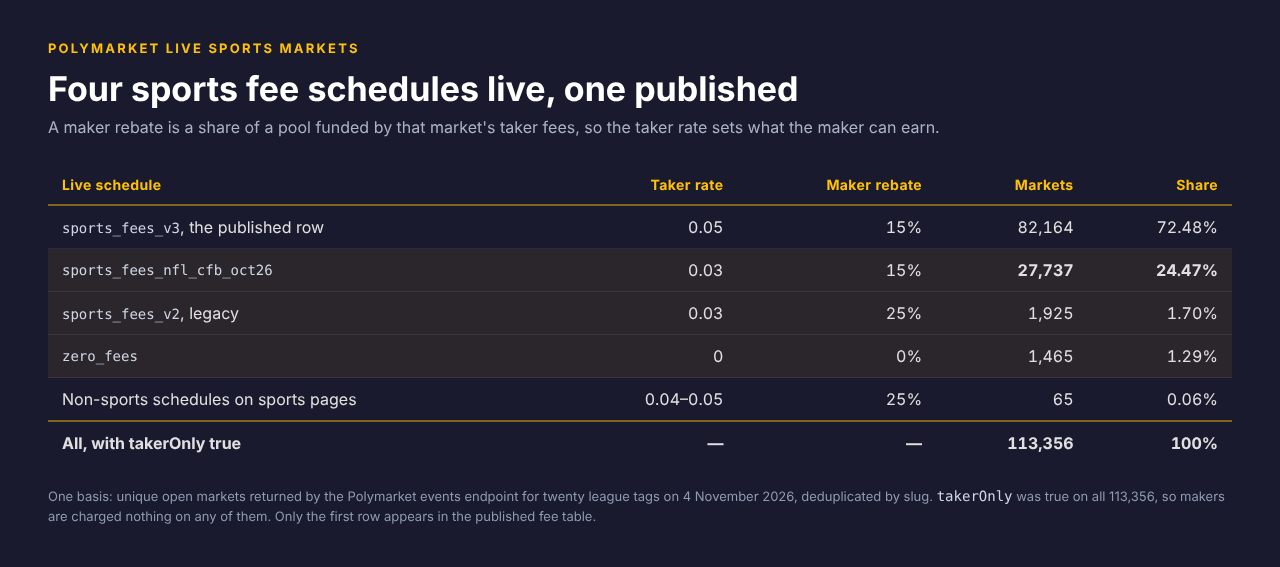
| Live schedule | Taker rate | Maker rebate | Markets | Share |
|---|---|---|---|---|
sports_fees_v3 — the published row | 0.05 | 15% | 82,164 | 72.48% |
sports_fees_nfl_cfb_oct26 | 0.03 | 15% | 27,737 | 24.47% |
sports_fees_v2 — legacy | 0.03 | 25% | 1,925 | 1.70% |
zero_fees | 0 | 0% | 1,465 | 1.29% |
| Non-sports schedules on sports pages | 0.04–0.05 | 25% | 65 | 0.06% |
| All, with takerOnly true | — | — | 113,356 | 100% |
The second row is the one with money in it. sports_fees_nfl_cfb_oct26 names its own month, runs a 0.03 taker rate instead of 0.05, and covers 27,737 NFL and college football markets. Good news for takers. For makers it is a 40% cut to the pool their rebate comes out of, on about a quarter of all live sports markets, under a schedule that does not appear in the published table at all.
The zero_fees row is worse for a maker, and unambiguous: Polymarket's own rebate rules say fills in 0% taker-fee markets "earn no maker rebate for as long as the fee is 0". On 1,465 live markets you are providing liquidity for nothing. Our maker rewards breakdown covers the separate programme that pays for resting quotes whether or not they fill, and Polymarket fees by category has the taker picture.
A trap for anyone reading the API. Every one of the 113,356 markets also reports makerBaseFee: 1000. Taken as basis points that would be a 10% maker fee, which nobody pays and which takerOnly: true on the same object contradicts. It is a vestigial field. The feeSchedule object is the one that describes what you are actually charged.
The same 1,000 contracts, both venues
Here is the comparison that does not exist anywhere else: one resting order, 1,000 contracts at 50c, on an NBA game, on each venue, on 4 November 2026. Both venues list the fixture. Both price it within about half a cent, which we measured across 626 matched prices. The maker terms are not within half a cent of each other.
| 1,000 contracts at 50c, NBA game | Kalshi | Polymarket |
|---|---|---|
| Series or schedule | quadratic_with_maker_fees | sports_fees_v3 |
| Is the maker charged? | Yes | No |
| Maker pays | $4.38 | $0.00 |
| Maker can earn | Nothing | Up to $1.88 |
| Taker on the other side pays | $17.50 | $12.50 |
| Certain or variable | Certain charge | Share of a daily pool |
| Swing to the maker | $6.26 per 1,000 contracts, or 0.63c a contract | |
The $1.88 is a ceiling, not an expectation. Polymarket pays rebates as your share of that market's pool: the full $1.88 only arrives if the taker side of your own fills is the only taker volume in that market and you are its only maker. Put one serious market maker in the book beside you and your share falls accordingly. The $0.00 is not a ceiling, though — it is exact, and it is the number that actually separates the two venues.
Two caveats before you act on $6.26. It is one price point in one series: at 10c the gap narrows to about $2.70, and in a Kalshi series without maker fees it is zero. And Polymarket pays in pUSD daily, with a $1 minimum accrual before anything is sent, so small quoting will bank nothing for days.
Thirteen months of quietly adding leagues
Kalshi publishes a fee-change ledger through its API, and as far as we can tell nobody has read it. It returns 107 historical changes across 12 dates, from 4 October 2025 to 3 September 2026. Sixty-seven of them put a series onto maker fees at full rate; four are combo-maker changes; one is the only reduction in the file; the remaining 39 move series to plain taker-only pricing.
| Effective | Series | What went on maker fees |
|---|---|---|
| 4 Oct 2025 | 4 | Pro baseball game and series, WNBA and WNBA game — the first |
| 15 Nov 2025 | 23 | Bundesliga, La Liga and Ligue 1 (league and game), ATP match, March Madness, World Cup winner, NBA awards |
| 1 Jan 2026 | 3 | NFL game, college football spread and total |
| 5 Jun 2026 | 1 | World Cup game |
| 3 Jul 2026 | 2 | S&P 500 and Nasdaq-100 yearly range |
| 7 Aug 2026 | 1 | Pro baseball game cut to a 0.5 multiplier — the only maker reduction on record |
| 20 Aug 2026 | 3 | The multi-event combo series, at the dearer 0.5 maker multiplier |
| 3 Sep 2026 | 30 | GPU and compute price series — A100, B200, H100, H200, RTX 5090. The largest single batch |
Two things fall out of the dates. The first is that the NBA, NHL, Premier League and college football game series have no entry at all — they carried maker fees before this ledger opens, so they have been charging from the start. The second is that baseball has moved in both directions: on maker fees in October 2025, then halved in August 2026, which is why it is the single series on the exchange at a 0.125 effective maker ratio.
The 3 September batch is the tell for where this is going. Thirty GPU-price series in one day is not a sports decision; it is a market-making decision about the venue's newest and least liquid listings. Expect the 163 to keep growing, and check before you quote.
Check the fee type before you post the quote
One field on the series object decides whether resting an order costs you a quarter of the taker fee or nothing at all. It takes one API call, and on a 1,000-contract quote it is worth $4.38 a fill.
Visit Polymarket.com →Affiliate link to Polymarket; we have no commercial relationship with Kalshi. 18+ only. Polymarket restricts access from the United States, Canada and other listed jurisdictions. Prediction markets carry a substantial risk of loss. Nothing here is financial advice.
What to do if you rest orders
Read the series, not the sport. "Does Kalshi charge maker fees on soccer" has no answer: the Premier League does and the Eredivisie does not. One call to the series endpoint settles it, and the answer is one of four fee_type values.
If you quote the top leagues on Kalshi, the maker charge is a real cost of about 0.44c a contract at the midpoint, and it is worst where you are most likely to be filled. Price it into your spread rather than discovering it on the statement. If you quote outside the 163, resting orders are free and the only thing that matters is whether you get filled.
On Polymarket the decision is different, because the downside is not a charge but an absence. Check the market's feeSchedule: on zero_fees markets your quote earns nothing, and on the NFL and college football schedule the pool is 40% smaller than the published table implies.
The one-line version. On the games with the biggest crowds, Kalshi charges you to provide liquidity and Polymarket pays you — but Kalshi's books are the ones with the depth. If you are quoting for the rebate, Polymarket wins on terms and you should check the schedule. If you are quoting to actually get filled in size, the depth difference can be worth more than 0.44c a contract — and that is a judgement about your own fill rate, not a fee comparison.
Related guides
- Kalshi Fees by Market 2026: 195 Exceptions — the taker side of the same series census, market by market.
- Polymarket Maker Rewards 2026: $852 a Market — the separate programme that pays for resting quotes that never fill.
- Polymarket Fees 2026: Every Rate by Category — what the taker pays, and where the rebate pool comes from.
- Kalshi vs Polymarket Liquidity 2026: 357 Books — how deep each book actually is, which decides whether your quote fills.
- Kalshi vs Polymarket Odds 2026: 626 Prices — why the prices agree and the fee decides.
- Polymarket Slippage 2026: 897 Books Measured — what crossing the spread costs, if you decide to be the taker instead.
Kalshi maker fees FAQ
Does Kalshi charge maker fees?
On 163 of its 15,687 series, yes — 1.04%. On the other 98.96% a resting order pays nothing. The charge applies only when the resting order fills; cancelling is always free.
How much is a Kalshi maker fee?
A quarter of the taker fee on the same trade. Kalshi's API reference states the 0.25 maker multiplier. On 1,000 contracts at 50c on an NBA game that is a $4.38 model fee against the taker's $17.50, or about 0.44c a contract.
Which Kalshi markets charge maker fees?
107 of the 163 are sports, and they are the top-tier leagues: NFL, NBA, NHL, college football and basketball, the big five European soccer leagues and the Champions League. The rest are GPU and compute prices, CPI and Fed series, index yearly ranges, the Emmys and two bitcoin milestone markets.
Why does the Bundesliga charge maker fees when Bundesliga 2 does not?
Kalshi has not said. What the data shows is that the charge tracks league tier, not sport or country: both series had 27 open markets on 4 November 2026, and only the first division bills the maker. The same split appears between the NHL and the AHL.
Does Polymarket charge maker fees?
No. All 113,356 open sports markets we read carry takerOnly set to true, and the documented maker fee rate is 0 in every category. Makers can instead earn a rebate funded by taker fees, which is 15% of the pool in sports.
How much does a Polymarket maker rebate actually pay?
Up to $1.88 on 1,000 contracts at 50c in sports, and only if you are the market's sole maker. The rebate is your share of that market's daily pool, paid in pUSD, and nothing is sent until $1 has accrued.
Which venue is better for a market maker?
On terms alone, Polymarket: $0.00 against $4.38 on the same order, a $6.26 swing per 1,000 contracts. On fill probability, Kalshi, whose books are several times deeper in the same leagues. Which wins depends on whether your quotes actually get hit.
Do Kalshi fees really round up to the next cent?
Not as usually described. Kalshi's rounding documentation says the trade fee is rounded up to six decimal places, and the difference between that and your balance precision is held in a per-order accumulator and rebated back in increments. The round-up is not simply kept.
Method and sources
Read on 4 November 2026. The Kalshi series census is one call to the series endpoint, which returned all 15,687 series with their fee_type and fee_multiplier; market objects carry no fee fields at all, so a series is the only place to look. Open-market counts are per-series calls, paced to avoid rate limiting. The fee-change ledger is the historical fee-changes endpoint. On the Polymarket side we walked the events endpoint for twenty league tags and read the feeSchedule on every nested market, deduplicating by slug to 113,356 unique open markets.
Four caveats, and one gap we could not close. The 0.07 general coefficient behind the dollar figures was not re-verified in this run: kalshi.com, which hosts the fee-schedule PDF, returned HTTP 429 to every request we made all evening. The 0.25 maker multiplier is quoted from Kalshi's API reference and is solid; treat the absolute dollars as dependent on a coefficient last read in October 2026, and the ratios as current. Counts are of markets open on one evening and will differ on yours. The Polymarket figures cover polymarket.com, not the separate US app. And a rebate is discretionary — Polymarket says the percentage is at its sole discretion and may change.
- Kalshi docs: Get series — defines
fee_typeandfee_multiplier, and states the 0.25 maker multiplier in describing the combo variant. - Kalshi docs: fee rounding — the six-decimal round-up, the per-order accumulator and the rebate increments.
- Kalshi help centre: Fees — "charged for orders placed that are not immediately matched", and that cancelling is free.
- Polymarket docs: Fees — the published category table, the 0 maker fee rate and "Makers are never charged fees. Only takers pay fees."
- Polymarket docs: Maker rebates — the pool formula, the 15% sports rebate, the pUSD payout and the $1 minimum.
- OddsShopper: Kalshi fee schedule by market — the only other published series count, 129 of 12,699 on 11 August 2026, read for comparison.