Kalshi Outcome Review Committee 2026: 3 People
The Kalshi Outcome Review Committee can decide your payout. We read all 3,427 contract documents: 99.9% of markets can be sent to it, 12.1% name it.
Affiliate disclosure: contains affiliate links; we may earn a commission at no extra cost to you. We have no commercial relationship with Kalshi and earn nothing from it. 18+ only — see BeGambleAware.org. Last checked November 2026.

Key takeaways
- The Kalshi Outcome Review Committee is three people. The rulebook makes it a standing committee of three members appointed by the Regulatory Oversight Committee, at least two of whom must be Public Directors, each serving one-year renewable terms.
- Every market on the board can be sent to it. We read all 3,427 live contract documents covering 17,072 markets: 99.9% of markets name the Market Outcome Review Process. Only 12.1% name the committee that runs it.
- It has 24 hours, and your settlement waits for it. Rule 7.1(b) gives the committee a 24-hour window from initiation; Rule 7.1(a) says settlement happens on the day it decides, and that Kalshi will post the review on its website.
- 6,343 markets cite the wrong paragraph. 1,454 documents point readers at Rule 6.3(d) for the review process. Since 17 March 2026 the pointer is Rule 6.3(f); 6.3(d) is the clearing-house instruction.
- Rule 7.2 lets Kalshi swap the source agency after you buy — a power no competing guide mentions and no contract document explains.
On this page
You can read a Kalshi contract from top to bottom, understand every line, and still not know who settles it. Buried in the contingencies paragraph of almost every contract on the exchange is a sentence saying that before settlement Kalshi may, at its sole discretion, initiate the Market Outcome Review Process — and the body that process hands your money to is the Kalshi Outcome Review Committee. On a thin market with a disputed result, that committee's view is the only one that pays.
The stakes are the whole position: the committee's determinations are “final and not subject to review”, and its decision date is your settlement date. So who are these people, how long do they get, and does the contract you bought tell you any of it?
This piece answers that from the documents. I pulled Kalshi's public series list, fetched every contract-terms document it points at — 3,455 URLs, 3,427 readable, covering 17,072 of the board's 17,148 markets — and read the committee's governance rules out of the KalshiEX rulebook on file at the CFTC, including the amendment effective March 2026.
Two things came out of it that nobody has published. The committee is three people, and the paragraph most of the board tells you to read about it is the wrong paragraph.
What the Kalshi Outcome Review Committee actually is
Chapter 1 of the rulebook is short about it. “Outcome Review Committee” means “a committee of the Board to determine Market Outcomes in accordance with Chapter 7.” That is the entire definition, and it is the only place a reader starting from a contract document is likely to land.
Chapter 7 is where the machinery sits. Rule 7.1(a) lets Kalshi start the Market Outcome Review Process before settlement, at its sole discretion, “taking into account several factors including any circumstances that may have a material impact on the reliability or transparency of the Underlying”. Once started, “the Outcome Review Committee will determine the final Market Outcome”, and — the line traders should read twice — “Settlement will occur on the date that the Outcome Review Committee reaches a determination”.
So this is not an appeals body you escalate to. It is a step the exchange can insert into any settlement on its own initiative, and once inserted it replaces the contract's resolution mechanism with three people's judgement. Rule 7.1(c): the committee “has full discretion” and its determinations “are final”.
That is a different animal from the fallback ladder in Rule 6.3(c), which reaches for the tape first and only calls the committee when no trade exists. We counted that clause separately in our Kalshi last fair price census; this article is about the discretionary route, which is far wider.
Every market can be sent to review. One in eight says so
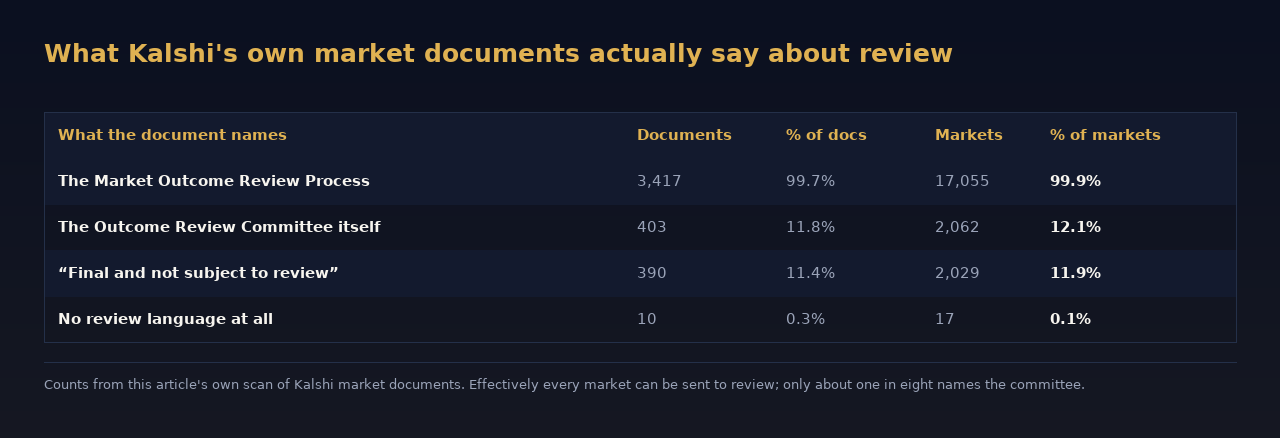
Here is the measurement that frames everything else. Across the 3,427 readable contract documents, the Market Outcome Review Process is named in 3,417 of them — 99.7% of documents, covering 17,055 of 17,072 markets, or 99.9%. It is in the standard contingencies boilerplate, so it reaches essentially the entire exchange.
The committee is a different story. The phrase “Outcome Review Committee” appears in just 403 documents, covering 2,062 markets — 12.1%.
| What the document names | Documents | % of docs | Markets | % of markets |
|---|---|---|---|---|
| The Market Outcome Review Process | 3,417 | 99.7% | 17,055 | 99.9% |
| The Outcome Review Committee itself | 403 | 11.8% | 2,062 | 12.1% |
| “Final and not subject to review” | 390 | 11.4% | 2,029 | 11.9% |
| No review language at all | 10 | 0.3% | 17 | 0.1% |
The gap is not Kalshi hiding anything. It is a drafting artefact with a real consequence: the committee gets named only where a document spells out a specific contingency. Of the 403 documents that name it, 272 carry the death-caveat clause, 189 the act-of-terrorism clause and 117 the participant-elimination clause. Every one of those 272 death-clause documents names the committee. The other 3,014 documents say “the Market Outcome Review Process” and stop, leaving a cross-reference as the only way through.
Which means the honest reading is the uncomfortable one: the committee's reach is 99.9% of markets, and its visibility is 12.1%. Both numbers are in the documents; only one is on the page you read before you buy.
Which categories name the committee, and which never do
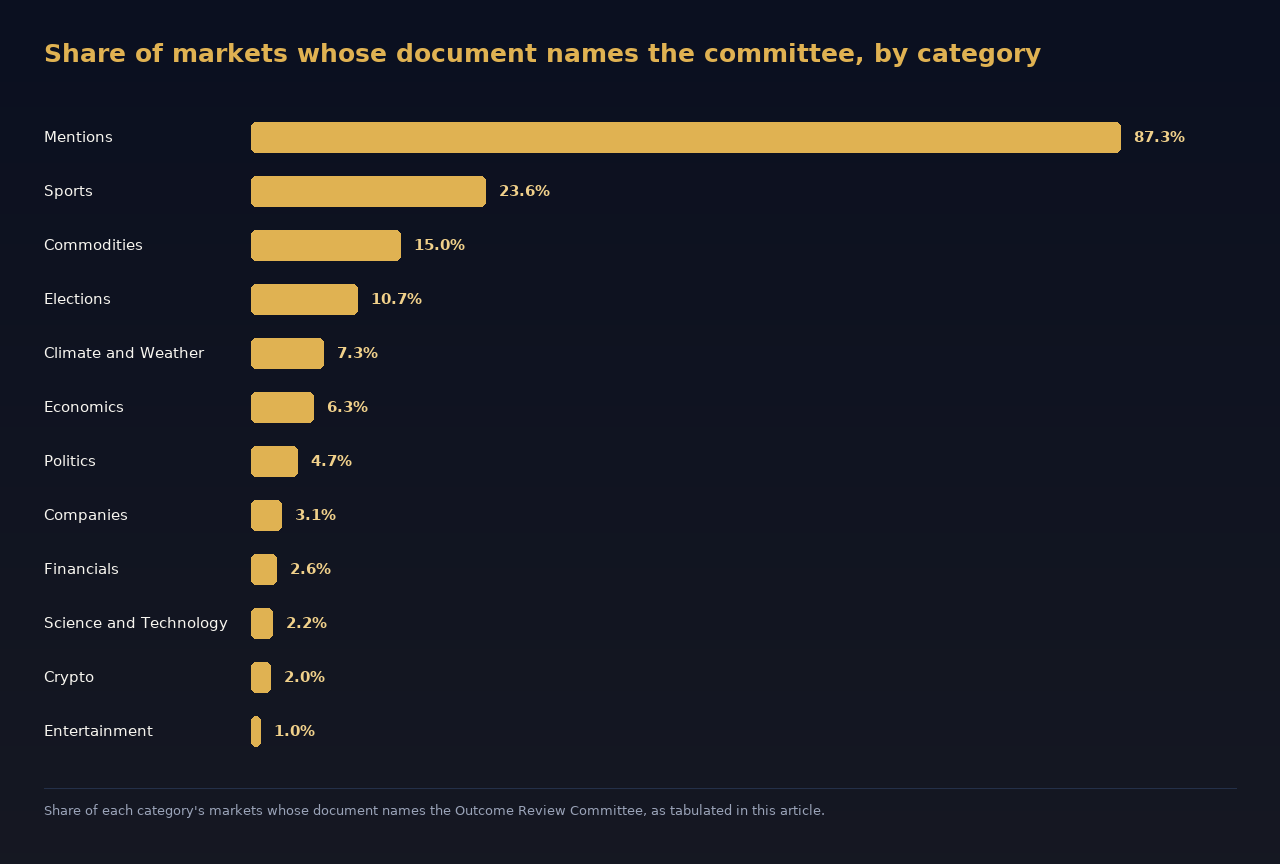
Splitting those 2,062 markets by category shows the naming is wildly uneven, and not in the way you would guess.
| Category | Docs naming it | Markets naming it | Markets in category | Share |
|---|---|---|---|---|
| Mentions | 6 | 438 | 502 | 87.3% |
| Sports | 217 | 1,014 | 4,293 | 23.6% |
| Commodities | 5 | 18 | 120 | 15.0% |
| Elections | 112 | 284 | 2,644 | 10.7% |
| Climate and Weather | 7 | 40 | 545 | 7.3% |
| Economics | 9 | 58 | 922 | 6.3% |
| Politics | 18 | 122 | 2,603 | 4.7% |
| Companies | 2 | 5 | 160 | 3.1% |
| Financials | 17 | 41 | 1,589 | 2.6% |
| Science and Technology | 4 | 9 | 400 | 2.2% |
| Crypto | 2 | 6 | 306 | 2.0% |
| Entertainment | 18 | 27 | 2,655 | 1.0% |
Mentions markets — will a named person say a named word — are the transparent ones at 87.3%, because two documents carry nearly the whole category and both spell the committee out. Sports is second at 23.6%, which fits: sports documents are the ones with abandonment and disqualification clauses to write.
The bottom of the table is where I would spend attention. Entertainment is 1.0% and Crypto is 2.0% — categories where a result is genuinely contestable: an award reversed, a token delisted mid-contract. Same exposure as Sports, disclosure twenty-three times thinner.
Three people, two of them Public Directors
None of this is in the contract documents. Searching all 3,427 for “three members”, “Public Director” and “Regulatory Oversight Committee” returns zero documents each. Every governance fact below comes out of the rulebook filed with the CFTC, which is a separate document the contract never links.
| Question | What the rulebook says | Rule |
|---|---|---|
| How many people? | “A standing committee consisting of three members” | 2.7(e)(a) |
| Who appoints them? | The Regulatory Oversight Committee, whose own members may serve concurrently | 2.7(e)(a) |
| Any independence requirement? | “At least two of the members must be Public Directors” | 2.7(e)(a) |
| For how long? | One calendar year from appointment, renewable without limit | 2.7(f) |
| Can the Board overrule it? | The Board's power to override its subcommittees “does not apply to the Outcome Review Committee” | 2.7(c) |
| How long does it get? | “Within a 24 hour period after the Outcome Review Process is initiated” | 7.1(b) |
| Can you appeal? | “Full discretion”; determinations are “final” | 7.1(c) |
| Will you be told? | “Kalshi will post on its website that the Contract's Market Outcome is under review” | 7.1(a) |
Read as a whole, this is better governance than the contract language implies. A three-person committee with a two-thirds Public Director floor, appointed by the regulatory oversight body rather than management, is a recognisable market-integrity structure — and Rule 2.7(c) carving it out of Board override means its call stands even against the Board that constituted it.
The weak points are the overlap and the term. Regulatory Oversight Committee members may sit on the committee they appoint, and a one-year renewable term appointed by the same body each year is not a strong independence guarantee. Neither is a defect you can trade around; both are worth knowing before you treat “final and not subject to review” as a formality.
The 24-hour clock, and the notice that is not an email
Rule 7.1(b) is the most useful line in Chapter 7 for anyone holding a position: the committee “shall review all relevant evidence and determine a final Market Outcome within a 24 hour period after the Outcome Review Process is initiated”. That is a hard ceiling, and it is far tighter than the open-ended waits in the contingency clauses themselves — the 48-hour data windows we found in the last fair price documents, for instance.
Two caveats stop that being pure comfort. The clock starts at initiation, and initiation is at Kalshi's sole discretion with no deadline of its own, so the 24 hours bounds the committee's deliberation and not your wait. And because Rule 7.1(a) ties settlement to the determination date, a review started late moves your settlement, not just your information.
The notification duty is real but narrow. Kalshi “will post on its website” that the outcome is under review — a published notice, not a push to holders. Compare that with Rule 6.3(g), which does promise electronic notification to every Member holding the contract, but only at settlement. So the sequence is: a website post when your market enters review, then an email once it is over. If you are not refreshing the market page, the first you will know is the number.
The exchange does volunteer one thing: for a death or terrorism event the same clauses let it halt trading “with public notice on Kalshi's website or the Platform”, and a halt is at least visible in the app.
6,343 markets point you at the wrong paragraph
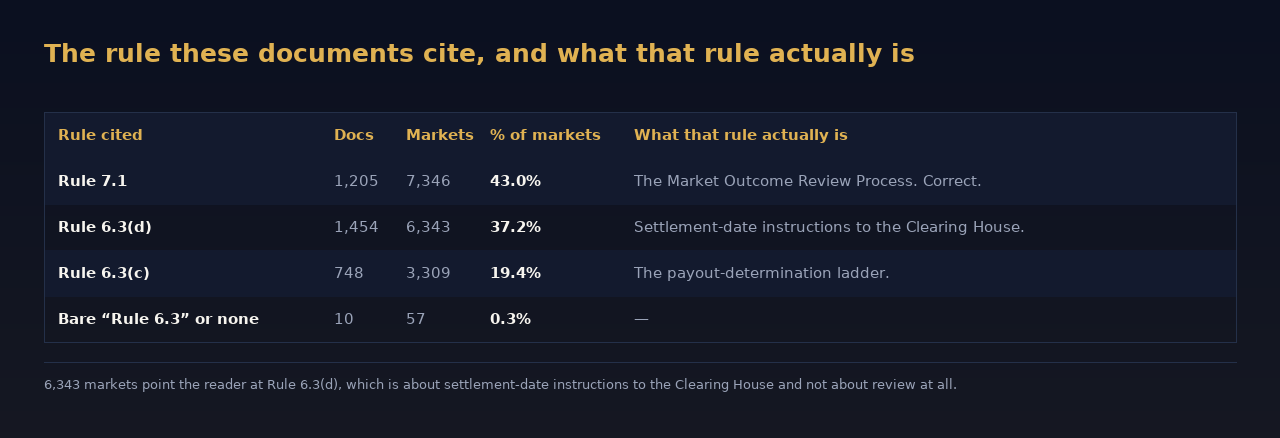
This is the finding I did not go looking for. The contingencies sentence is boilerplate, but the rule number inside it is not consistent across the board. Parsing the citation out of all 3,427 documents gives three different answers for one process.
| Rule the document cites | Docs | Markets | % of markets | What that rule actually is |
|---|---|---|---|---|
| Rule 7.1 | 1,205 | 7,346 | 43.0% | The Market Outcome Review Process. Correct. |
| Rule 6.3(d) | 1,454 | 6,343 | 37.2% | Settlement-date instructions to the Clearing House. Nothing to do with review. |
| Rule 6.3(c) | 748 | 3,309 | 19.4% | The payout-determination ladder. Not the review process, but it does reach the committee. |
| Bare “Rule 6.3” or no citation | 10 | 57 | 0.3% | — |
The 6.3(d) rows are the clean error. In the rulebook version on file, Rule 6.3(d) reads “On the Settlement Date, Kalshi will cause and/or instruct Clearing House to” debit, credit and delete contracts. It is plumbing. The review-process pointer sat one letter away at 6.3(e) — and then moved again.
On 2 March 2026 KalshiEX filed an amendment to Rule 6.3 with the CFTC, effective 17 March 2026, inserting the death caveat as a new subsection (e). The filing states “[Existing subsections (a) through (d) unchanged]” and the tracked-changes copy shows the old (e) renumbered to (f). So the current chain is Rule 6.3(f), which says “Before Settlement, Kalshi may at its sole discretion initiate the Market Outcome Review Process as provided in Rule 7.1”, and from there to Chapter 7.
Which leaves 1,454 documents — 6,343 markets, 37.2% of the board — sending readers to a paragraph that was never the right one and is now two letters stale. The biggest single offender is ELECTION.pdf, which covers 494 markets on its own. The same drift shows in the second half of the sentence: 1,474 documents cite Rule 6.3(b) for Kalshi's “right to determine payouts”, and 6.3(b) is the Scalar Contract proportion rule — the determination power is in 6.3(c).
Does it change a settlement? No — the rulebook governs whatever the document misnumbers, and MENTION.pdf shows the correct citation already in use on 43% of markets. But a cross-reference is the only bridge a document gives you to the committee, and on a third of the board it lands in clearing-house plumbing. A trader doing exactly what the contract says finds nothing, and concludes there is nothing to find.
What the committee is told to decide with
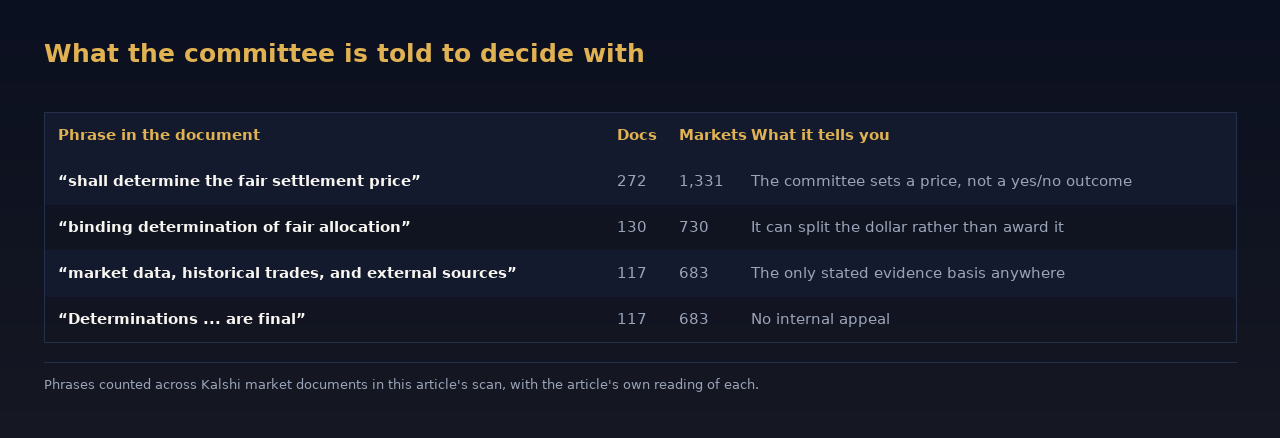
Chapter 7 gives the committee “full discretion” and no methodology. The contract documents are more forthcoming, and where they speak they are consistent.
| Phrase in the document | Docs | Markets | What it tells you |
|---|---|---|---|
| “shall determine the fair settlement price” | 272 | 1,331 | The committee sets a price, not a yes/no outcome |
| “binding determination of fair allocation” | 130 | 730 | It can split the dollar rather than award it |
| “market data, historical trades, and external sources” | 117 | 683 | The only stated evidence basis anywhere |
| “Determinations of the Outcome Review Committee are final” | 117 | 683 | No internal appeal |
That third row is the one to hold on to. “Market data, historical trades, and external sources” appears in 117 documents covering 683 markets, and it is the only evidence standard published anywhere in the corpus or the rulebook. It puts the tape first, which is reassuring on a liquid market and hollow on an illiquid one: a contract with three trades all week has market data in the technical sense and nothing usable in the practical sense.
The fair-allocation row matters for a different reason. On 730 markets the committee is empowered to divide the settlement value between sides rather than pick a winner, which is a materially different payoff from the binary you thought you bought.
Rule 7.2: the source agency can change after you buy
Chapter 7 has a second rule, and it is the one I would put in front of anyone who picks markets on settlement-source quality. Rule 7.2(a) says that if any circumstance materially affects the reliability or transparency of a contract's Source Agency or Underlying — including the source becoming unavailable or undergoing “significant modifications” — Kalshi “retains the authority to designate a new Source Agency and Underlying for that Contract and to change any associated contract specifications after the first day of trading”.
There are two guardrails: the replacement “would be objective and verifiable”, and Kalshi “would announce any such decision on its website”. Both are real, and both are weaker than the thing they replace, because the original source agency was named in the contract you agreed to and the replacement is announced in a notice you have to go and read.
Rule 7.2(b) to (d) do the same for timing: Kalshi may adjust the expiration date and time when an expiration value cannot be determined accurately, may move expiration earlier if a qualifying expiration value occurs before the stated date, and the last trading date follows automatically. So the date, the source and the underlying are all adjustable after you hold the position, each announced on the website.
This is directly relevant to anyone who has used our source agency census to screen markets: a named, high-quality source agency is a snapshot, not a guarantee, and Rule 7.2 is the clause that can change it. The census tells you what the document says today; this rule tells you who can rewrite it tomorrow.
Checking your own market in two minutes
None of this needs an API key. Here is the sequence I would run before sizing anything on a market whose result could be contested.
- Open the contract document, not the rules summary. The market page links it; the file lives on assets.kalshi.com. The summary will not carry the contingencies paragraph.
- Search it for “Outcome Review”. You will almost certainly find the process named — 99.9% of markets carry it. That tells you the route exists.
- Then search for “Committee”. If it is absent, you are in the 87.9% of markets whose document never names the decision-maker. That is not a reason to avoid the market; it is a reason not to assume the contract text is the whole mechanism.
- Read the rule number it cites, and ignore it if it says 6.3(d) or 6.3(b). Go to Rule 7.1 in the rulebook instead. On 37.2% of markets the citation will send you to clearing-house plumbing.
- Check the liquidity before you rely on the fallback. The only published evidence standard puts market data first, so a market with a thin tape is a market where the committee has least to work from and most discretion.
- Bookmark the notices page. Both the review notice under Rule 7.1(a) and any source-agency substitution under Rule 7.2(a) are published on the website, not emailed to you.
Know who settles it before you size it
Every venue hands someone the final call when the facts run out. Finding out who takes ten seconds in the contract; finding out at settlement costs you the position.
Visit Polymarket.com →Affiliate link to Polymarket; we have no commercial relationship with Kalshi and earn nothing from it. 18+ only.
My verdict
The Kalshi Outcome Review Committee is better constituted than the contract documents let on and worse disclosed than it deserves. Three members, two of them Public Directors, appointed by the regulatory oversight body and insulated from Board override, deciding inside a 24-hour window against a published evidence standard — that is a defensible structure, and I would rather have it than Polymarket's bonded-dispute model on a contract where the facts genuinely fail.
What I would fix is the paperwork. Reach is 99.9% of markets and naming is 12.1%; 37.2% cite a clearing-house paragraph; and the three facts a holder most wants — three people, 24 hours, website notice — are in none of the 3,427 documents. All drafting problems, not governance ones, and a one-line fix to the boilerplate citation closes most of it.
Practically: treat the review process as live on every market you hold, read Rule 7.1 rather than whatever your contract cites, and weight thin markets down a notch, because that is where discretion does the most work.
Related guides
- Kalshi Last Fair Price 2026 — the Rule 6.3(c) fallback ladder, counted across 4,997 markets.
- Kalshi Source Agency 2026 — which body each contract consults first, and how often the field is blank.
- Kalshi Contract Terms 2026 — why one document serves many markets, and what that costs the reader.
- Kalshi Payout Time 2026 — the published settlement timer against the measured wait.
- Kalshi vs Polymarket Rules 2026 — the two venues' dispute mechanisms side by side.
- Kalshi Prohibited Traders 2026 — the per-market prohibition lists nobody reads.
Kalshi Outcome Review Committee FAQ
What is the Kalshi Outcome Review Committee?
It is a standing committee of the KalshiEX Board, defined in Chapter 1 of the rulebook as “a committee of the Board to determine Market Outcomes in accordance with Chapter 7”. Under Rule 2.7(e) it has three members appointed by the Regulatory Oversight Committee, at least two of whom must be Public Directors. It decides the final outcome of any contract Kalshi puts into the Market Outcome Review Process.
How long does the committee have to decide?
Rule 7.1(b) requires it to review the evidence and determine a final Market Outcome “within a 24 hour period after the Outcome Review Process is initiated”. That bounds the committee's deliberation, not your total wait, because Kalshi chooses when to initiate and has no deadline for doing so. Settlement then happens on the date the committee reaches its determination.
Can I appeal an Outcome Review Committee decision?
No. Rule 7.1(c) gives the committee “full discretion” and states that its determinations are final, and 390 contract documents covering 2,029 markets repeat that they are “final and not subject to review”. Unusually, Rule 2.7(c) also removes the Board's normal power to override a subcommittee in this committee's case.
Will Kalshi tell me if my market goes under review?
It will publish it, not send it. Rule 7.1(a) says Kalshi “will post on its website that the Contract's Market Outcome is under review”. The electronic notification promised in Rule 6.3(g) goes to holders at settlement, after the fact. For a death or terrorism event the exchange may also halt trading with public notice on the website or in the app.
Why does my contract mention Rule 6.3(d) instead of Rule 7.1?
Because the boilerplate is stale. We found 1,454 documents, covering 6,343 markets, citing Rule 6.3(d) for the Market Outcome Review Process. In the filed rulebook 6.3(d) is the Settlement Date instruction to the Clearing House; the pointer to Rule 7.1 was at 6.3(e) and became 6.3(f) when the 2 March 2026 amendment inserted a new subsection. Read Rule 7.1 regardless of what your document cites.
What evidence does the committee use?
The rulebook names none. The only published standard is in the contract documents: 117 of them, covering 683 markets, say determinations “will be made using market data, historical trades, and external sources”. Putting market data first means the committee has most to work with on liquid contracts and least on thin ones, which is where its discretion is widest.
Can Kalshi change a contract's settlement source after I have bought?
Yes. Rule 7.2(a) lets Kalshi designate a new Source Agency and Underlying, and change associated contract specifications, after the first day of trading, where a circumstance materially affects the original source's reliability or transparency. The replacement must be “objective and verifiable” and the decision is announced on Kalshi's website. Rule 7.2(b) to (d) allow the expiration date to be moved later or earlier.
Method and sources
Everything counted here was measured on 26 November 2026. I pulled the full series list from Kalshi's public series endpoint in one unauthenticated request (21.8 MB, HTTP 200, 17,148 series; the endpoint is documented in the Kalshi API reference). Those series resolve to 3,455 distinct contract-terms URLs; 3,426 returned HTTP 200 on the first pass and one more on a retry, 28 returned 404, and 27 of the 404 responses were unparseable, leaving 3,427 readable documents covering 17,072 markets. Text was extracted with pdftotext and matched on whitespace-normalised strings, so a phrase broken across a line break still counts.
Governance and procedure come from the KalshiEX rulebook filed with the CFTC (Appendix A, version 1.18), and the renumbering from the 2 March 2026 Rule 6.3 amendment, effective 17 March 2026. Kalshi's own rulebook page returned HTTP 429 to this container on every attempt, as it has on our last four runs, so both rule texts are cited from the CFTC filings rather than from kalshi.com. For context on how other writers approach the rules tab, OddsShopper's rules explainer is the best of them and does not cover Chapter 7.
Two limits. The 12.1% figure counts the exact phrase “Outcome Review Committee” in the contract-terms document only; a market page or help-centre article may name it where the document does not. And the citation analysis compares each document against the two rulebook versions I could read — if a version between them numbered the process differently, some 6.3(d) citations were right when written and have since gone stale, a maintenance finding rather than a drafting one. Either way the reader following them today lands in the wrong paragraph.
Nothing here is financial advice. Event contracts can lose their full value. 18+ only.