Kalshi vs Polymarket Settlement 2026: 1,737
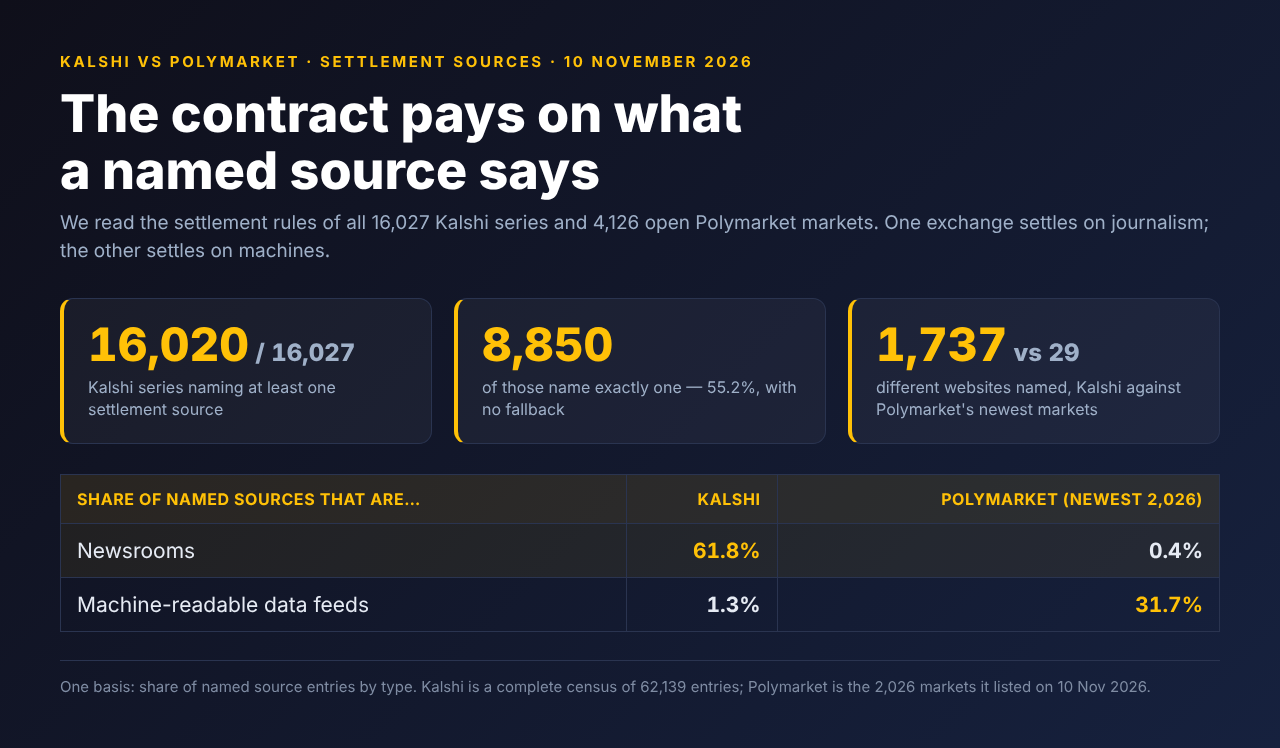
Kalshi vs Polymarket settlement read off 16,027 contract rules: Kalshi names 1,737 sources, 61.8% of them newsrooms. Polymarket’s new markets name 29.
Affiliate disclosure: contains affiliate links; we may earn a commission at no extra cost to you. We have no commercial relationship with Kalshi. 18+ only — see BeGambleAware.org. Last updated 10 November 2026.
Key takeaways
- Kalshi names a settlement source on almost every contract it lists. Of 16,027 series we read on 10 November 2026, 16,020 name at least one — 62,139 source entries drawn from 1,737 different websites. Only 7 name none.
- Kalshi settles on journalism; Polymarket settles on machines. 61.8% of Kalshi's source entries are news organisations and 1.3% are data feeds. Of the 2,026 Polymarket markets listed on 10 November, 0.4% of the hosts named are newsrooms and 31.7% are machine feeds.
- 8,850 Kalshi contracts rest on exactly one source. That is 55.2% of the book, and the rate is worst where you would least expect it: 81.5% in Entertainment and 80.4% in Climate and Weather, against 23.9% in Sports, where ESPN acts as everyone's second opinion.
- The "Polymarket doesn't name sources" take is out of date. Its newest 2,026 markets fill the
resolutionSourcefield 90.3% of the time and leave zero without a URL anywhere. Among its oldest open markets, still tradeable today, 45.8% have no link of any kind. - Chainlink is now the single most-named source on Polymarket's new listings — 960 mentions of
data.chain.link, ahead of nba.com on 461. A year-old crypto market on the same platform points at a Binance ticker instead.
On this page
You can be right about the event and still lose the trade, because the contract does not pay on what happened — it pays on what a named source says happened. Kalshi vs Polymarket settlement is where that gap lives, and it is almost never priced: on 8,850 Kalshi contracts there is exactly one website standing between you and your money, and on 962 of Polymarket's older open markets there is no link at all to check. Every guide on page one explains the two resolution models and then stops, because the sources are not in anybody's documentation — Kalshi's own market settlement page says only that timing "can vary based on market type, data source availability, and manual review requirements" and names not one source. So we read the rules instead: all 16,027 Kalshi series and 4,126 open Polymarket markets, on 10 November 2026, and counted who actually decides.
What actually settles a prediction market
Both venues pay $1.00 a share to the winning side and $0.00 to the losing one. What differs is the thing that decides which side won.
Kalshi, as a CFTC-regulated exchange, writes the source into the contract before the market opens. Its API exposes that as a settlement_sources list on every series — a name, and usually a URL. Polymarket's markets are settled by UMA's optimistic oracle, where a proposer posts a result against a bond and token holders vote if it is challenged; we covered that machinery in detail in when UMA decides. But the oracle still has to be told what to look at, and that instruction lives in a resolutionSource field and in the market's own rules text.
| Kalshi | Polymarket | |
|---|---|---|
| Who decides | The exchange, against a source fixed in the contract | UMA proposer, then token-holder vote if disputed |
| Where the source is stated | settlement_sources on the series | resolutionSource field + rules text |
| Named on | 16,020 of 16,027 series (99.96%) | 1,829 of 2,026 newest markets (90.3%) |
| Different websites named | 1,737 | 29 across the newest cohort |
| Typical source | A newsroom (61.8% of entries) | A price feed or a league scoreboard |
| Second opinion if the source is wrong | A backup source on 7,170 series; none on 8,850 | Dispute the oracle, at the cost of a bond |
The practical difference is not regulation, it is recourse. On Kalshi you can read the source before you buy and argue it afterwards. On Polymarket you can read the feed instantly but the argument costs money. Both are better than the third model — an operator deciding at its own discretion — and neither is any better than the source it points at.
16,027 Kalshi rules, counted
Nobody publishes this, so here it is. Kalshi's public series endpoint returns every series it lists with the settlement sources attached, which makes a full census a single call rather than an estimate. On 10 November 2026 that was 16,027 series across 20 categories, carrying 62,139 source entries between them.
The headline is reassuring: 16,020 of the 16,027 name at least one source. Only 7 name none, and they are scattered across Politics, Economics, Climate and Weather and Entertainment rather than clustered in one neglected corner. The distribution underneath is where the Kalshi vs Polymarket settlement comparison starts to bite.
| Sources named in the contract | Series | Share |
|---|---|---|
| None | 7 | 0.0% |
| Exactly one | 8,850 | 55.2% |
| Two | 3,096 | 19.3% |
| Three to five | 1,463 | 9.1% |
| Six to fourteen | 1,078 | 6.7% |
| Fifteen or more | 1,533 | 9.6% |
| All series | 16,027 | 100% |
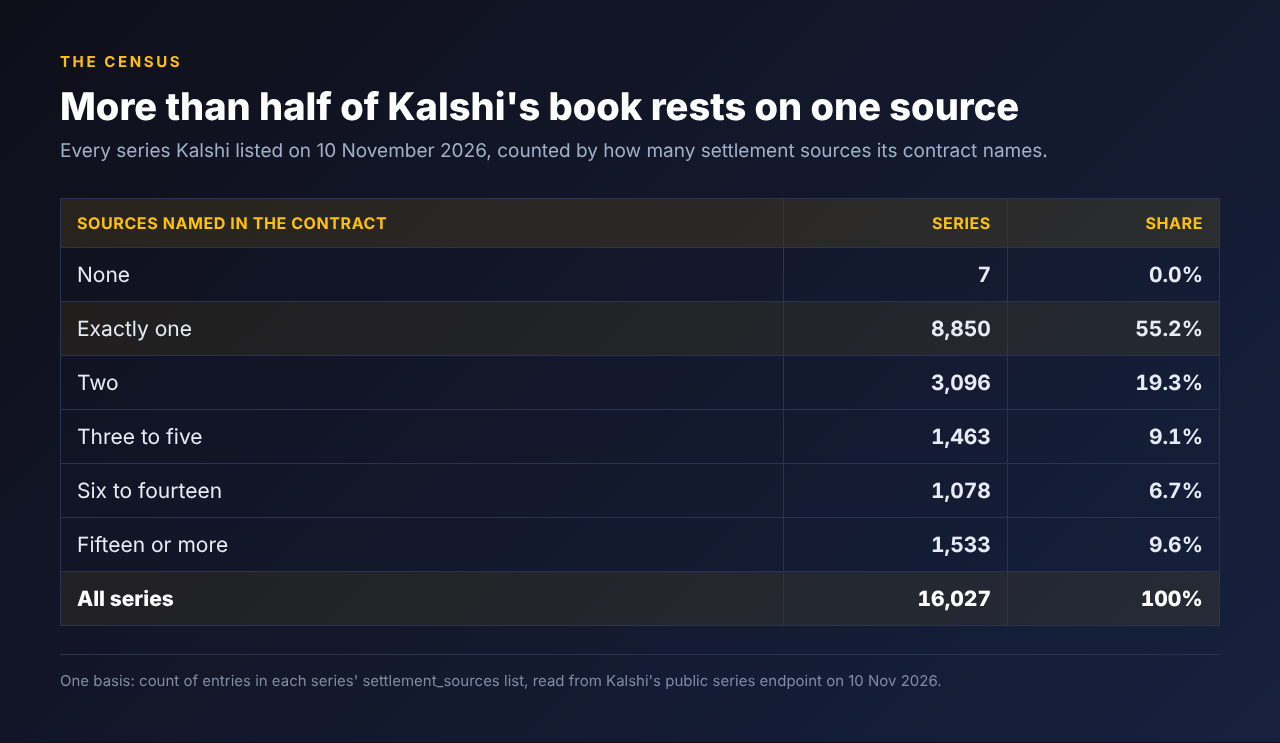
The long tail at the top of that table is real: one series names 40 separate sources. Those are the political and "mentions" contracts where the question is whether a thing was said, and the contract hedges by listing every outlet that might report it. The thin end is the problem, and it is the majority.
Kalshi settles on journalism
Sort the 62,139 entries by website and the exchange's character is unmistakable. The most-named source on Kalshi is ESPN, on 3,277 entries. Behind it sit the Wall Street Journal, Reuters, the Associated Press, CNN and the New York Times, each on more than two thousand.
| Source named in the contract | Entries | Type |
|---|---|---|
| ESPN | 3,277 | Newsroom |
| The Wall Street Journal | 2,468 | Newsroom |
| Reuters | 2,424 | Newsroom |
| The Associated Press | 2,055 | Newsroom |
| CNN | 2,021 | Newsroom |
| The New York Times | 2,001 | Newsroom |
| The Washington Post | 1,998 | Newsroom |
| Fox News | 1,938 | Newsroom |
| Politico | 1,888 | Newsroom |
| ABC | 1,840 | Newsroom |
| the Governing League | 925 | Primary / official |
| Library of Congress | 590 | Primary / official |
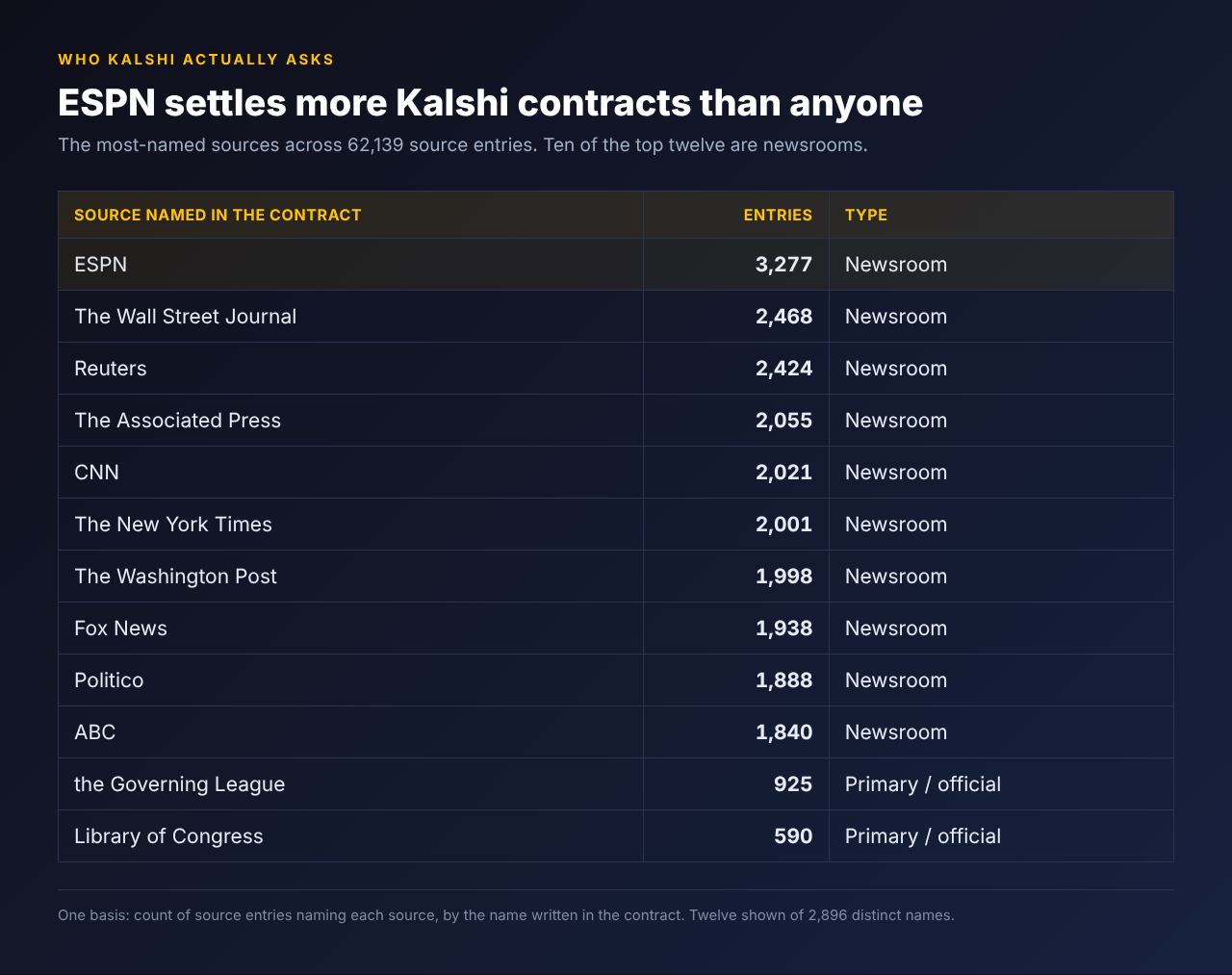
Bucket all 62,139 entries and 38,376 of them — 61.8% — are news organisations. 18,262 (29.4%) are primary or official bodies: leagues, statistical agencies, Congress, electoral commissions. 4,687 (7.5%) point at kalshi.com itself, which we come back to below. Machine-readable data feeds account for 814 entries, or 1.3%.
There is a reason for that mix and it is not laziness. A question like "will the Senate confirm X" has no API. But it does mean a large part of a regulated exchange's book settles on reporting that sits behind a paywall, carries corrections, and was written by people with no idea a contract depends on them.
8,850 contracts rest on a single source
This is the number that should change how you read a rules box. More than half of Kalshi's series — 8,850 of 16,027 — name exactly one source. If that one source is late, paywalled, ambiguous or simply wrong, the contract has nothing to fall back on.
It is not spread evenly, and the pattern is the opposite of intuition. Sports, the category people assume is casual, has the best redundancy on the exchange, because ESPN is named on 3,183 of 4,168 sports series (76.4%) as a second opinion alongside the governing league. The categories that sound most official are the ones running without a spare.
| Category | Series | Single-source | Share |
|---|---|---|---|
| Entertainment | 2,604 | 2,121 | 81.5% |
| Climate and Weather | 501 | 403 | 80.4% |
| Financials | 1,174 | 939 | 80.0% |
| Economics | 873 | 655 | 75.0% |
| Science and Technology | 391 | 279 | 71.4% |
| Elections | 2,504 | 1,560 | 62.3% |
| Mentions | 465 | 238 | 51.2% |
| Politics | 2,418 | 989 | 40.9% |
| Sports | 4,168 | 998 | 23.9% |
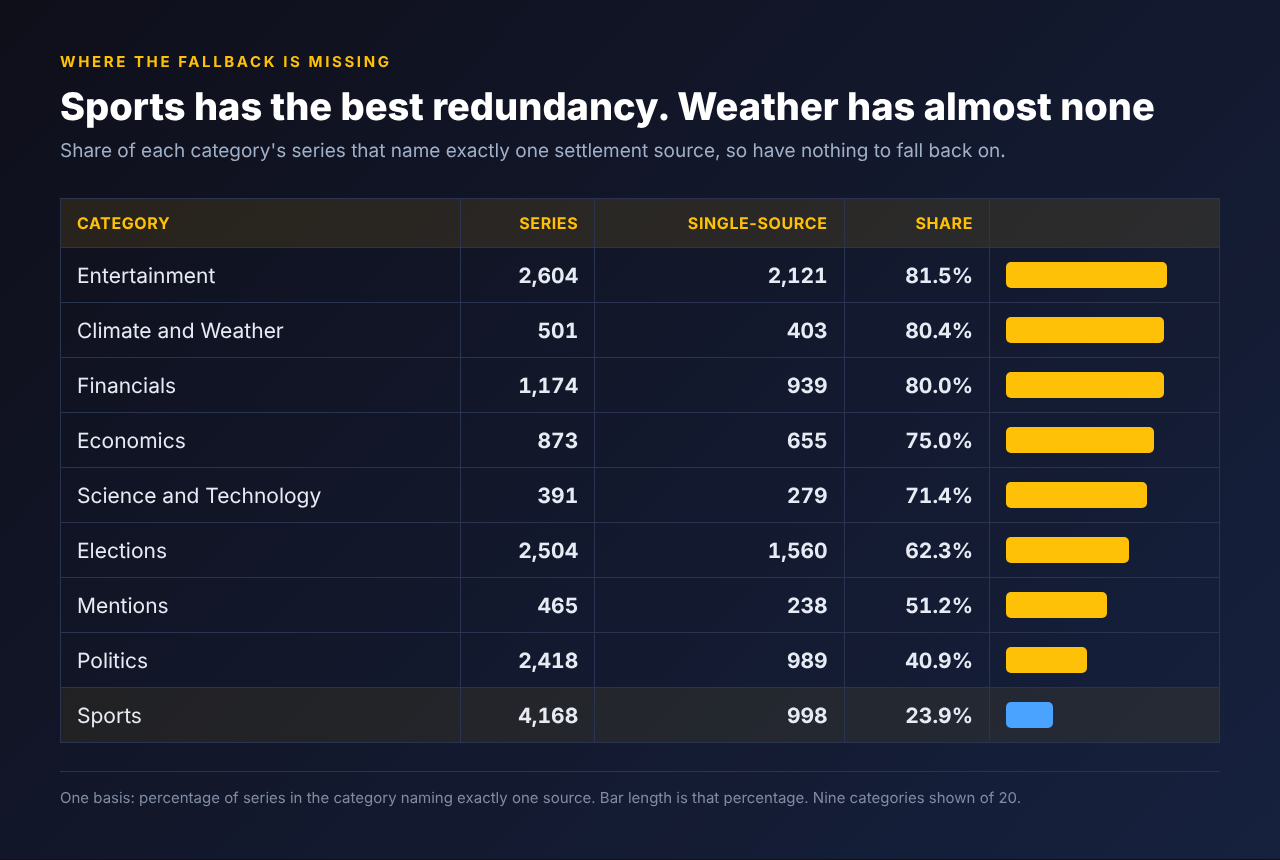
Look at what the sole source actually is and the concentration gets sharper. Of the 8,850 single-source series, 652 depend on congress.gov alone, 353 on espn.com, 320 on billboard.com, 300 on an open.spotify.com chart, 242 on rottentomatoes.com and 187 on weather.com. A Billboard chart delay is, for 320 contracts, the whole settlement process.
426 contracts point back at Kalshi
The most-cited website in the whole census is not a newsroom. It is kalshi.com, on 4,687 entries across 1,713 series. On 426 of those series it is the only link in the contract.
This is less damning than it sounds, and more awkward than it looks. The pattern is consistent: where the real authority varies by jurisdiction, the contract describes it in words and uses the Kalshi homepage as the URL. The Turkey presidential election series names "the official electoral commission, constitutional court, or equivalent electoral authority of the relevant jurisdiction" and links to https://kalshi.com/. That phrasing alone covers 187 series; a near-identical one about certifying authorities covers another 35.
Why it matters anyway: a source you cannot open is a source you cannot pre-check. On 338 Elections series and 34 Politics series, the only clickable thing in the rules is Kalshi's own front page, so the only way to know which body will be consulted is to ask after the fact.
It is a documentation gap, not a conflict of interest — the described authority is third-party in every case we read.
Two of those 426 are in Sports, which is the one place the generic wording is hard to justify. Everywhere else the drafting problem is genuine: there is no single URL that means "whichever electoral commission is relevant".
Polymarket names machines, not newsrooms
Now the other side of the Kalshi vs Polymarket settlement question, and it is a genuinely different philosophy rather than a weaker version of the same one. We read the 2,026 open markets Polymarket created on 10 November 2026 — it lists more than two thousand a day — and extracted every host named in the resolutionSource field or linked in the rules text.
Across that cohort, 29 distinct websites do all the work, against Kalshi's 1,737. And the top one is not a publication at all.
| Host named (newest 2,026 markets) | Mentions | What it is |
|---|---|---|
| data.chain.link | 960 | Chainlink price feed |
| nba.com | 461 | League scoreboard |
| lfpb.com.bo | 222 | Bolivian league site |
| binance.com | 192 | Exchange ticker |
| cbf.com.br | 184 | Brazilian federation |
| pythdata.app | 172 | Pyth price feed |
| flashscore.com | 171 | Scores aggregator |
| efa.com.eg | 148 | Egyptian federation |
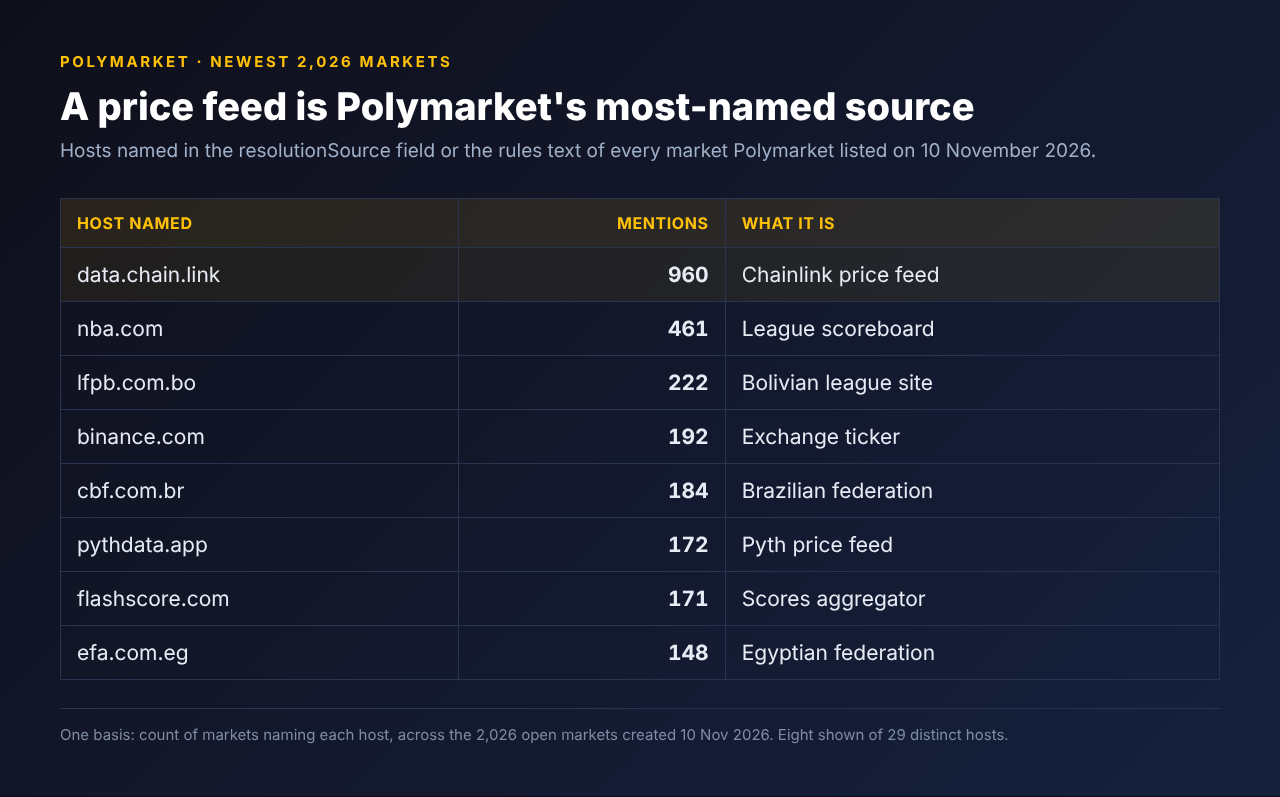
Classify those host mentions the way we classified Kalshi's and the contrast is stark. In Polymarket's newest cohort, 31.7% are machine-readable feeds and just 0.4% — nine mentions in total — are newsrooms. On Kalshi those figures are 1.3% and 61.8%. The two venues have made opposite bets about what a trustworthy source looks like.
The Chainlink number is the newsworthy one. Polymarket's integration of Chainlink Data Streams was announced as a partnership; measured against the live board it is now the platform's single most-named resolution source. The specific feeds are explicit — btc-usd-twap-60s-streams, bnb-usd, xrp-usd and hype-usd, each on 60 markets — which means a crypto settlement on Polymarket is now a 60-second time-weighted average published on-chain, not a human reading a chart.
Read the resolution source before the bond, not after
Every market carries its own source field, and on this platform it changed character inside a year. A crypto market listed today settles on an on-chain average; one listed last winter may not name a URL at all.
Visit Polymarket.com →Affiliate link to Polymarket; we have no commercial relationship with Kalshi. 18+ only. Polymarket restricts access from the United States, Canada and other listed jurisdictions. Prediction markets carry a substantial risk of loss. Nothing here is financial advice.
Polymarket's old markets are the thin ones
Here is where we nearly published the wrong article. The first 2,100 open markets the Gamma API will page through look bad: only 52.3% fill the resolutionSource field, and 962 of them — 45.8% — carry no URL anywhere, in the field or the rules text. Written up on its own, that is a story about a platform that does not say who settles its markets.
It is a sampling artefact. The API returns markets by ascending id by default, so that window is the oldest open markets — created between 3 July 2025 and 5 February 2026, and still open because they are long-dated. Reverse the sort and the same measurement comes out completely differently.
| Measure | Oldest open (n=2,100) | Newest open (n=2,026) |
|---|---|---|
| Created | Jul 2025 – Feb 2026 | 10 Nov 2026 |
resolutionSource filled | 1,098 (52.3%) | 1,829 (90.3%) |
| Rules text says "resolution source" | 1,865 (88.8%) | 1,985 (98.0%) |
| No URL anywhere | 962 (45.8%) | 0 (0.0%) |
| Distinct hosts named | 102 | 29 |
| Newsroom share of hosts | 5.5% | 0.4% |
| Machine-feed share of hosts | 19.5% | 31.7% |
So the honest finding is a direction of travel, not a verdict. Polymarket's sourcing discipline has tightened sharply: zero of the markets it listed on 10 November lack a URL, against nearly half of its year-old ones. The catch for a trader is that the thin cohort has not gone anywhere — those 962 markets are open and tradeable right now, and they are exactly the long-dated political and macro questions where an ambiguous source does the most damage.
We should flag the limit on our own number. Polymarket's API refuses any offset past 2,100, so there is no way to enumerate its entire open board from the public endpoint; these are two dated cohorts at either end, not a census. Kalshi's 16,027 is a complete count.
Can you actually check the source?
A named source is only worth having if you can open it. Of the 1,737 websites Kalshi names, 862 are cited by exactly one series — the long tail of foreign electoral commissions, federations and statistical agencies. We took a random sample of 60 of those and fetched each one.
| Result | Hosts | Reading |
|---|---|---|
| HTTP 200 | 32 | Opens normally |
| HTTP 403 | 22 | Bot wall — not evidence the source is down |
| No connection | 5 | Four refuse our IP; one is genuinely broken |
| HTTP 402 | 1 | Paywall meter |
We are deliberately not reporting that as "28 of 60 sources are dead", because it is not. A 403 from a datacentre IP is a bot wall, and three of the five connection failures — amtrak.com among them — resolve in DNS and plainly work for ordinary visitors. Measuring from a server tells you about the server as much as the source.
One failure survives that caveat. www.cne.gob.ve, Venezuela's national electoral council, is the named settlement source for the Venezuela presidential election call series, and its hostname is a dead end: it resolves to a CNAME, www.gslb.cne.gob.ve, which has no address record at all. That is not our egress — public resolvers return the same. One contract, one broken link, and the kind of thing that is only visible if you fetch all 1,737.
What to check before you buy
None of this makes either venue a bad place to trade. It makes the rules box the first thing you read rather than the last.
- Count the sources, don't just notice there is one. On Kalshi, one named source means no fallback, and that is the majority case. Two or more means the exchange has somewhere to go if the first is late.
- Treat Entertainment, Weather and Financials as the thin categories. Four in five of those contracts run on a single website, against roughly one in four in Sports.
- Open the link before you buy. If it points at a homepage rather than the page carrying the number, you cannot pre-check the settlement, and on 426 Kalshi series that homepage is Kalshi's own.
- On Polymarket, check the market's age. A market listed this week will name a feed. A long-dated one from last year may name nothing you can click.
- For crypto questions, read which feed. A 60-second TWAP on Chainlink and a spot price on a Binance ticker will not always agree at the moment of expiry, and both are in use.
- Remember the source outranks your own eyes. The contract pays on what the named source publishes, including when it publishes a correction later; that is also why Kalshi's payout timing varies so much by category.
If you want the rest of the cross-venue picture, the rulebook comparison covers deadlines and expiry, and the per-category fee breakdown covers what each venue charges to get the position on in the first place.
Related guides
- Polymarket Resolution 2026: When UMA Decides — the oracle machinery that acts on the source named here.
- Kalshi vs Polymarket Rules 2026: 48 Hours — the full cross-venue rulebook comparison.
- Polymarket Soccer Rules 2026: 1,407 Deadlines — what a called-off match pays, and why soccer is the exception.
- Kalshi Fees by Market 2026: 195 Exceptions — the same per-series data read for price instead of sources.
- Polymarket Odds Accuracy 2026: 9,836 Scored — whether the prices are right once the source has spoken.
- Kalshi Payout Time 2026: 15,382 Timed — how long settlement actually takes per category.
Kalshi vs Polymarket settlement FAQ
Who decides the outcome of a Kalshi market?
Kalshi settles the contract itself, against a source written into the series rules before the market opens. Its API exposes that as a settlement_sources list, and on 10 November 2026 16,020 of 16,027 series named at least one. Kalshi's own settlement documentation does not name any source — it only says timing depends on "data source availability" — so the per-contract rules are the only place to look.
What is Polymarket's resolution source?
It varies per market and is carried in a resolutionSource field plus the market's rules text. Of the 2,026 markets listed on 10 November 2026, 1,829 (90.3%) filled that field and none lacked a URL somewhere. The most-named host is data.chain.link on 960 mentions, ahead of nba.com on 461. UMA's oracle then acts on whatever that source says.
How many Kalshi contracts have only one settlement source?
8,850 of 16,027 series, or 55.2%, name exactly one. A further 3,096 name two and 1,533 name fifteen or more. The single-source rate is highest in Entertainment (81.5%), Climate and Weather (80.4%) and Financials (80.0%), and lowest in Sports (23.9%), because ESPN is named as a second source on 3,183 of 4,168 sports series.
Does Kalshi use news articles to settle markets?
Routinely. Of the 62,139 source entries across its series, 38,376 (61.8%) are news organisations, led by ESPN on 3,277, the Wall Street Journal on 2,468 and Reuters on 2,424. Primary and official bodies account for 29.4% and machine-readable data feeds for just 1.3%. For questions with no API — a confirmation vote, a public statement — reporting is the only available source.
Does Polymarket use Chainlink to settle markets?
For price questions, yes, and it is now the platform's most-cited source. In the 10 November cohort, data.chain.link appears 960 times, with named 60-second TWAP streams for BTC, BNB, XRP and HYPE each covering 60 markets. Pyth feeds appear on another 172. Non-price markets still point at league scoreboards, federations and government statistics, and UMA remains the oracle that acts on all of them.
Which venue names its sources more clearly?
Kalshi, on coverage: 99.96% of its series name a source, and it draws on 1,737 different websites. Polymarket is more consistent on its new listings — 90.3% fill the field and zero lack a URL — but concentrates on 29 hosts and left 45.8% of its oldest open markets with no link at all. Kalshi is broader; Polymarket's recent markets are tighter.
What happens if the settlement source is wrong or unavailable?
On Kalshi it depends on whether the contract named a backup: 7,170 series name two or more sources, and 8,850 name one, with no stated alternative. On Polymarket the route is to dispute the proposed resolution with UMA, which costs a bond. In both cases the contract pays on what the named source reports, not on what you watched happen.
Are any named settlement sources actually broken?
Rarely, and most apparent failures are not failures. Of 60 randomly sampled hosts cited by a single series, 32 returned 200, 22 returned 403 bot walls and one a paywall meter — none of which proves a source is down. One is genuinely broken: www.cne.gob.ve, Venezuela's electoral council and the named source for the Venezuela presidential election call, resolves to a CNAME with no address record on public resolvers.
Method and sources
Read on 10 November 2026. Kalshi figures are a complete census: every series from the public series endpoint (16,027 on the day), with the settlement_sources list read verbatim from each. Hosts are counted by normalised domain, so two links to the same site score once per entry; names are counted as written in the contract. Our newsroom / primary / machine-feed split is our own classification of those hosts, applied by a fixed list and stated so you can disagree with the edges — the per-host counts above are the underlying facts.
Polymarket figures come from the public Gamma markets API, read in two cohorts because the endpoint rejects any offset past 2,100: the oldest 2,100 open markets by ascending id, and the newest 2,026 by descending id, all of the latter created on 10 November. Those are dated samples at either end of the open board, not a census, and we have labelled every Polymarket figure with which cohort it came from. The link test sampled 60 of the 862 Kalshi hosts cited by exactly one series, fetched with a browser user-agent and following redirects, from a datacentre IP — which is why 403s are reported as bot walls rather than outages.
Prices and market counts move constantly; the rules text and the named sources do not. Where a figure here differs from an earlier article of ours, this read supersedes it and the difference is stated in the section above rather than quietly corrected.