Polymarket vs Kalshi 2026: Fees, Access and Who Settles
Kalshi vs Polymarket in 2026: top fees are now within a cent, so the real choice is who can sign up, how money moves and who settles each market.
Affiliate disclosure: contains affiliate links; we may earn a commission at no extra cost to you. 18+ only — see BeGambleAware.org. Last updated 9 October 2026.
Key takeaways
- The Kalshi vs Polymarket fee gap has closed. Kalshi's taker fees on most markets run $0.07–$1.75 per 100 contracts; Polymarket US runs $0.07–$1.74 on standard markets. "Polymarket is free, Kalshi takes up to 7%" is wrong on both counts.
- Polymarket.com charges by category, and geopolitics is free. Makers are never charged. In our worked example, 100 shares at 50¢ cost $1.75 in fees on Crypto, $1.00 on Politics and $0 on Geopolitics.
- Polymarket is now two products. Polymarket.com serves users outside the US and Polymarket's other restricted countries, the UK included. US residents must use the separate Polymarket US app.
- Kalshi is no longer US-only, but UK residents cannot trade on it. Kalshi says you can trade "from many countries", yet its Member Agreement bars trading from 55 Restricted Jurisdictions, the United Kingdom, Canada and France among them.
- The real split is who settles. Kalshi decides outcomes itself. On Polymarket.com prediction markets anyone can propose or dispute a result through UMA — about 2 hours if nobody objects, 4–6 days if someone does — while up-down markets settle on a Chainlink price with no dispute round.
Our pick if you are eligible
Polymarket.com, for readers outside the US and the restricted list
Geopolitics markets carry no fee, makers never pay, Polymarket charges nothing to deposit or withdraw USDC, and prediction-market results go through a public process you can watch and challenge.
Visit Polymarket.com →In the US? Polymarket.com is not open to US residents — use the separate Polymarket US app instead. In the UK or another of the 39 restricted countries? Polymarket is not available to you.
Affiliate link — we earn a commission at no extra cost to you. 18+ only. Prediction-market trading can lose you money.
On this page
Most Kalshi vs Polymarket comparisons still tell you that Polymarket is commission-free and Kalshi skims up to 7% of your winnings. On 9 October 2026 neither half is true: a 100-contract taker order costs $0.07 to $1.75 on most Kalshi markets and $0.07 to $1.74 on a standard Polymarket US market, while Polymarket.com prices fees by category and charges nothing at all on geopolitics. So this guide drops the fee myth and compares what actually separates the platforms now — who can sign up, how money gets in and out, and who decides the result — with every number read off Kalshi's and Polymarket's own fee, access and resolution pages and re-checked on 9 October 2026.
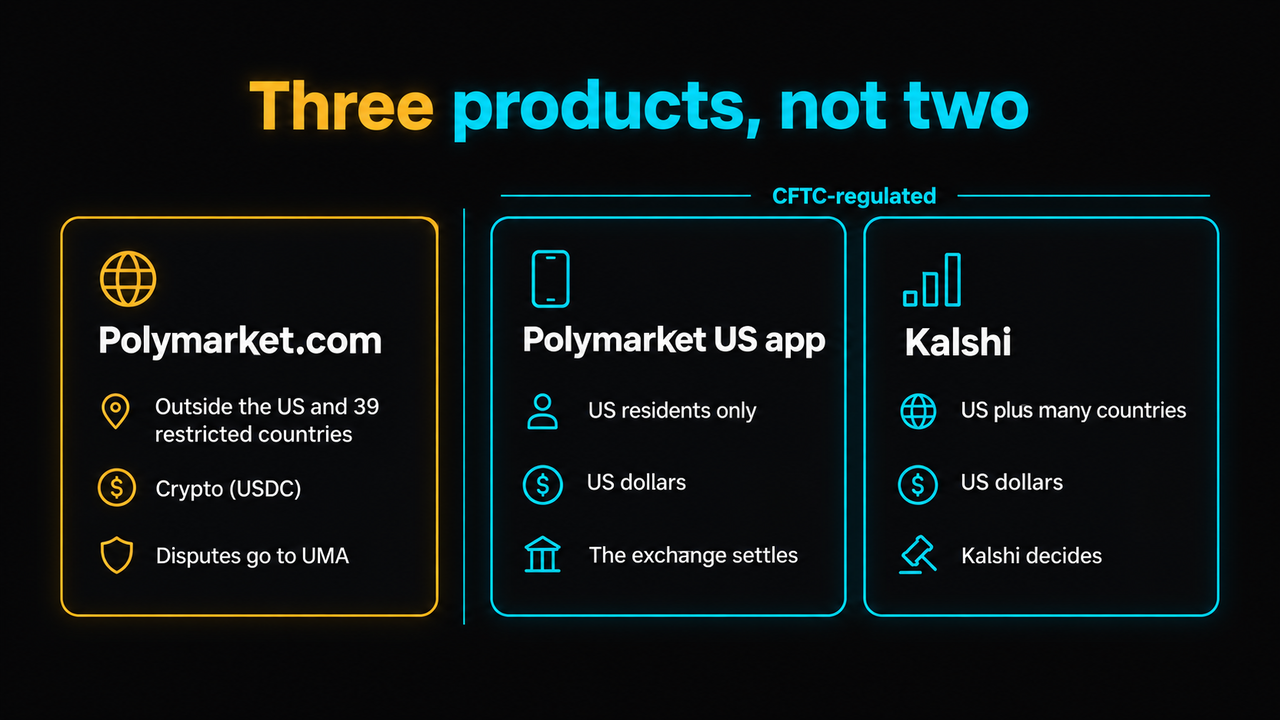
Most comparisons also miss that this is three products, not two. Polymarket runs Polymarket.com for international users and a separate, CFTC-regulated Polymarket US app for Americans, with different fees, money and settlement. I keep them apart throughout.
Disclosure up front: we earn a commission if you open a Polymarket.com account through our link, and I recommend exactly that if you are eligible. Kalshi still gets a straight hearing. New to YES/NO shares? Our Polymarket explainer covers the basics first.
Kalshi vs Polymarket at a glance: three products, not two
Every cell below comes from the platform's own help centre, docs, fee schedule or member agreement, re-checked on 9 October 2026.
Two of the three are US-regulated exchanges moving dollars through cards and banks. Polymarket.com is the odd one out: a crypto-funded, non-custodial product for everyone outside the US and its restricted list.
What changed since June
An earlier version of this page said Kalshi was US-only, took up to 7% of winnings, and that Polymarket charged no commission. All three were wrong by October 2026 and are corrected; unsourced volume and spread figures are gone. A 9 October re-check added Kalshi's UK restriction, two Polymarket US fee changes and Polymarket.com's Chainlink-settled up-down markets.
Polymarket vs Kalshi fees: within a cent at the top
All three now charge a fee that is largest on a coin-flip contract and shrinks toward the extremes. Polymarket publishes its formulas; Kalshi calls its fee "a transaction fee on the expected earnings on the contract" and publishes the range on its fee schedule.
Polymarket.com: a rate per category
Polymarket.com's trading-fees page sets the fee at C × feeRate × p × (1 − p), where C is the number of shares and p the price. "Makers are never charged fees. Only takers pay fees." The formula is symmetric — "a trade at 30¢ incurs the same dollar fee as a trade at 70¢" — and the fees fund a Maker Rebates Program.
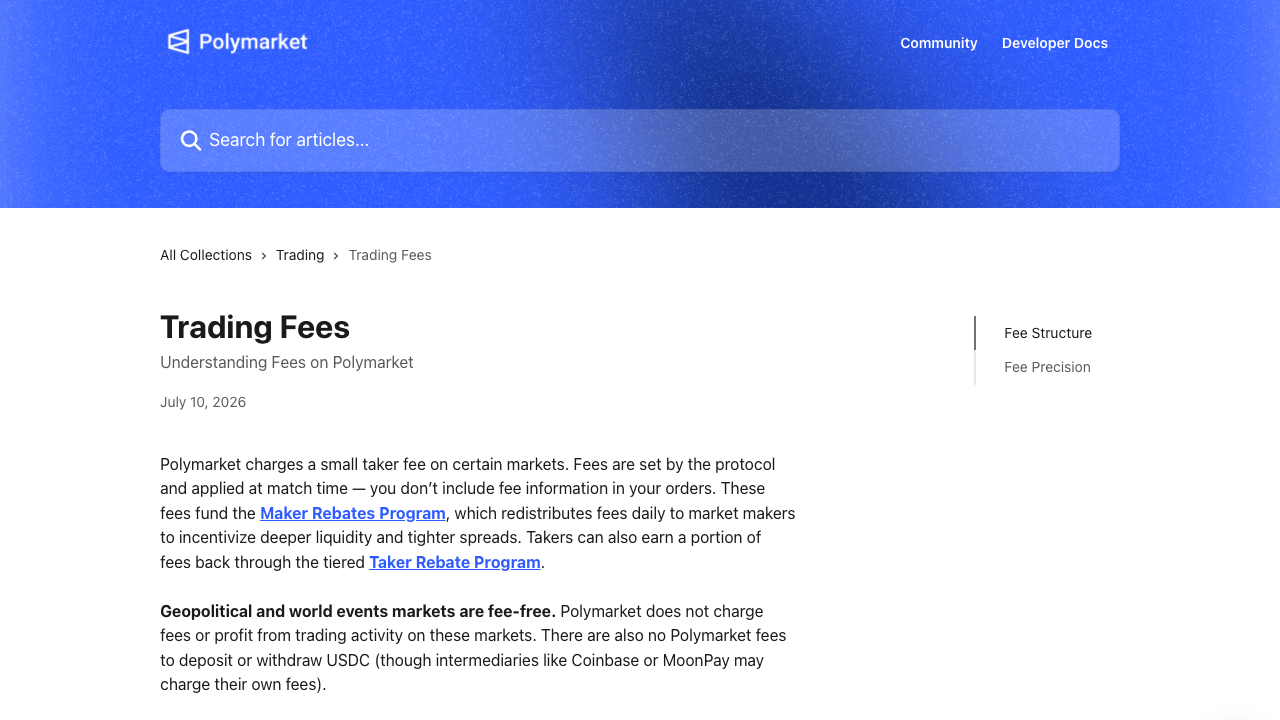
The last column is our own worked example from Polymarket's published rates, at the price where the fee peaks. Geopolitics is the outlier: Polymarket says it "does not charge fees or profit from trading activity" on geopolitical and world-events markets.
Polymarket US: one curve for most markets, plus a maker rebate
The US app's fee schedule uses Θ × C × p × (1 − p), with a taker Θ of 0.0695 and a maker Θ of −0.0125 — a negative fee, so a resting order that fills is paid. The published schedule is "Effective exchange-wide from 10 AM ET, Thursday October 1, 2026"; per 100 contracts on a standard market:
From 7 October 2026, Polymarket US says "The Table Tennis taker fee coefficient becomes 0.10" and "The maker rebate on combo trades is being removed. Straight trades are unchanged." Its table had not been updated by 9 October; on our calculation from the 0.10 coefficient, a 100-contract Table Tennis taker order at 50¢ costs $2.50.
Heavy traders get a slice back: a 10% taker rebate on $250,000–$999,999 of prior-month taker volume, 25% from $1,000,000 and 50% from $10,000,000.
Kalshi: $0.07–$1.75, with exceptions
Kalshi's fee schedule lists most markets at $0.07–$1.75 per 100 contracts in taker fees, with no changes scheduled. Combos also charge makers 50% of the taker fee ($0.04–$0.88), and some series carry maker fees of $0.02–$0.44; a few of the 157 series it lists individually are marked "no fees". Cancelling a resting order is free.
The comparison that matters
At the top of each curve, 100 contracts cost $1.75 on most Kalshi markets and $1.74 on a standard Polymarket US market, and between $0 and $1.75 on Polymarket.com depending on category. Polymarket US has two dearer corners: its combo curve peaks at $1.98 per 100, and Table Tennis reaches $2.50 at 50¢ on our calculation. If you post limit orders instead, Polymarket.com never charges you and Polymarket US pays you on straight trades; Kalshi charges makers only on combos and listed series.
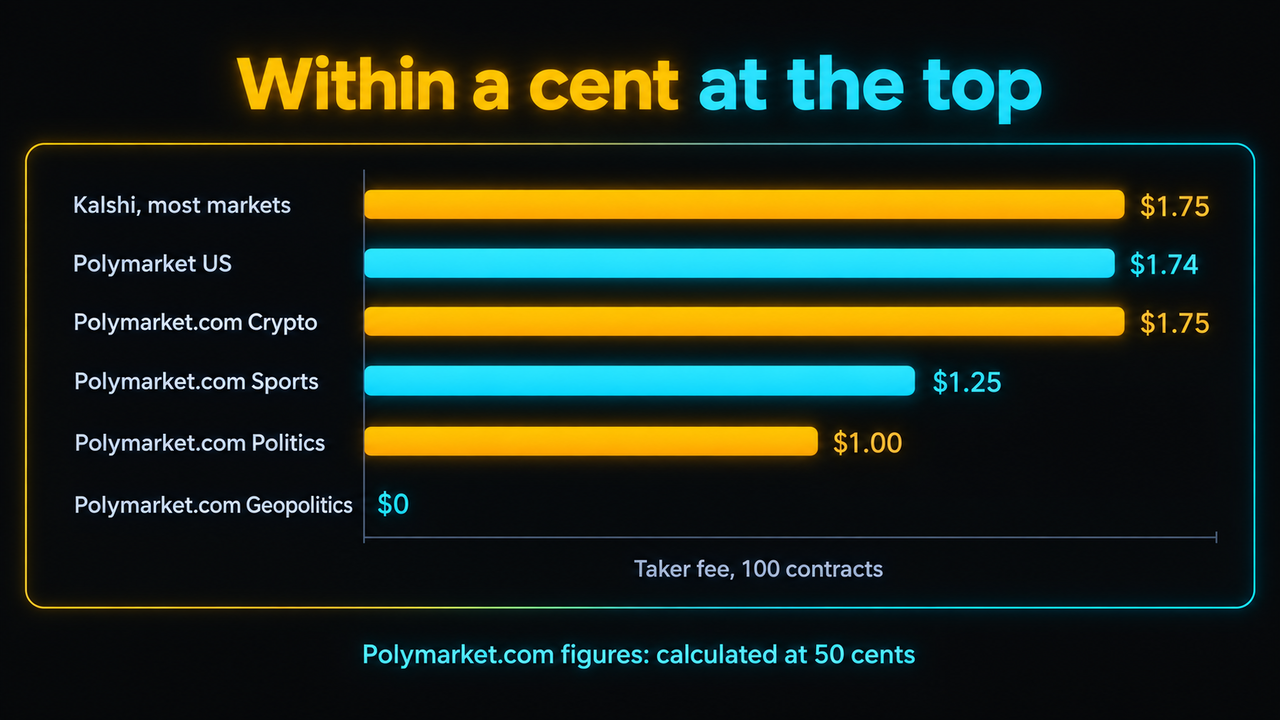
So fees no longer pick the winner. Access does.
Who can use Polymarket and Kalshi in 2026
Polymarket's website-vs-app page is plain about it: "Polymarket.com is for international users, while US residents must use the Polymarket US app." It adds that US users "cannot deposit funds or place trades on the website."
Outside the US, Polymarket.com restricts 39 countries completely, including the United Kingdom, France, Germany, Italy, the Netherlands, Ireland, Belgium, Poland, Australia, New Zealand, Japan, Singapore, Taiwan, Thailand and Brazil, alongside sanctioned states. It also blocks four Canadian provinces — Alberta, British Columbia, Ontario and Quebec — plus Crimea, Donetsk and Luhansk. Polymarket "strictly prohibits the use of VPNs or similar tools to bypass geographic restrictions" under section 2.1.4 of its terms.
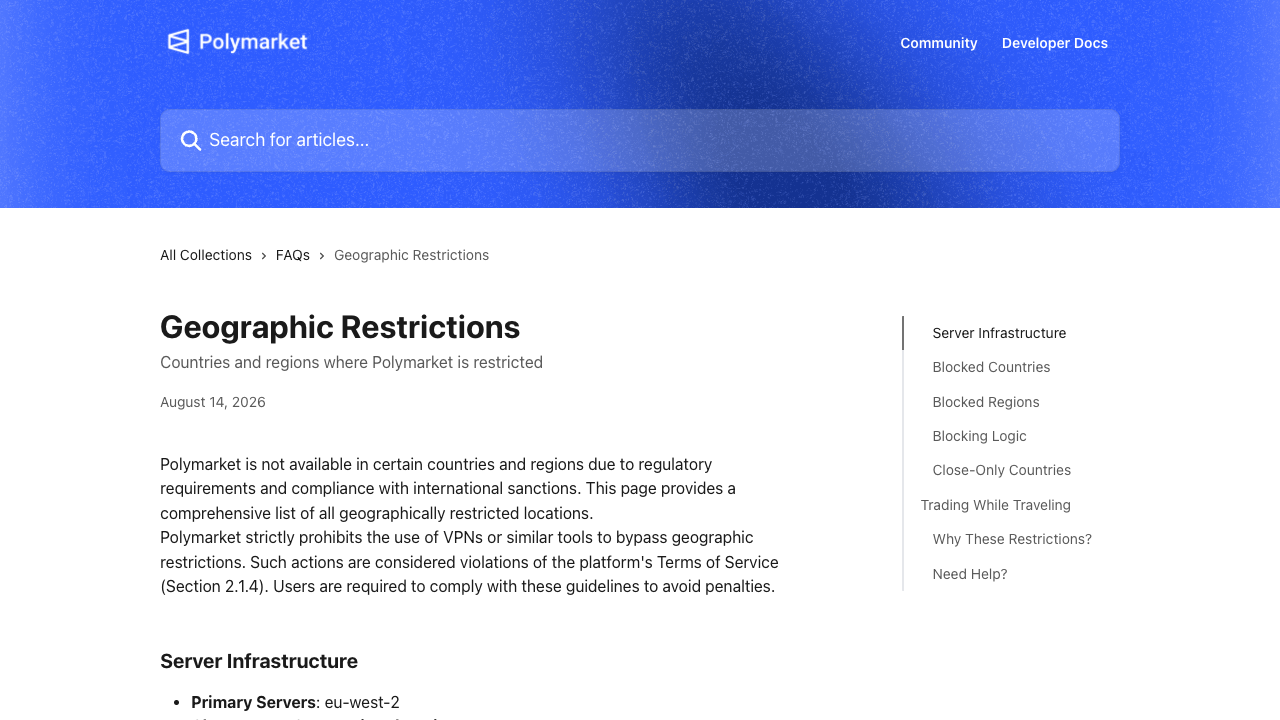
The Polymarket US app is the American route: iPhone now, Android "coming soon", and "entirely separate from Polymarket.com - accounts are not connected." Kalshi now says "Yes, you can trade on Kalshi from many countries", with eligibility "subject to the terms of the Kalshi Member Agreement". That Member Agreement bars anyone "domiciled in, organized in, or located in" its 55 Restricted Jurisdictions, the United Kingdom included, from trading event contracts.
The Kalshi column comes from that agreement, which I could not read on 1 October and read in full on 9 October 2026. An unlisted country is no guarantee: Kalshi reserves the right "to grant, deny, condition, suspend, or revoke membership or access to the Platform". UK readers should start with our Polymarket UK guide; for how differently platforms draw these lines, see our restricted-countries comparison.
Eligible for Polymarket.com?
Not on the list? This is where to sign up
If you are outside the US and your country and region are not on Polymarket's restricted list, Polymarket.com is open to you. Sign up with Google, an email code or a crypto wallet.
Open Polymarket.com →Not for US residents, who must use the Polymarket US app, and not for the 39 restricted countries.
Affiliate link — we earn a commission at no extra cost to you. 18+ only. Prediction-market trading can lose you money.
Deposits and withdrawals: crypto rails vs bank rails
This is the biggest practical difference. Kalshi and Polymarket US move dollars through cards and banks; Polymarket.com moves crypto.
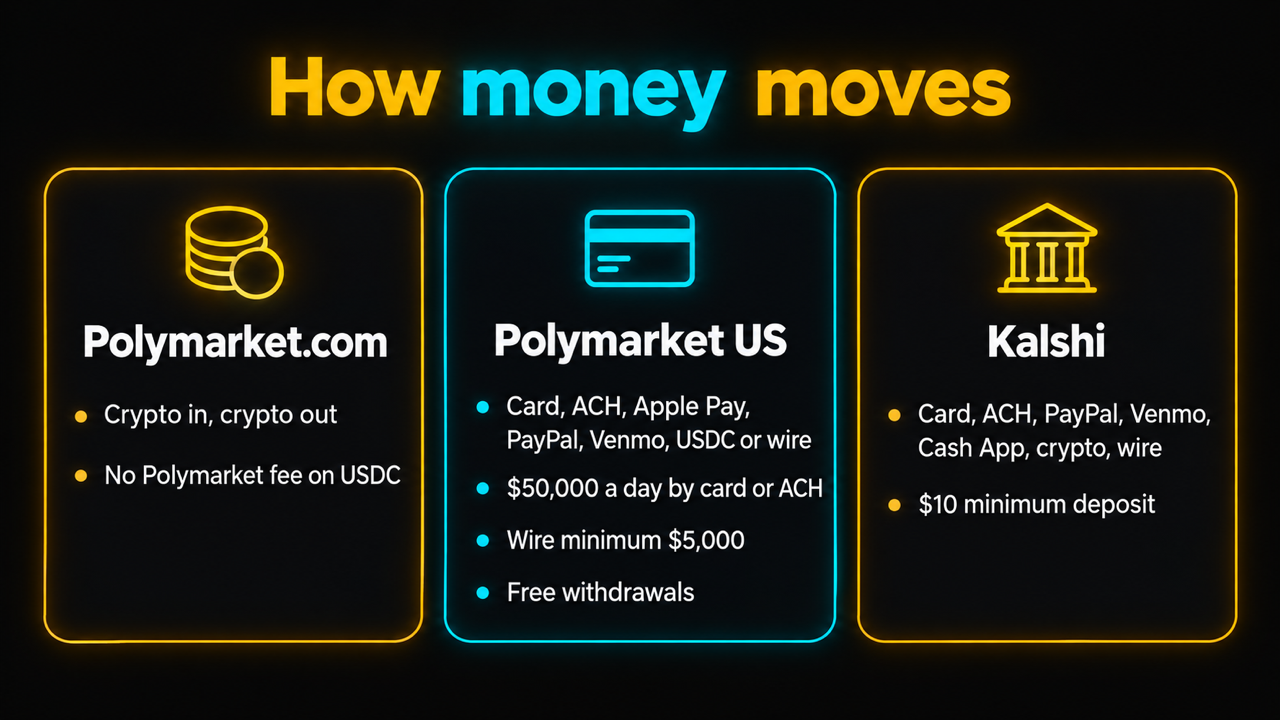
Polymarket.com works like a wallet, not a bank account. You deposit by sending crypto to an address tied to your profile and withdraw by entering a recipient address. Its help centre says the wallets are non-custodial, "meaning we never take possession of your USDC", and you can export your private key.
The flip side is that mistakes are yours to own. "Transactions sent to the wrong chain or address cannot be reversed", deposits below a network's minimum sit pending until they add up, and any intermediary you use — Polymarket names Coinbase and MoonPay — may charge its own fee. Network choice matters too: when we priced the same stablecoin deposit on seven networks, the most-recommended one came last by a factor of 100.
Kalshi's rails are more familiar, with one catch for international users: per its transfers FAQ, no ACH, PayPal, Venmo or Cash App outside the US, and withdrawals by debit card or crypto only.
Who settles the market: Kalshi decides, Polymarket lets anyone challenge
Settlement is a genuine difference in philosophy, and the part I would read twice before choosing.
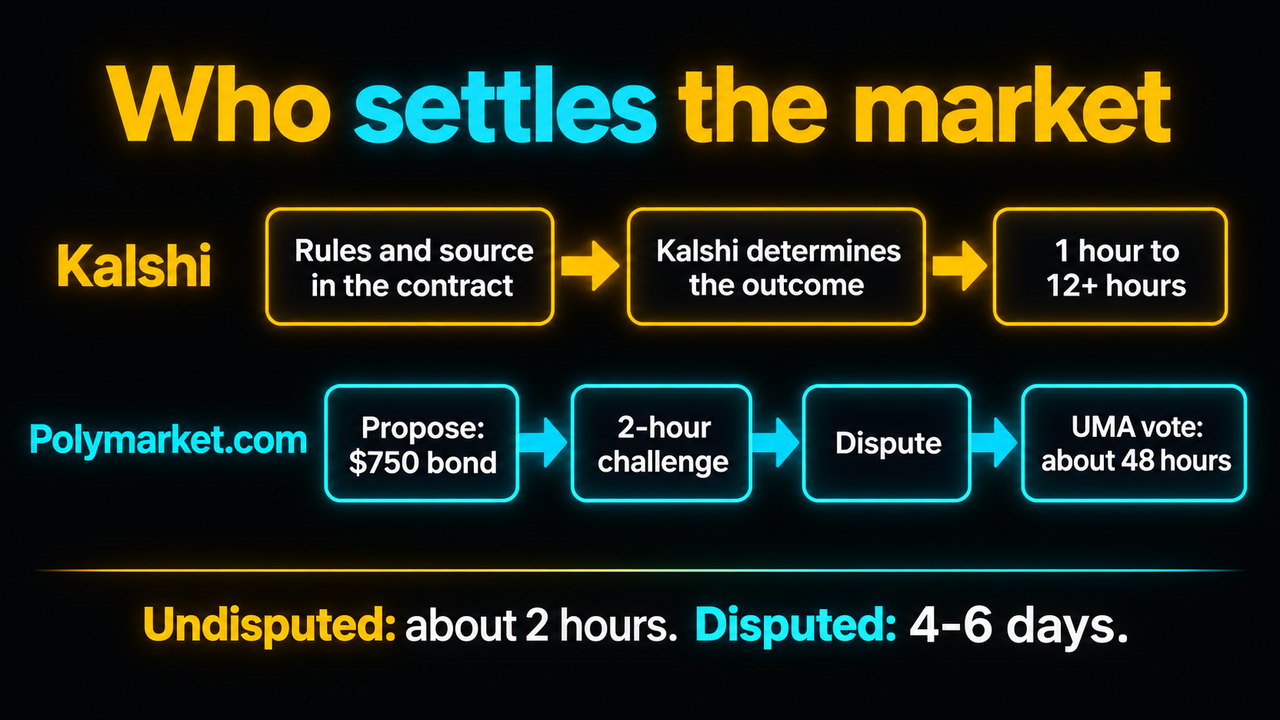
Kalshi decides. Each contract names its rules and source, and "Kalshi determines the market's outcome based on these rules and the information from the source." Determination takes "anywhere from one hour to more than twelve hours" after close, usually depending on when the source publishes. Polymarket US works the same way: the exchange confirms the result, and its resolution page says "Markets resolve using the specific sources listed in the rules." Resolutions are final under its rulebook.
Polymarket.com hands prediction markets to an open process. Its resolution docs say "Polymarket uses two Resolution Sources, UMA for prediction markets and Chainlink TWAP for up-down markets", the latter settling "without UMA's proposal-and-dispute process". Prediction markets use UMA's Optimistic Oracle: anyone can propose an outcome by posting a bond, "typically $750 pUSD", and anyone can dispute it during a 2-hour challenge period. A disputed proposal gets a second round; dispute that too and UMA token holders vote, which takes "approximately 48 hours" after a 24–48 hour debate period. A wrong or premature proposer loses the whole bond.
Read the rules, not the title
Polymarket's own docs put it best: "Always read the resolution rules before trading. The market title describes the question, but the rules define how it resolves." That holds on all three. It is also why holding YES on one platform and NO on the other is not a hedge you can rely on: each writes its own rules and names its own sources, so two markets that look identical can resolve differently or days apart — and you pay fees on both legs.
Which is better? Kalshi's model is simpler: one accountable decision-maker and no dispute rounds. Polymarket.com's prediction markets can stretch to 4–6 days when contested, and the final word belongs to token holders rather than a regulator — but every step is public. For messy real-world questions I would rather see the argument than take an answer on trust. That is a judgement, not a fact.
Markets covered: Kalshi is not just politics and macro any more
The old claim that Kalshi does macro but not crypto, or sports outrights only, is out of date. Kalshi's own navigation now runs Elections, Politics, Sports, Culture, Crypto, Commodities, Climate, Economics, Mentions, Finance and Tech & Science, and its fee schedule lists match-level series such as "ATP Tennis Match" and "Bundesliga Game" next to crypto series like "When will bitcoin hit 150k?".
The category lists now overlap almost completely. Where they differ is price: Polymarket.com is the only one of the three that zero-rates a whole category, and that category is geopolitics and world events.
What I removed
Earlier versions of this page compared trading volumes and bid-ask spreads. Neither platform publishes comparable figures on the pages used here, so those numbers are gone. Before any trade, look at the order book on that specific market: the spread and the size on offer tell you more about your real cost than any platform-wide volume figure.
Regulation and safety: CFTC oversight on two of the three
Kalshi is regulated by the CFTC "as a Designated Contract Market (DCM)". Polymarket US operates "as a designated contract market (DCM) and derivatives clearing organization (DCO) under CFTC oversight", with all trading in US dollars. Polymarket.com is, in Polymarket's words, "our international, crypto-based product that operates on blockchain technology".
That gives Polymarket.com different safeguards rather than none. Funds sit in a non-custodial wallet you control, as the deposits section above sets out, and prediction-market resolutions happen in public. What it lacks is a US regulator standing behind the venue, which matters more to some readers than to others.
Set your limits before you fund
Kalshi's help centre has pages for a Trading Break, Voluntary Self-Exclusion and a Personalized Funding Cap. Whichever platform you use, decide your limit before the first deposit, not after a losing week — and know that account-level tools have gaps, which our self-exclusion guide walks through.
Is Kalshi or Polymarket better? My verdict by where you live
With fees this close, the answer depends almost entirely on your address.
Outside the US and off the restricted list: Polymarket.com. It is the only one of the three that zero-rates a whole category, never charges makers, takes no Polymarket fee to move USDC in or out, leaves funds in a wallet you control, and settles prediction markets in public. The costs are real: you must send crypto on the right network, and a contested market can take 4–6 days to settle. If your country is also off Kalshi's Restricted Jurisdictions list, Kalshi may accept you — worth a look if you would rather fund by card or wire.
In the US: Polymarket US or Kalshi. Both are CFTC-regulated and on most markets their top taker fees differ by one cent. Kalshi adds Cash App and Google Pay; Polymarket US pays makers a rebate on straight trades. Our affiliate link goes to Polymarket.com, which you cannot use.
In the UK or another restricted country: Polymarket is not available to you, on the website or the app. Kalshi is no alternative for UK residents either: its Member Agreement makes the United Kingdom a Restricted Jurisdiction. Elsewhere, check both lists, and see our Polymarket hub for the rest of our coverage.
Ready to choose
Polymarket.com for international readers
Fee-free geopolitics, no maker fees and no Polymarket fee to deposit or withdraw USDC. Read the resolution rules on any market before you trade, and only stake what you can afford to lose.
Visit Polymarket.com →For users outside the United States and Polymarket's other restricted countries. US residents: use the Polymarket US app; this link is not for you.
Affiliate link — we earn a commission at no extra cost to you. 18+ only. Prediction-market trading can lose you money.
Related guides
Polymarket guide hub
Every Polymarket guide we publish, in one place.
How Polymarket works
YES/NO shares, prices as probabilities, and placing a trade.
Polymarket in the UK
Why it is restricted and what UK readers can use instead.
Cheapest crypto network
The same deposit priced on seven networks.
Restricted countries
How six operators draw their country lists.
Self-exclusion that holds
What account-level limits do, and what they miss.
Kalshi vs Polymarket FAQ
Is Kalshi or Polymarket better?
It depends on where you live more than on fees. Outside the US and Polymarket's other restricted countries, Polymarket.com is our pick: geopolitics is fee-free, makers never pay and prediction-market settlement is public. In the US the choice is Polymarket US or Kalshi, both CFTC-regulated, with top taker fees on most markets of $1.74 and $1.75 per 100 contracts.
Which is cheaper, Kalshi or Polymarket?
On most markets they are within a cent at the top of each fee curve: $0.07 to $1.75 per 100 contracts on most Kalshi markets, $0.07 to $1.74 on most Polymarket US markets. Polymarket.com depends on category; in our worked example, 100 shares at 50 cents cost $1.75 in fees on Crypto, $1.00 on Politics and nothing on Geopolitics.
Can US residents use Polymarket?
Only through the Polymarket US app, a separate CFTC-regulated product on iPhone, with Android listed as coming soon. US residents cannot deposit or trade on Polymarket.com, and the two products' accounts are not connected.
Can I use Kalshi outside the United States?
Kalshi says you can trade from many countries, subject to its Member Agreement, which bars trading from 55 Restricted Jurisdictions, including the UK, Canada, France and Australia. Accepted international users can deposit by Visa or Mastercard debit card, crypto or wire (minimum $1,000) and withdraw by debit card or crypto.
Is Polymarket available in the UK?
No. The United Kingdom is one of 39 countries Polymarket lists as completely restricted, and the US app is for US residents only. Polymarket prohibits using a VPN to bypass its geographic restrictions. Kalshi is not an option either: its Member Agreement lists the United Kingdom as a Restricted Jurisdiction for trading event contracts.
Who decides the outcome on Kalshi and Polymarket?
Kalshi determines outcomes itself from the source named in each contract, and the Polymarket US exchange does the same. Polymarket.com uses UMA's Optimistic Oracle for prediction markets: anyone can propose a result with a bond, anyone can dispute it, and a twice-disputed market goes to a UMA token-holder vote. Its up-down markets settle on a Chainlink price instead, with no dispute round.
Does Polymarket charge deposit or withdrawal fees?
Polymarket.com charges no Polymarket fee to deposit or withdraw USDC, though intermediaries such as Coinbase or MoonPay may charge their own. Polymarket US describes its withdrawals as free, and its wire deposits have a $5,000 minimum. Kalshi's minimum deposit is $10, or $1,000 by wire.
Can I buy YES on one platform and NO on the other?
You can hold both, but it is not a locked-in result. Each platform writes its own rules and names its own sources, so markets that look identical can resolve differently or days apart, and you pay fees on both legs.
18+ only. Prediction-market trading carries financial risk and can become a problem — see BeGambleAware.org, or in the US the National Council on Problem Gambling. Sources read on 1 October 2026 and re-checked on 9 October 2026: Polymarket's help centre on trading fees, website vs app, geographic restrictions, sign-up, deposits and custody; Polymarket's resolution docs; Polymarket US docs on fees, regulation, deposits, withdrawals and resolution; Kalshi's fee schedule and help centre on fees, international access, regulation, transfers and market outcomes; and the Kalshi Member Agreement. The fee-at-50¢ column for Polymarket.com is our own worked example from Polymarket's published rates. Fees, country lists and rules change without notice — check each platform's page before you trade. Affiliate links earn us a commission at no cost to you.