Crypto Casino Deposit Fees 2026: The Cheapest Network
We priced the same crypto casino deposit on seven networks in September 2026. TRC-20 USDT, the one everyone recommends, came last by a factor of 100.
Affiliate disclosure: This page contains affiliate links. We may earn a commission at no extra cost to you. 18+ only. Gamble responsibly — see BeGambleAware.org. Last updated 7 September 2026. Every fee below was read from live network data on that date; the method for each is stated in the table.
Key takeaways
- TRC-20 USDT is the most expensive routine way to fund an account right now — 6.5 to 13.5 TRX of burnt energy, or $2.17 to $4.52, per transfer.
- The same USDT on Ethereum cost $0.017 on 7 September 2026, because the base fee was 0.10 gwei. That is roughly 130 times cheaper than TRON.
- Bitcoin was 11 cents with the mempool empty at 1 sat/vB — and would be $11.15 at the 100 sat/vB rates seen during past fee spikes.
- On a $20 deposit the network choice swings you from 0.003% to 22.6% of your money. On a $200 deposit almost nothing matters. Deposit size decides the network, not brand loyalty.
On this page
Every guide to crypto casino deposit fees tells you the same thing: send USDT on TRON, because TRC-20 is the cheap network. That advice was correct for years. On 7 September 2026 we priced it against six alternatives and it finished last — by a margin large enough to matter on any deposit under about $100.
The stakes are small per transaction and enormous in aggregate. A player funding an account twice a month on the wrong network burns roughly $100 a year in fees that buy nothing. At the small-stakes end it is worse: a $20 deposit on TRON can lose 22.6% of itself before a single spin, which is more than the house edge on almost every game you would then play.
So we stopped reading roundups and read the chains instead. Bitcoin fee rates came from mempool.space, Ethereum's base fee from a public JSON-RPC node, and TRON's energy price from the network's own chain parameters. Prices are CoinGecko spot at the moment of the reading.
Every figure below is a snapshot of one day, and we say so on every row. Network fees are not a property of a coin — they are a property of a moment. That is the whole point of the article.

What a deposit actually costs today
This is one transfer, sent from your own wallet to a casino deposit address, priced on 7 September 2026. Bitcoin was at block 965,962 and Ethereum at block 25,927,311 when we read them.
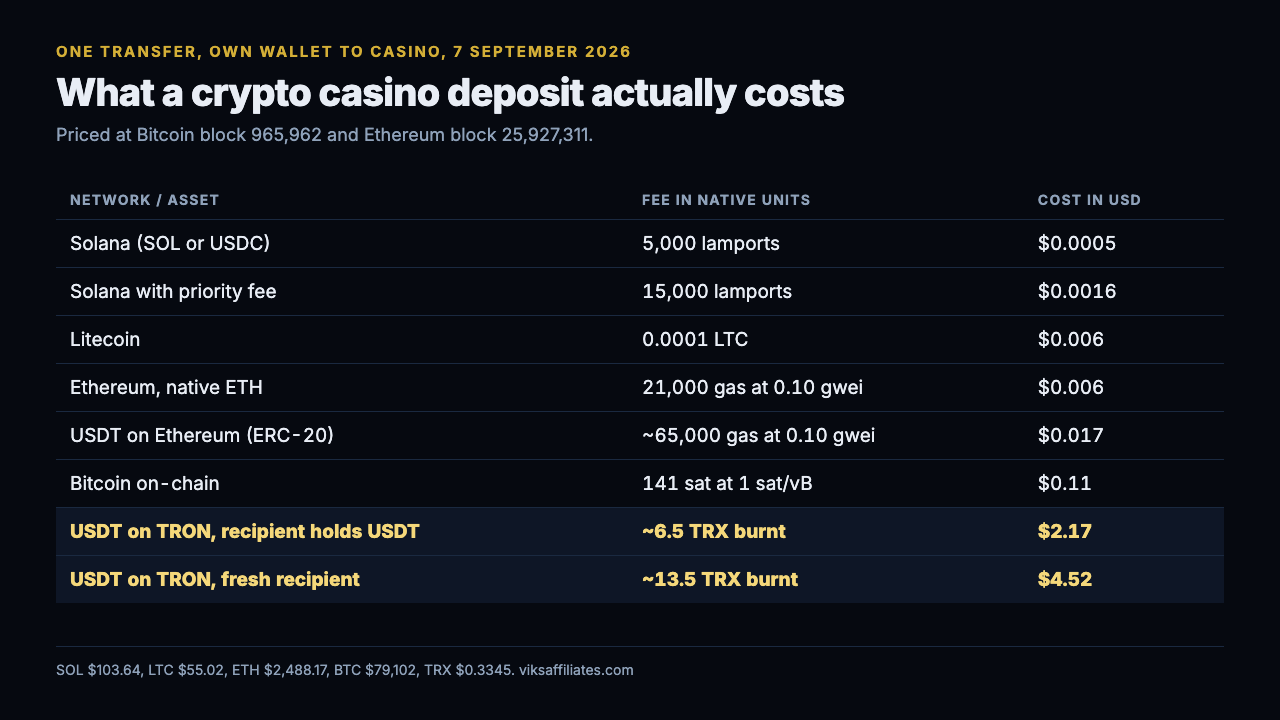 The ordering is the story. Two years of forum wisdom put TRON at the top of this table and Ethereum at the bottom; today they have swapped ends. Nothing dramatic happened to TRON — Ethereum simply got cheap and stayed cheap, while TRON's energy price stayed where it was.
The TRC-20 trap, and the one case where it does not apply
TRON does not charge a gas price the way Ethereum does. It charges energy, and you either own energy (by freezing TRX) or you burn TRX to buy it at the moment you transact. The network's own chain parameters set that burn rate, and on 7 September 2026 the value of getEnergyFee was 100 sun per unit of energy — 0.0001 TRX each.
A USDT transfer consumes roughly 65,000 units of energy when the receiving address already holds USDT, and roughly double that when it does not. Multiply it out and you get 6.5 to 13.5 TRX, which at $0.3345 is $2.17 to $4.52. The mechanics are documented in TRON's own resource model.
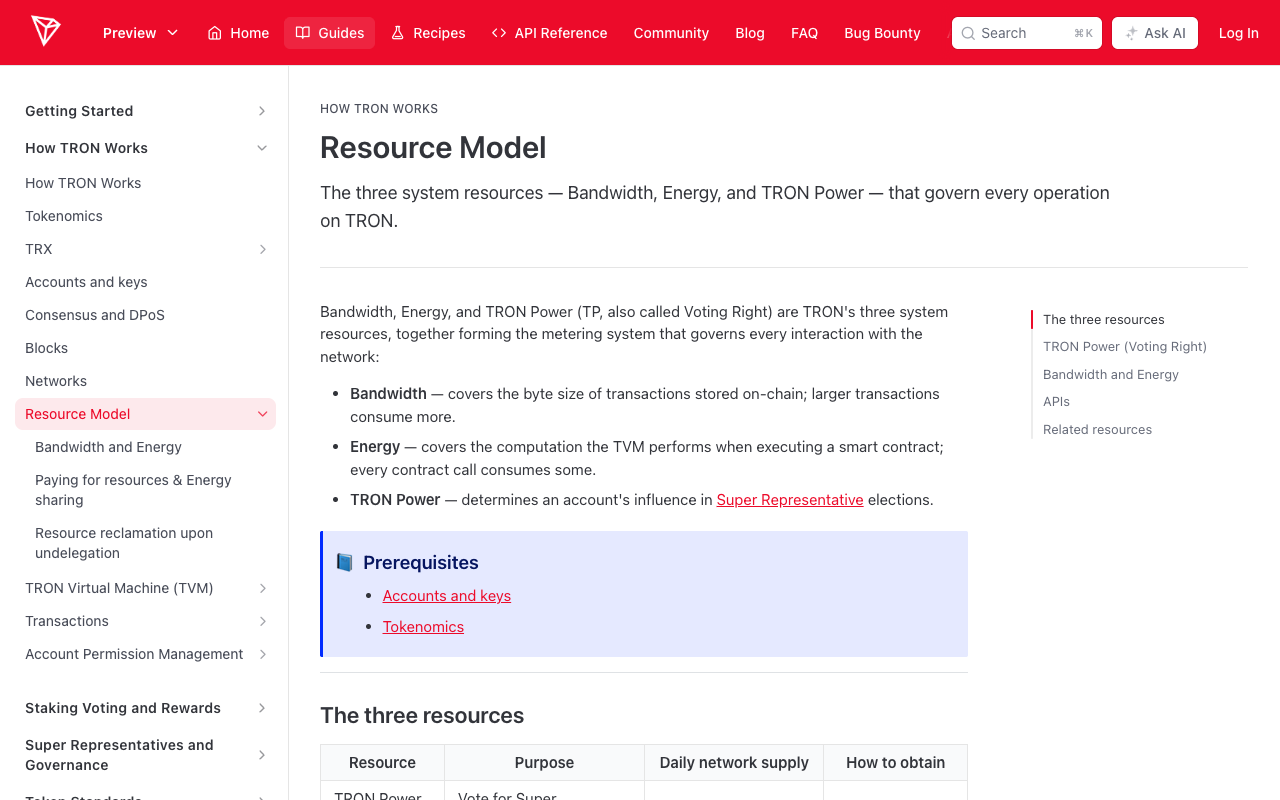 Casino deposit addresses are busy addresses, so you will usually land on the cheaper 65,000 figure rather than the fresh-address one. That is still $2.17 to move money you already own.
The exception worth knowing. If you send USDT from an exchange rather than from your own wallet, you do not pay energy at all — you pay the exchange's flat withdrawal fee, which on TRON is often around 1 USDT and sometimes zero on promotion. The exchange has frozen TRX at scale and absorbs the energy internally. So "TRON is cheap" survives as advice for exchange withdrawals, and fails for self-custody wallets. Most guides never make that distinction.
If you hold your own keys and want the TRON route back, freezing roughly 5,000 TRX covers a transfer a day and drops the marginal cost to zero. That is around $1,670 of capital locked up to save $2 a go, which only makes sense if you are transacting daily.
Bitcoin: cheap today, unpredictable by design
Bitcoin was the second-cheapest option in our snapshot, which surprises people who last checked during a fee spike. The mempool was empty: every tier on mempool.space, from economy to fastest, quoted 1 sat/vB. A standard one-input, two-output segwit transaction is about 141 virtual bytes, so 141 satoshis, so 11 cents.
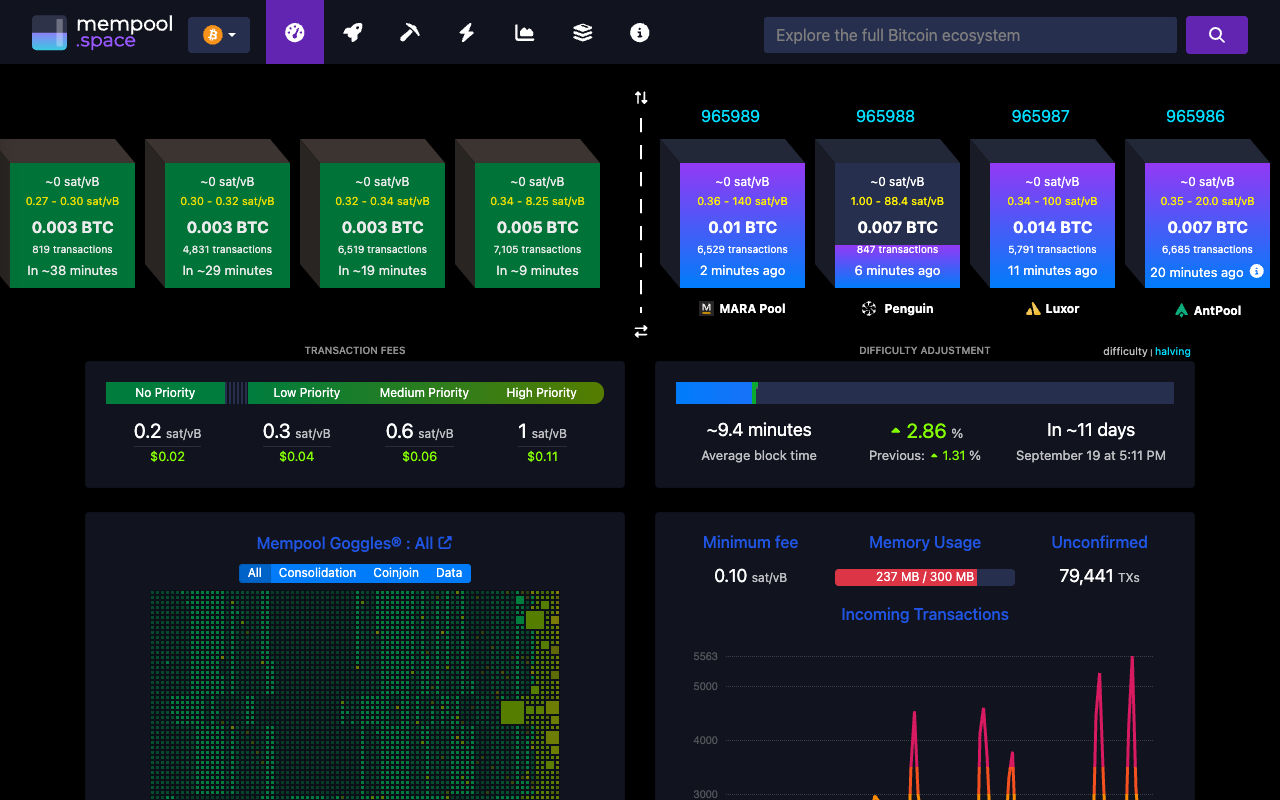 That number is not stable, and you should plan for it not being stable. Here is the same transaction at fee rates the network has genuinely traded at:
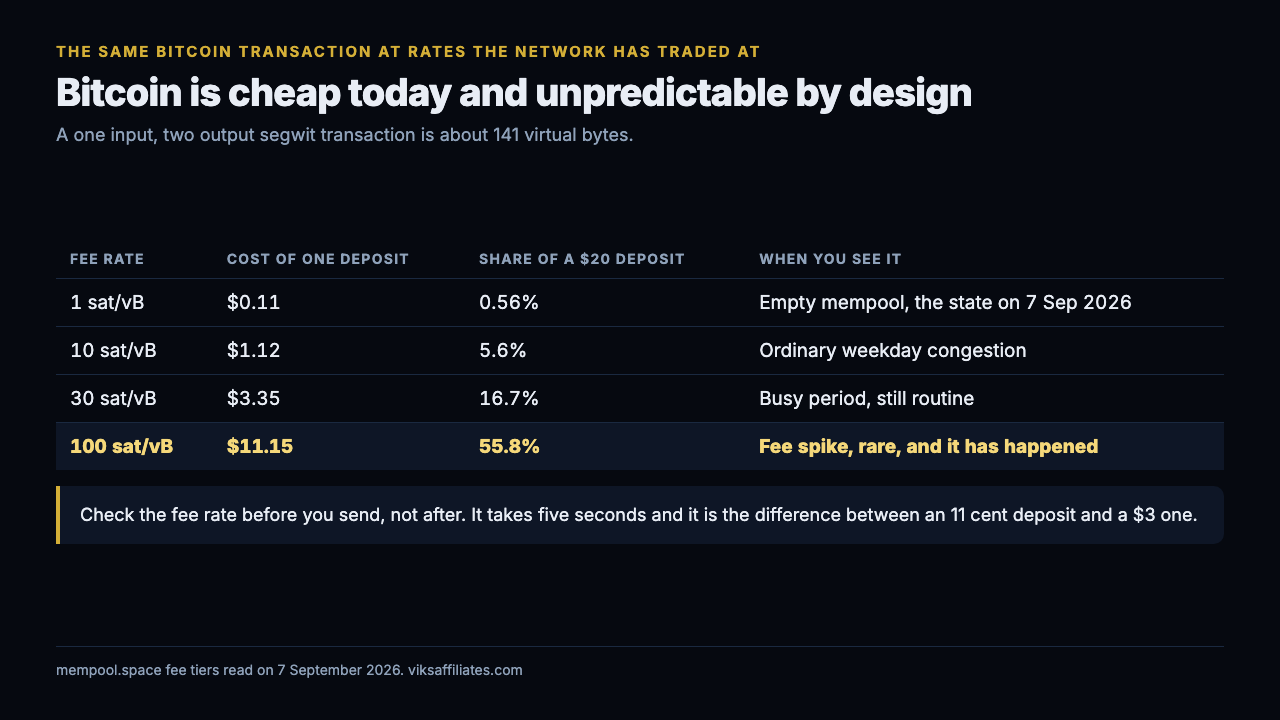
The practical rule: check the fee rate before you send, not after. It takes five seconds and it is the difference between an 11-cent deposit and a $3 one. If the mempool is congested and your deposit is small, use a different network that day — or use Lightning, which sidesteps on-chain fees entirely and is covered in our guide to Bitcoin Lightning casino sites.
One dollar, four different prices
This is where most players lose money without noticing, because a stablecoin balance looks identical whichever chain it arrived on. Your casino credits 100 USDT the same way regardless. The cost of getting it there varies by more than two orders of magnitude.
Two lessons sit in that table. The first is that Ethereum's cost is a variable, not a constant — the 0.10 gwei reading that made ERC-20 nearly free is a feature of a quiet day, and at 10 gwei the same transfer costs $1.62. Ethereum's gas documentation explains why the base fee moves with demand.
The second is that Solana is the only row that is cheap regardless of conditions, because its base fee is fixed per signature rather than auctioned. Its details are in the official Solana fee documentation. If your casino accepts it, that is the default answer — and most now do, as our roundup of Solana casino sites shows.
The $20 deposit test
Percentages make the argument better than dollars do. Here is every route as a share of the money you are actually moving, at two deposit sizes.
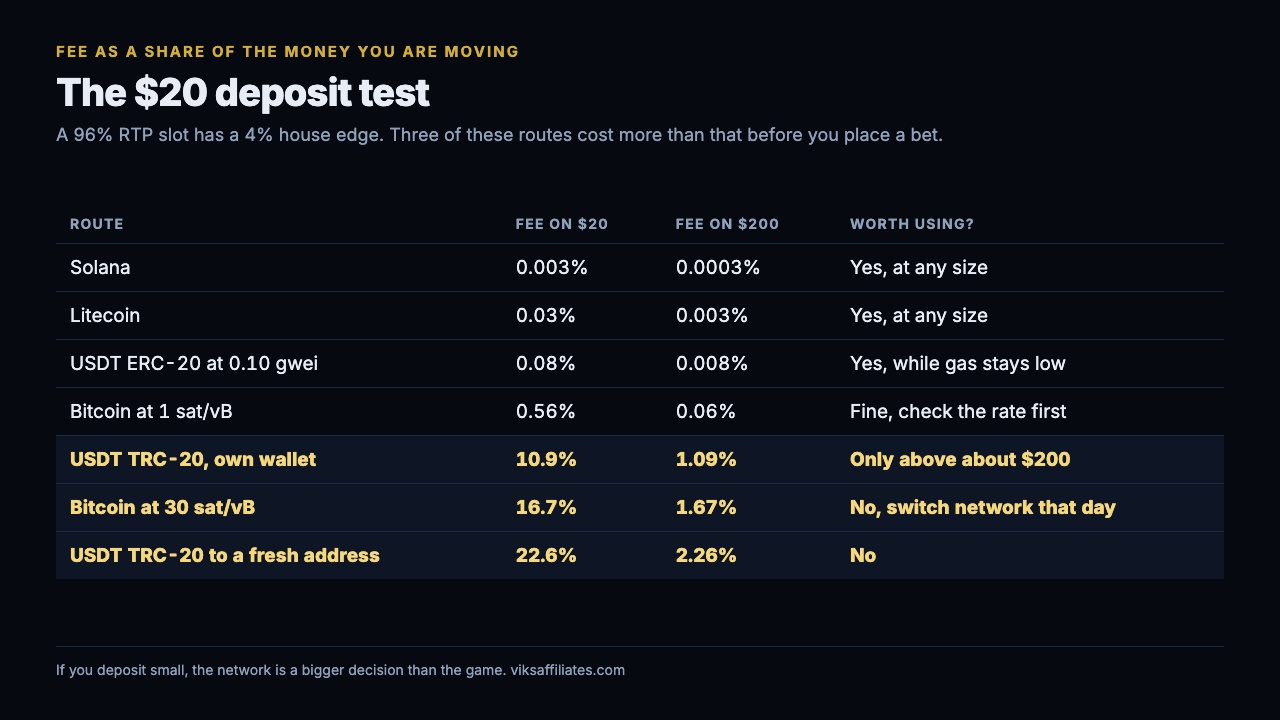 Put that next to the game you are about to play. A 96% RTP slot has a 4% house edge, so a 10.9% deposit fee has already cost you more than two and a half times the edge you are volunteering to face. If you deposit small, the network is a bigger decision than the game.
Small-stakes players get hit hardest by all of this, which is why we keep a separate guide to the best crypto casinos for small stakes — low minimums are worth little if the rail into the account eats a fifth of the deposit.
What the casino adds on top
Good news, mostly: the major crypto operators do not charge a deposit fee of their own. What they do impose is a minimum, and it is set per coin and per network rather than per account.
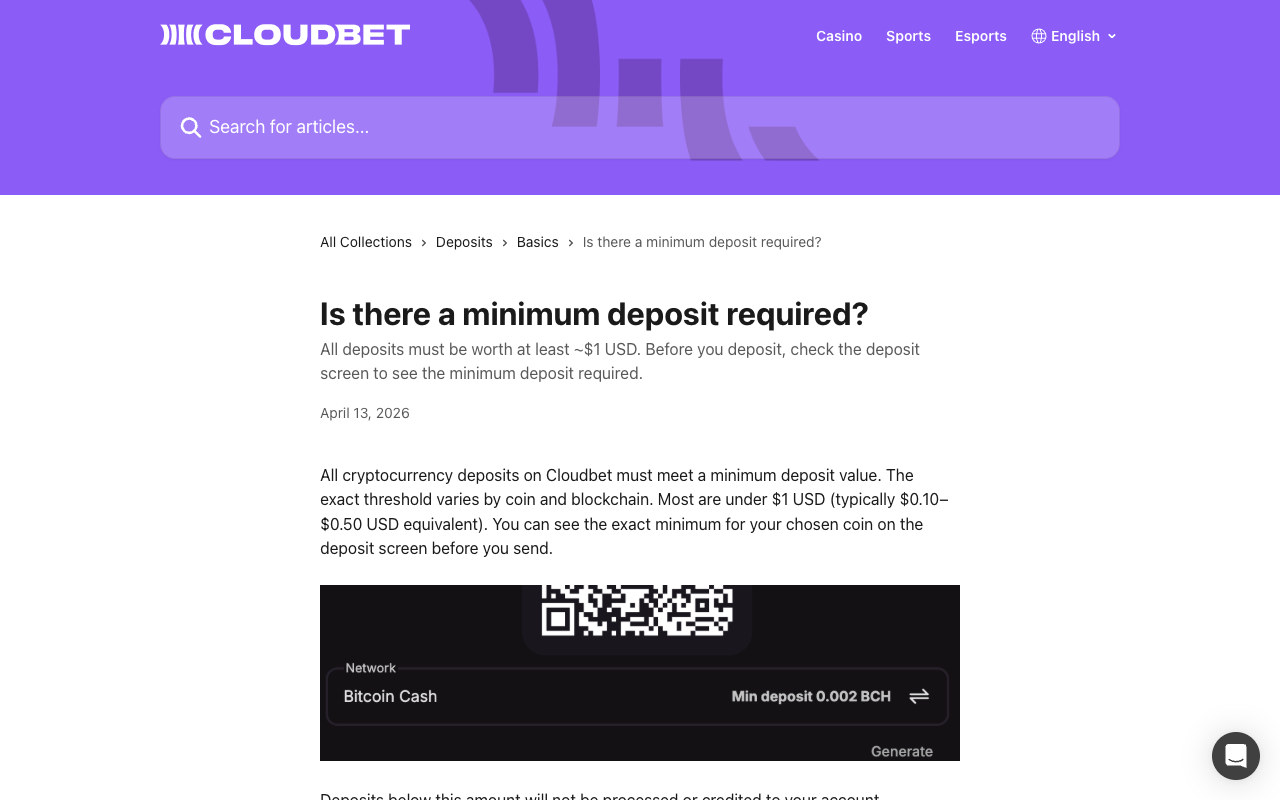
Cloudbet states in its help centre that all deposits must be worth at least about $1, that most coin minimums fall between $0.10 and $0.50 equivalent, and that the exact figure for your coin appears on the deposit screen before you send. Its guidance is blunt on the important part: from the network list, select the correct network and check the minimum. That is published on its minimum deposit page.
 What we could not verify, and will not invent. Confirmation requirements — how many blocks a casino waits before crediting you, and before letting you withdraw — are almost never published. Cloudbet's own article on confirmations describes the concept without committing to numbers. Treat any table of "confirmations required" you find elsewhere as unsourced unless the operator publishes it. If it matters to you, ask support in writing before you deposit.
The withdrawal side is where operators do sometimes charge, and the amounts are set in coin rather than as a percentage — which flips the maths for small withdrawals. We cover the operators that pay out fastest and cheapest in our guide to instant withdrawal Bitcoin casinos.
The mistake that costs 100%
Every fee in this article is rounding error next to sending USDT on the wrong chain. The token exists on Ethereum, TRON, Solana, BNB Chain and several more, and the deposit address you were given is valid on exactly one of them.
Send ERC-20 USDT to a TRC-20 deposit address and the money is not lost in the blockchain sense — it sits at an address the casino controls on a chain it was not watching. Recovery then depends entirely on whether that operator holds the key for that address and is willing to do a manual credit. Some will, for a fee and a wait. Some cannot. None of them owe you it.
Three habits remove the risk almost entirely:
- Copy the address from the deposit screen every time, after choosing the network on that same screen. Never reuse a saved address from last month — operators rotate them.
- Send a test amount first on any new casino or any new network. On Solana or Litecoin the test costs less than a cent, which makes it free insurance.
- Match the network name exactly. "USDT" is not a network. TRC-20, ERC-20, SPL and BEP-20 are, and the deposit screen names the one it expects.
Picking a network in ten seconds
Reduced to a decision you can make at the cashier without opening a spreadsheet:
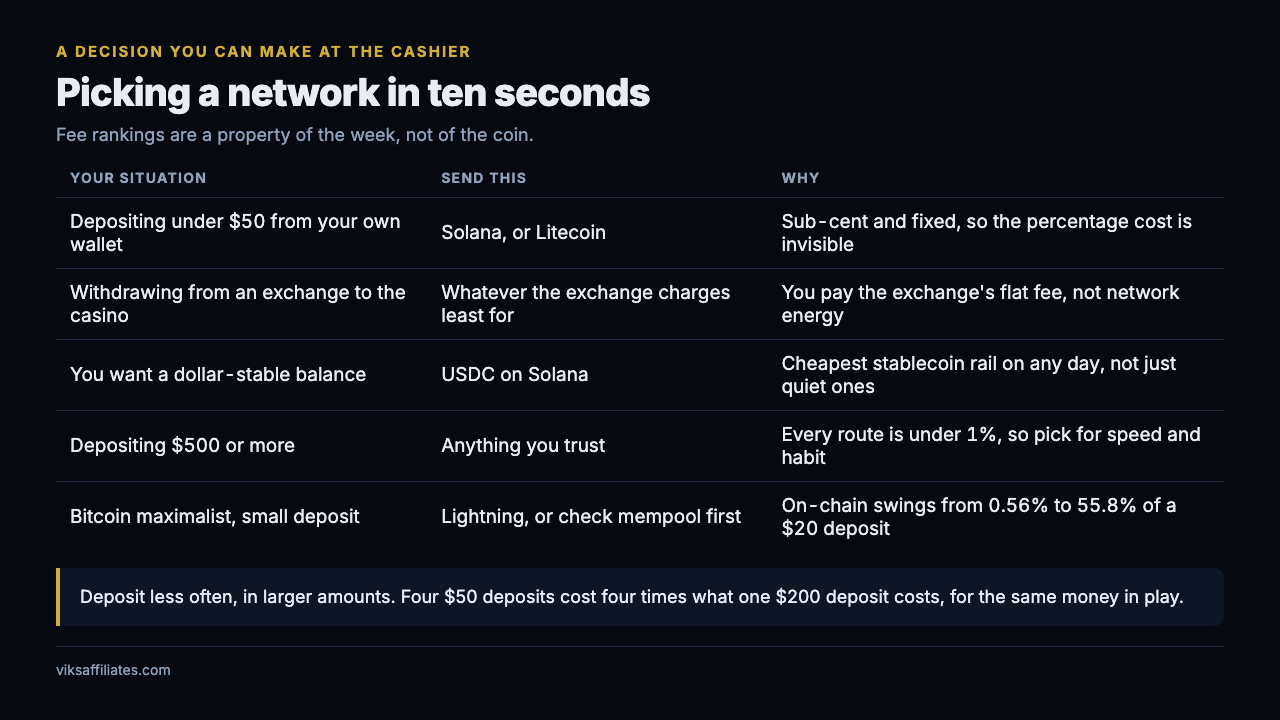 One more habit worth building: deposit less often, in larger amounts. Fees here are per transaction and mostly flat, so four $50 deposits cost four times what one $200 deposit costs, for the same money in play. That single change saves more than any network choice on this page.
Frequently asked questions
What is the cheapest network for a crypto casino deposit in 2026?
Solana, on the figures we read on 7 September 2026. Its base fee is 5,000 lamports per signature, about $0.0005, and unlike auction-priced chains it does not move much with demand. Litecoin is the next cheapest at roughly $0.006 per transfer.
Is TRC-20 USDT still the cheap option for casino deposits?
Not from a self-custody wallet. A TRC-20 USDT transfer burns roughly 6.5 to 13.5 TRX of energy, which was $2.17 to $4.52 on 7 September 2026. It stays cheap when you withdraw from an exchange, because the exchange charges a flat fee of around 1 USDT and absorbs the energy cost itself.
Do crypto casinos charge their own deposit fee?
The major operators generally do not charge to deposit. What they set is a minimum per coin and per network. Cloudbet, for example, states that deposits must be worth at least about one dollar, with most coin minimums between $0.10 and $0.50, shown on the deposit screen before you send.
Why did my Bitcoin deposit fee change so much between two deposits?
Bitcoin fees are an auction for block space, priced in satoshis per virtual byte. The same deposit costs $0.11 at 1 sat/vB and $11.15 at 100 sat/vB. Check the current rate on a mempool explorer before you send, and pick another network on a congested day.
How many confirmations does a crypto casino need before crediting a deposit?
Very few operators publish this, so we will not quote numbers we cannot source. It varies by coin and by operator, and it is often different for crediting your balance and for releasing a withdrawal. Ask support in writing if the answer matters to your bankroll.
What happens if I send USDT on the wrong network?
The funds land at an address on a chain the casino was not monitoring. Recovery depends on whether the operator controls the key on that chain and will do a manual credit, usually for a fee and a delay. Some can, some cannot, and none guarantee it. Send a small test transaction first.
Does the deposit network affect how fast I can withdraw?
Indirectly. Faster-settling chains such as Solana and TRON credit in seconds, while Bitcoin waits for blocks, so a congested mempool delays the start of your session rather than the payout. Withdrawal speed is set mostly by the operator's own processing and verification policy.
The verdict
The received wisdom about crypto casino deposit fees is a few years out of date. TRON is no longer the cheap chain for anyone holding their own keys, Ethereum has quietly become one of the cheapest, and Solana is the only rail that is cheap on a bad day as well as a good one.
None of that is permanent, which is the actual lesson. Fee rankings are a property of the week, not of the coin, and any article that gives you a fixed answer without a date on it is guessing. Ours has a date on every figure: 7 September 2026.
Do two things and you have captured most of the available saving. Check the current fee rate on the chain you are about to use, and deposit less often in larger amounts. Everything else on this page is refinement.
Check the minimum before you send
Deposit on a casino that publishes its rules
Cloudbet is one of the few operators that puts its deposit minimums and network list in a public help centre rather than behind a login. Multi-network support means you can pick the cheap rail on the day instead of the one the cashier defaults to.
Visit Cloudbet →Related guides
Best USDT casinos
Which operators accept Tether on more than one network.
Solana casino sites
The cheapest deposit rail in this article, and who takes it.
Litecoin casinos
The quiet second-cheapest option, and long the sensible default.
Lightning casinos
How to keep Bitcoin deposits cheap when the mempool is not.
Fast withdrawal casinos
The other half of the round trip, timed rather than promised.
Cloudbet review
The operator whose deposit rules we could actually read.
18+ only. Gambling can be addictive — see BeGambleAware.org. Network fees quoted are a snapshot of 7 September 2026 and will have moved by the time you read this; check the current rate before you send. Affiliate links earn us a commission at no cost to you.