Crypto Casino Self-Exclusion 2026: What Actually Holds
Crypto casino self-exclusion locks one account, and a no-KYC account takes a minute to remake. We read six operators own rules on 11 September 2026.
Affiliate disclosure: This page contains affiliate links. We may earn a commission at no extra cost to you. 18+ only. Gamble responsibly — see BeGambleAware.org. Last updated 11 September 2026. Every rule below was read from the operator's own help centre or the regulator's own policy document on that date, and is quoted rather than summarised.

Key takeaways
- Every tool on this page binds an account, not a person. At a casino that never asked for your ID, a new account costs one email address, so an operator exclusion is a speed bump measured in minutes.
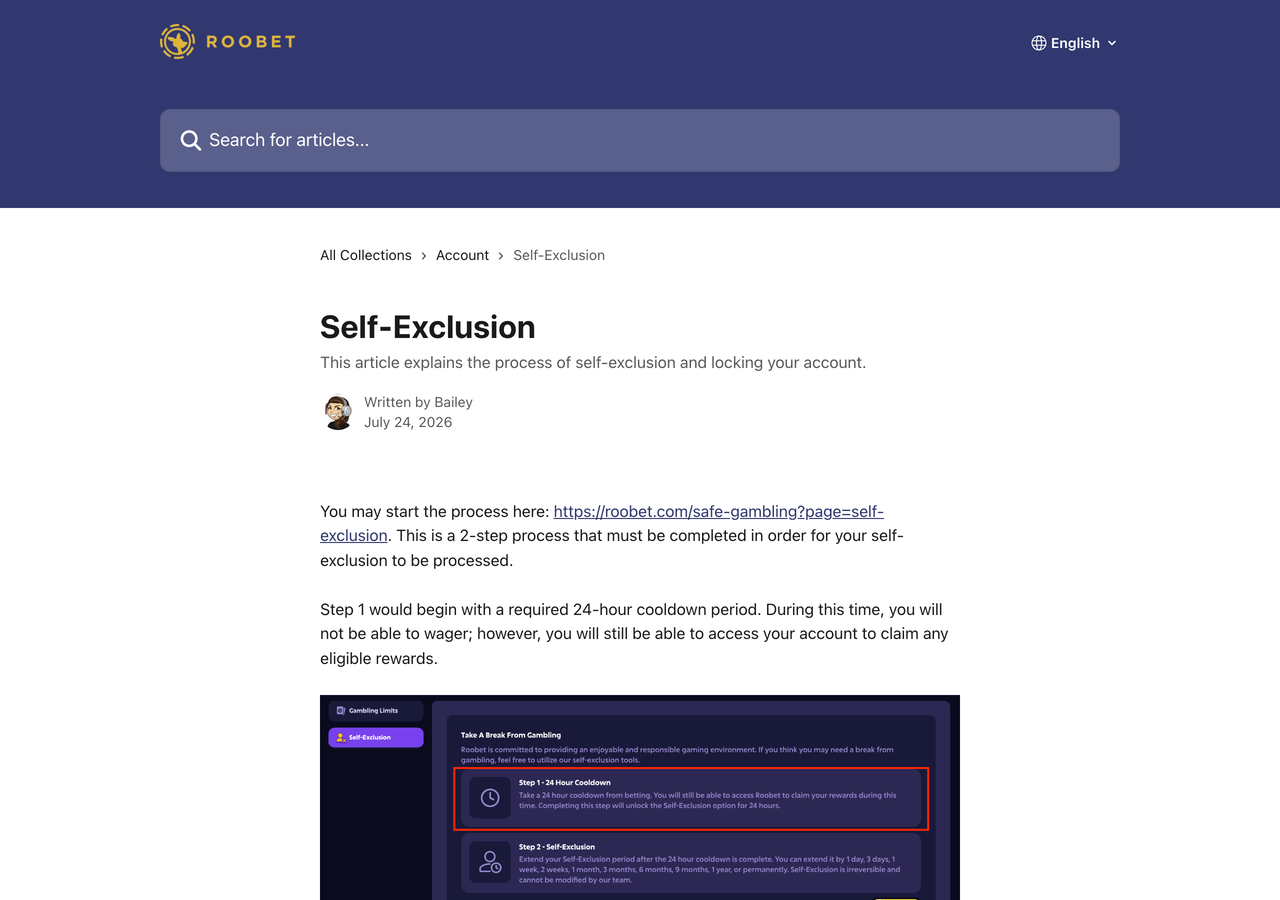
- Roobet makes you wait 24 hours before you can self-exclude, and during that wait its help centre says you can still log in "to claim any eligible rewards". Stake and Cloudbet apply their restrictions instantly and put the 24-hour delay on loosening one instead.
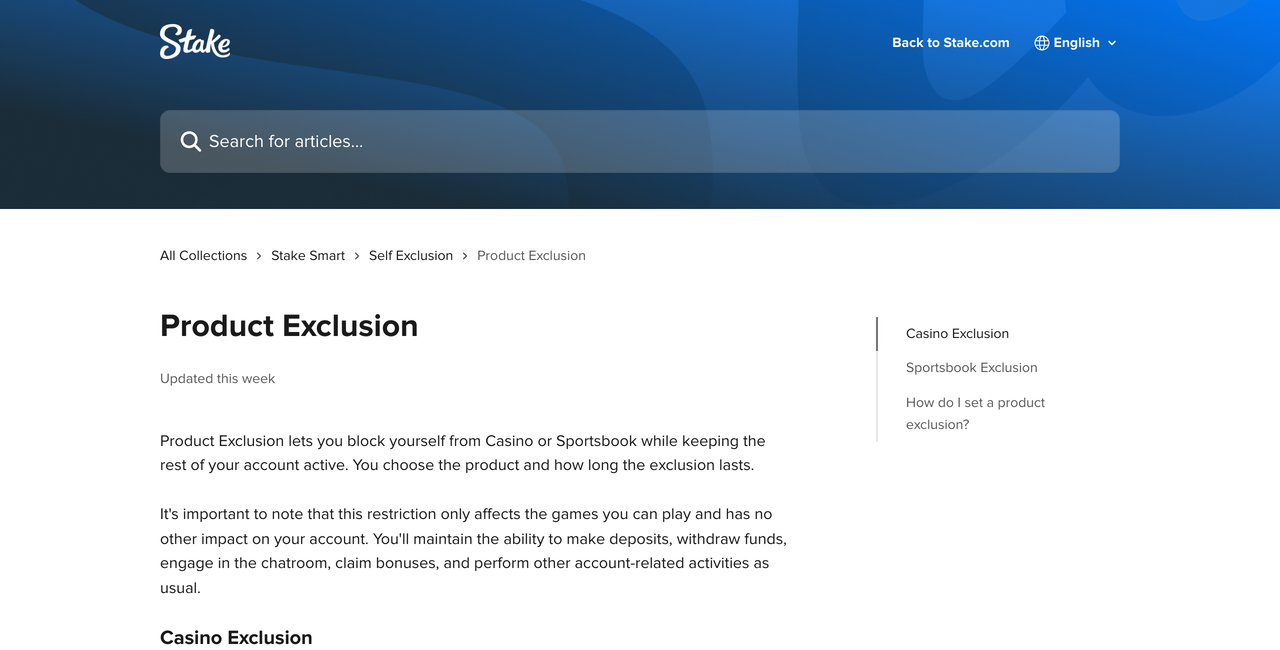
- Stake's Product Exclusion leaves the deposit button working. Exclude the casino and you keep "the ability to make deposits, withdraw funds, engage in the chatroom, claim bonuses" — and you can still bet the sportsbook.
- Curaçao's regulator now requires a self-exclusion period of at least one year, and its own list of problem-gambling warning signs includes "Attempts to open multiple accounts to bypass deposit or loss limits". The regulator knows where the hole is.
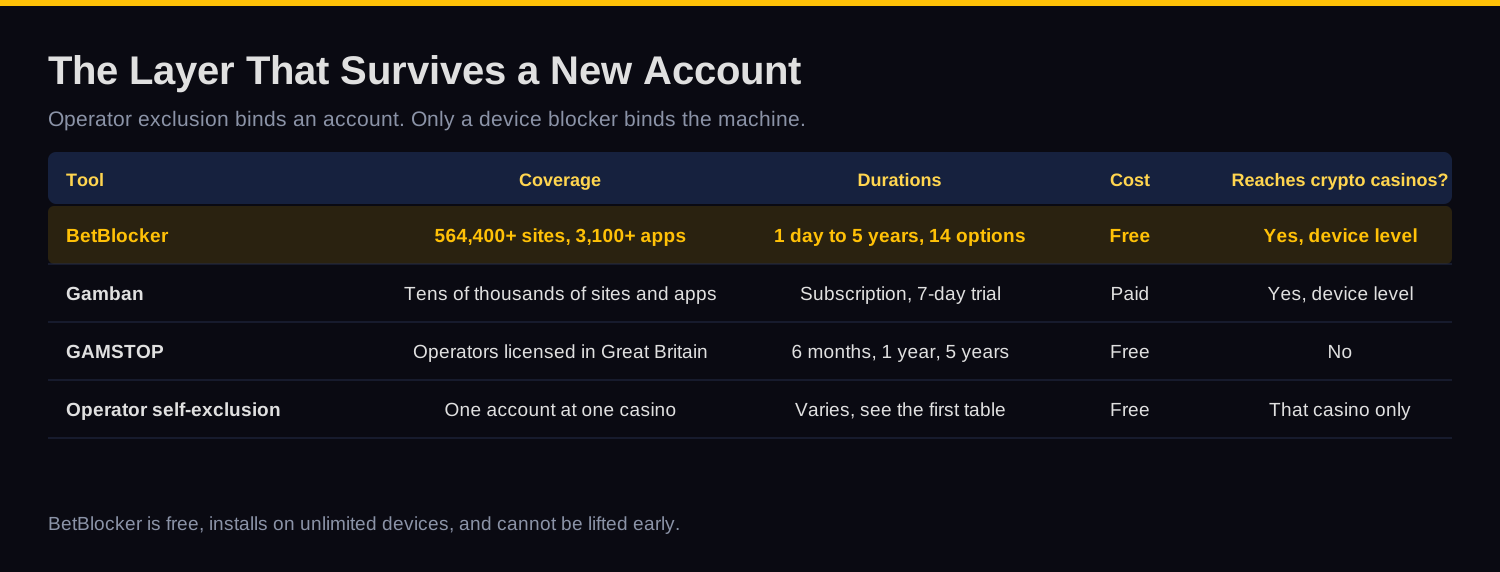
- The only layer that survives a new account is the device. BetBlocker is free, blocks 564,400+ gambling sites, installs on unlimited devices, and cannot be lifted early.
On this page
Every no-KYC casino review on this site, ours included, sells the same thing: an account you can open in thirty seconds without handing anyone your passport. That is a genuine feature. It is also the exact reason crypto casino self-exclusion behaves differently here than it does at a licensed high-street book, and almost nobody writing about it says so.
The stakes are easy to state. A GAMSTOP registration covers roughly 1,600 operators in one form; a self-exclusion at Stake covers one. If you exclude yourself from six crypto casinos and there are hundreds, you have solved 2% of your problem and spent an evening feeling like you solved all of it.
So I stopped reading roundups and read the source documents instead. On 11 September 2026 I went through the published responsible gambling pages at Stake, Cloudbet, Roobet, BC.Game and Wild.io, plus the Curaçao Gaming Authority's own Responsible Gaming Policy for Licensed Operators — the regulator that licenses most of them. Every duration, delay and quoted sentence below came from one of those pages.
What follows is not a lecture. It is a comparison of which tools exist, which way their friction points, and which single layer still works after you have clicked everything the casino offers.
What six operators actually offer
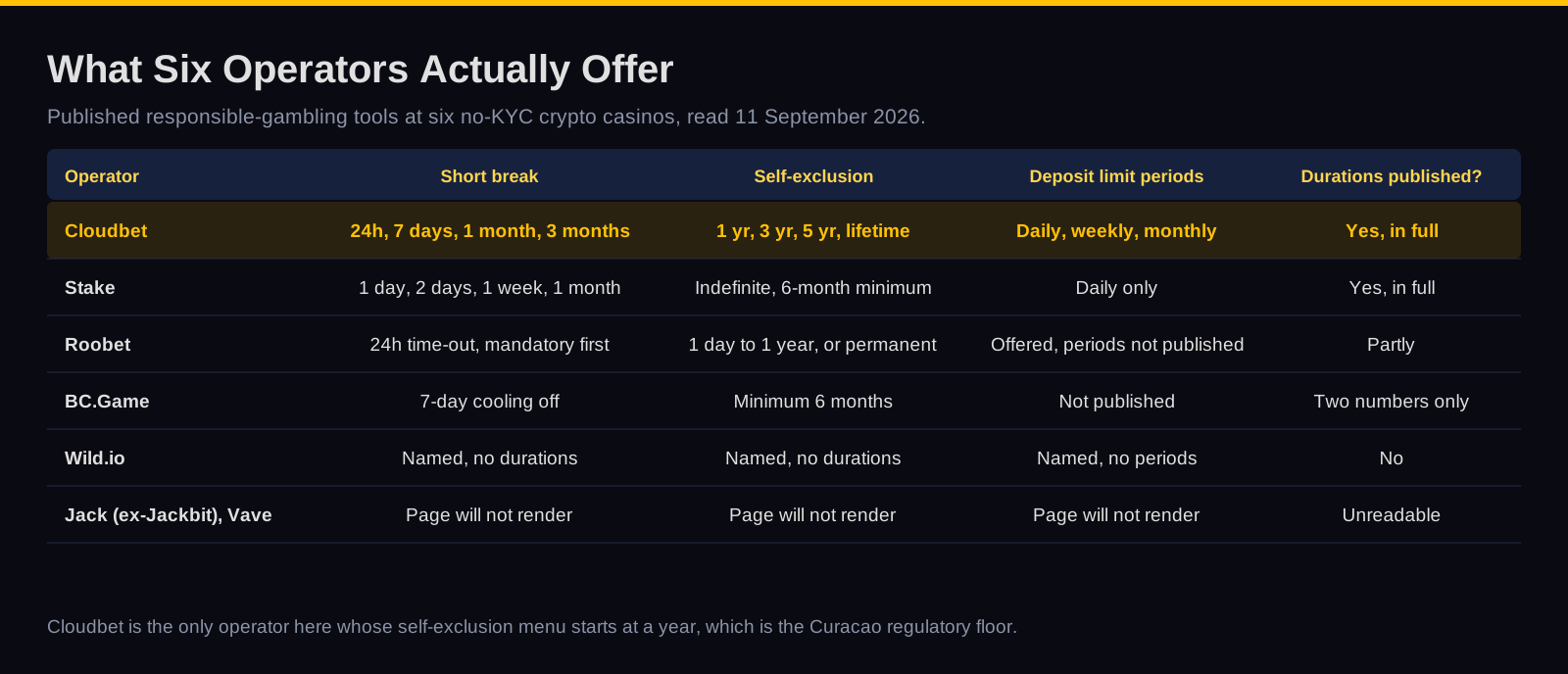
Start with the menu. This is what each operator publishes, in its own help centre, with the durations exactly as written. The last column is the one that separates a documented tool from a marketing claim.
Two things fall out immediately. Cloudbet is the only operator here whose self-exclusion menu starts at a year, which is not a coincidence — it is the regulatory floor, and we come back to that below. And Stake, despite publishing the most detailed set of articles of anyone, supports only a daily deposit limit, which is the least useful period of the three for someone trying to hold a monthly budget.
The bottom row matters too. Jack (formerly Jackbit) and Vave both serve their responsible gaming pages as JavaScript that never resolves for a plain fetch. Whatever those tools are, they cannot be compared, quoted or audited by anyone who has not already signed up.
The friction test: which way does the delay point?
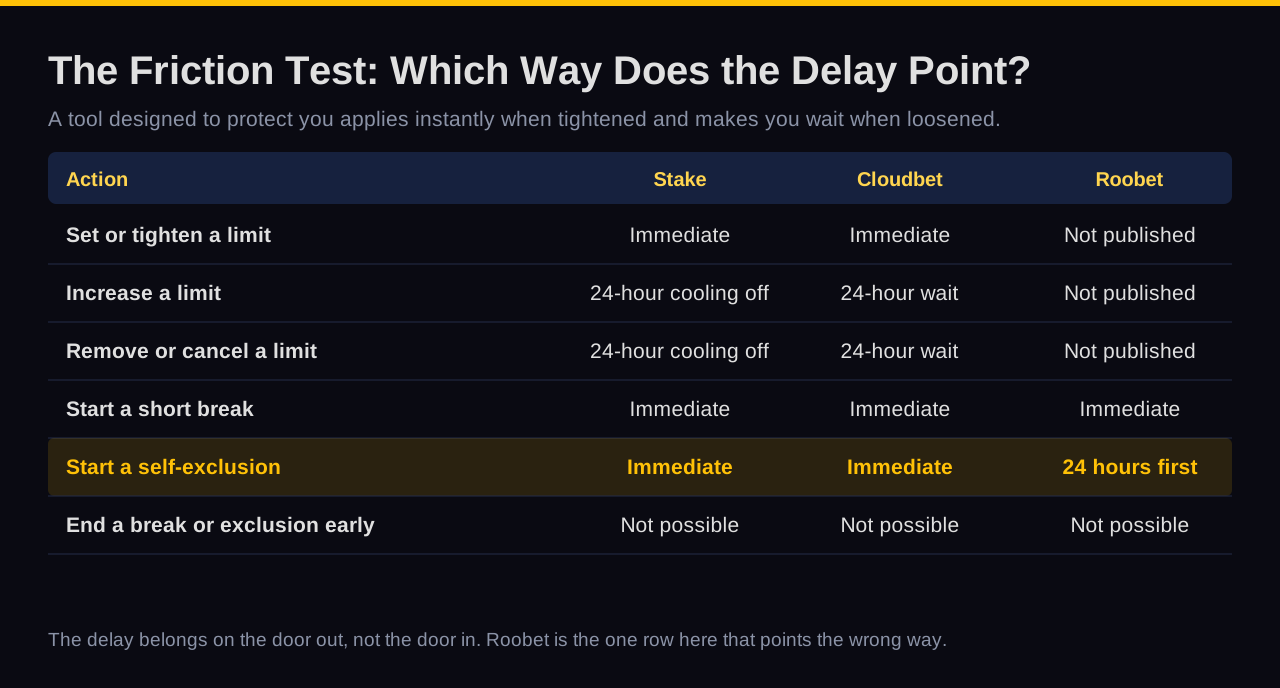
Here is the single question I would ask of any responsible gambling tool, at any casino, crypto or otherwise. When you make the tool stricter, does it apply now? And when you make it looser, does it make you wait? A tool that answers yes twice is designed to protect you. A tool that answers no to either is decoration.
Stake and Cloudbet both pass. Stake's deposit limits article is explicit — set or decrease is "Immediate", increasing is "24 hours", removing is "24 hours" — and its gambling limits article applies the same rule to loss and wager limits: "When initially setting a loss limit or decreasing an existing one, the change is applied immediately," while "Any increase in the loss limit is subject to a 24-hour cooling-off period."
Cloudbet words it as strictness rather than direction, and lands in the same place: tightening takes effect immediately, and a request to relax or cancel a limit is "subject to a 24-hour waiting period before taking effect". Both are the correct shape. The delay belongs on the door out, not the door in.
Roobet makes you wait 24 hours to quit
Roobet is the row that fails the test, and it fails it on the one tool where failure costs the most.
Its self-exclusion article describes a mandatory 24-hour cooldown that runs before the self-exclusion options unlock. Wagering is disabled during that window — which is real protection, and worth saying — but the account itself stays open. In Roobet's own words: "During this time, you will not be able to wager; however, you will still be able to access your account to claim any eligible rewards."
Why the ordering matters
A person deciding to self-exclude has usually just had a bad session. That decision is at its strongest in the minutes right after it is made, and it is exactly then that a 24-hour gate stands in the way.
Once the wait is over, Roobet's menu is the most granular of anyone here — 1 day, 3 days, 1 week, 2 weeks, 1 month, 3 months, 6 months, 9 months, 1 year or permanent — and it is final: "Please note that this is irreversible and cannot be modified/undone by our team." The tool is good. The queue in front of it is not.
There is a second route at Roobet worth knowing about, because it is faster in practice than the exclusion flow: account deletion. A brand-new account with no activity can be closed from privacy settings. An established one needs an email to support with the subject "Account Deletion", followed by a 48-hour cooldown and a confirmation step. We go through the rest of Roobet's cashier mechanics in our Roobet review.
The exclusion that leaves the deposit button working
Stake offers something the others do not: Product Exclusion, which blocks the casino or the sportsbook individually over 24 hours, 7 days, 30 days, 90 days or indefinitely. A fixed-period one "cannot be reversed once it is in place".
For a genuinely product-specific problem — slots are the trouble, football accumulators are not — that is a sharper instrument than a blanket lockout, and I would rather it existed than not. But read what stays switched on.
What a Stake Product Exclusion does not stop
- Excluding the casino still lets you "place bets on our Sportsbook" and play Stake Poker.
- Excluding the sportsbook still lets you play "all casino games and Stake Poker".
- In both cases you keep "the ability to make deposits, withdraw funds, engage in the chatroom, claim bonuses, and perform other account-related activities as usual".
- Poker is a separate process entirely — "Poker exclusion isn't part of the Product Exclusion tool".
Depositing and claiming bonuses while excluded is the part I would flag. If the reason you excluded the casino is that money was leaving faster than you intended, a tool that leaves the funding rail open and the promotions flowing has addressed the symptom you named and none of the one you have. Stake's full lockout is the other article in the same collection, and its terms are stricter: indefinite only, with "a minimum period of 6 months from the application date", after which the account "can be considered for reactivation, subject to a formal return-to-play review".
Cloudbet holds the overflow instead of refusing it
One mechanic here is genuinely different from everyone else's, and I had to read it twice.
At most operators a deposit that would breach your limit is simply rejected. Cloudbet instead accepts the money and quarantines it: funds above the limit are "temporarily held and unavailable for use", and when the period rolls over, "an amount equal to your limit will be released from your withheld balance".
Set a $100 weekly limit and deposit $500
You do not get $400 back and you do not get a failed transaction. You get $100 to play with now and $100 released automatically each week for the next four weeks. The limit has become a drip feed rather than a wall — protective if you were about to chase, and an odd surprise if you assumed the excess would bounce.
I can argue this both ways, which is why it is worth knowing before you rely on it. It removes the re-deposit decision from a bad moment, and a rejected deposit at a crypto casino is not free — you have already paid a network fee to move the coins, as we priced across 78 published routes in our crypto casino withdrawal fees breakdown. On the other hand a balance sitting in your casino account is not a balance in your wallet, and getting it out means the withdrawal leg, its fee and its minimum.
What Curaçao actually requires in 2026
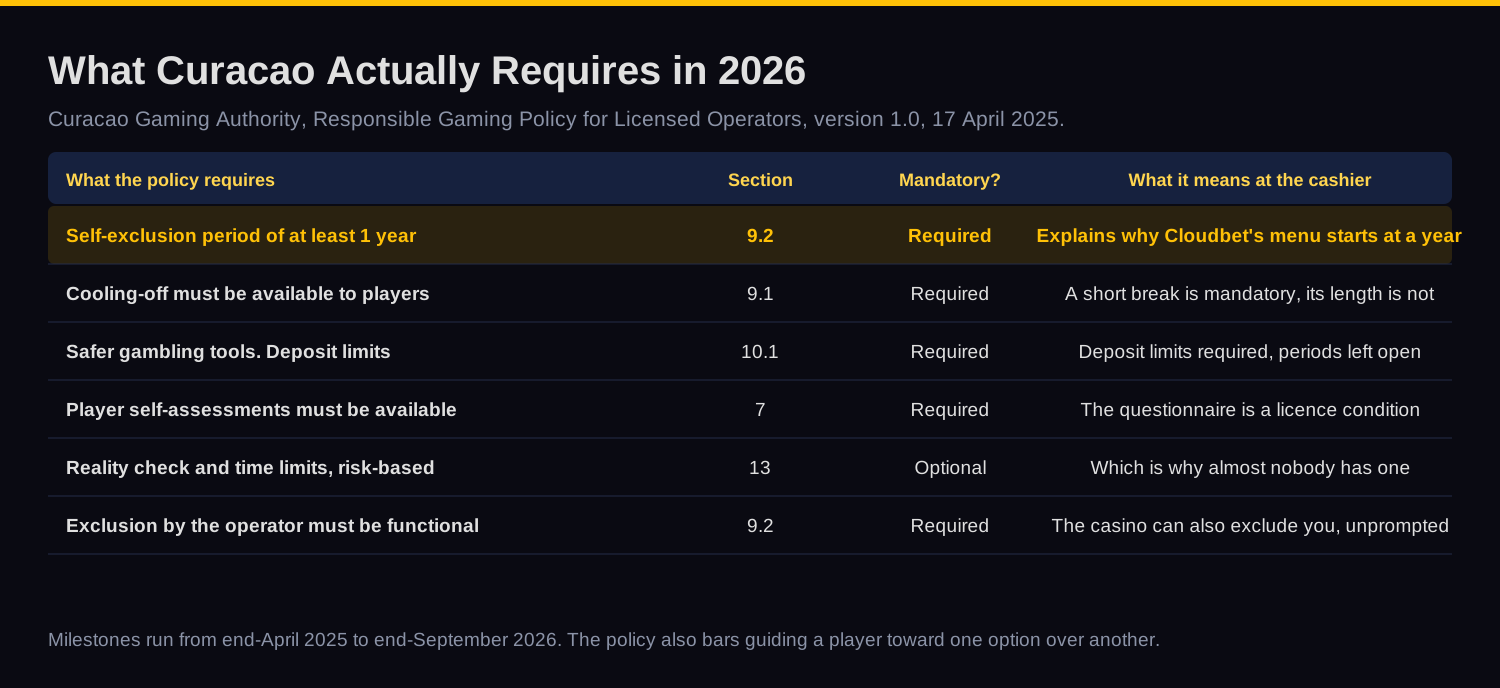
Most of these operators hold a Curaçao licence, and since 2025 that licence carries a written responsible gaming standard rather than a gesture. The Curaçao Gaming Authority's Responsible Gaming Policy for Licensed Operators (version 1.0, 17 April 2025) sets requirements on a phased timetable whose milestones run from end-April 2025 to end-September 2026 — this month.
Two sentences in that document do more work than the whole tool list. The first governs how the choice is presented: "Players must not be guided or influenced toward one option over another. No interference, bonuses, or reassurances may be provided." Read that next to the reward-claiming Roobet permits during its pre-exclusion wait, and next to the bonuses Stake leaves claimable during a product exclusion, and decide for yourself.
The second protects the money on the way out: "Under no circumstances may an operator use Responsible Gaming measures as a pretext to prevent or delay legitimate player withdrawals. Any misuse of protective interventions for financial gain will be considered a breach of licence conditions." That is a useful sentence to have in hand if a payout ever stalls behind a sudden responsible-gaming review.
The hole none of these tools closes
Now the part the operator pages do not say out loud, and the reason this article exists.
Every tool above is scoped to an account. Curaçao's own definition says so: self-exclusion is "an event where a player voluntarily bars themselves from all or certain online gaming-related activities with a specific operator". At a book that verified your identity, an account and a person are close to the same thing. At a no-KYC crypto casino they are not related at all — which is the entire product, and the reason the sector exists. Our guide to the best no-KYC crypto casinos treats that as the headline feature, because for most players it is.
Here it is a hole, and the regulator has already noticed. The Curaçao policy's list of behaviours that should flag a player as at risk includes, verbatim, "Attempts to open multiple accounts to bypass deposit or loss limits" alongside "Frequent changes to Responsible Gaming tools such as continuously setting or changing deposit or loss limits or repeatedly making use of cooling-off period."
Read that admission carefully
A rule that treats re-registration as a warning sign is a rule that expects re-registration to work. The regulator's answer is behavioural detection by the operator, not a technical block — and detection cannot run on an account it has never seen, at a casino that never asked who you were.
National registers do not fill the gap either. GAMSTOP is unambiguous about its scope: it "blocks you from signing up for or using online accounts with gambling companies licensed in Great Britain", for a period you choose "from 6 months up to 5 years". A Curaçao-licensed crypto casino is not a company licensed in Great Britain, so a GAMSTOP registration has nothing to say to it.
The layer that holds: block the device, not the account
If the account is the wrong unit, the device is the right one. Blocking software does not care whether you have registered once or eleven times, or which jurisdiction issued the licence. Notably, the operators themselves point here: Stake's help centre names BetBlocker, Net Nanny and GamBlock, and Cloudbet names BetBlocker, GamBlock and Gamban.
BetBlocker is the one I would start with, and the reasons are boring rather than clever. It costs "Absolutely nothing. Ever." It is deliberately hard to undo — "Once a gambling restriction has begun, it cannot be lifted before the end of the selected restriction period," and its support team "will not under any circumstances assist a user to disable an active" restriction. And the coverage follows you: "You can install BetBlocker as many times, on as many devices and on as many different platforms as you like. There are no limits what-so-ever."
That last line is the one that matters against a no-KYC casino. A new account does not get you past a blocked domain, and a second phone only helps if you never installed it there. The right order is device first, then the operator tools on top, not the other way round.
If you are going to play, play where the rules are published
Cloudbet publishes every duration
Of the six operators we read on 11 September 2026, Cloudbet was the only one publishing its full cool-off menu, its full self-exclusion menu, all three deposit-limit periods and the 24-hour rule on relaxing a limit — all on a public page, before you sign up. That is the minimum standard, and almost nobody meets it.
Visit Cloudbet →Affiliate link. 18+ only. If gambling has stopped being fun, install BetBlocker instead — it is free.
Frequently asked questions
Does self-exclusion work at a no-KYC crypto casino?
It works on the account you excluded, and only that account. Curaçao's own policy defines self-exclusion as barring yourself from activities "with a specific operator", and a casino that never verified your identity has no way to connect a new registration to the old one. Treat an operator exclusion as one layer, never the whole answer.
Does GAMSTOP cover crypto casinos?
No. GAMSTOP states that it blocks accounts "with gambling companies licensed in Great Britain". Most crypto casinos hold a Curaçao licence instead, so they sit outside its list entirely. If you have registered with GAMSTOP and want the same protection against crypto sites, you need a device-level blocker on top of it.
Can I cancel a self-exclusion if I change my mind?
Not at any of the operators we read. Cloudbet cannot end one early and calls its lifetime option "irreversible and cannot be undone". Roobet says its exclusions are "irreversible and cannot be modified/undone by our team". Stake's indefinite exclusion runs at least six months, after which reactivation is "subject to a formal return-to-play review".
What is the difference between a cool-off and a self-exclusion?
Curaçao's policy draws the line by length and reversibility: cooling off is "a short-term, temporary restriction from gambling activities, which the player can customize", while self-exclusion is "a long-term, irrevocable exclusion from all gambling activities". In practice a cool-off runs 24 hours to three months and expires by itself; a self-exclusion runs a year or more and does not.
Can I still deposit while I am excluded?
It depends which exclusion you picked. A full self-exclusion or a Stake Break in Play stops everything. A Stake Product Exclusion does not: its help centre says you keep "the ability to make deposits, withdraw funds, engage in the chatroom, claim bonuses, and perform other account-related activities as usual", and you can still bet the product you did not exclude.
How quickly does a deposit limit take effect?
Tightening is immediate at both operators that publish the rule. Stake lists set or decrease as "Immediate", with increasing or removing a limit at "24 hours". Cloudbet applies stricter requests immediately and puts relaxing or cancelling one behind "a 24-hour waiting period". Note that Stake currently supports a daily deposit limit only.
What happens to money above my Cloudbet deposit limit?
It is not refused and it is not refunded. Cloudbet holds it: funds over the limit are "temporarily held and unavailable for use", and at each reset "an amount equal to your limit will be released from your withheld balance". A single large deposit therefore becomes a scheduled drip rather than a rejected transaction.
Can a casino delay my withdrawal for responsible gambling reasons?
Not legitimately, if it is Curaçao-licensed. The regulator's policy is direct: "Under no circumstances may an operator use Responsible Gaming measures as a pretext to prevent or delay legitimate player withdrawals. Any misuse of protective interventions for financial gain will be considered a breach of licence conditions."
What I would actually do
If you want a budget to hold, set a deposit limit and pick the operator whose limit periods match how you actually think about money. That is a real argument for Cloudbet's daily, weekly and monthly options over Stake's daily-only, and it is the least dramatic tool on this page by a distance.
If you want a break, take the shortest one that covers the situation and let it expire. None of these can be cancelled early, which is the point, so a 24-hour cool-off you repeat is more useful than a three-month one you regret on day four.
And if you want to stop, install the device blocker first and self-exclude second, not the reverse. The exclusion is the part that feels decisive and the part a fresh email address undoes. The blocker is the part that is still there tomorrow when the feeling has passed, and BetBlocker costs nothing at all.
One honest caveat about this whole page: it is a snapshot of published policy on one day, and published policy is not the same as implementation. I could read what these operators promise. I could not test whether a new account at any of them is actually stopped after an exclusion, and neither can anyone else writing about this. Anyone telling you otherwise is guessing.
Related guides
Best no-KYC crypto casinos
The feature that makes exclusion hard, seen from the other side.
Crypto casino withdrawal fees
What it costs to get your balance out, across 78 published routes.
Cloudbet review
The only operator here publishing every duration in full.
Stake casino review
Eight help-centre articles on limits, and a daily-only deposit cap.
Roobet review
The cashier behind the 24-hour wait, and the deletion route.
BC.Game review
A 7-day cool-off, a 6-month floor, and not much else published.
18+ only. Gambling can be addictive — see BeGambleAware.org. Sources read on 11 September 2026: Stake self-exclusion, product exclusion, gambling limits, deposit limits, break in play and gambling blocks; Cloudbet responsible gambling; Roobet self-exclusion; BC.Game responsible gambling; Wild.io responsible gambling; the Curaçao Gaming Authority Responsible Gaming Policy; GAMSTOP; BetBlocker; and Gamban. Policies change without notice — check the operator's own page before you rely on a number here. Affiliate links earn us a commission at no cost to you.