Crypto Casino Withdrawal Fees 2026: 78 Rates Compared
Stake and Cloudbet both publish their crypto casino withdrawal fees. We read all 78 rates on 9 September 2026, and neither operator is cheaper.
Affiliate disclosure: This page contains affiliate links. We may earn a commission at no extra cost to you. 18+ only. Gamble responsibly — see BeGambleAware.org. Last updated 9 September 2026. Every rate below was read from the operator's own published schedule on that date, and converted at CoinGecko spot at the moment of the reading.
Key takeaways
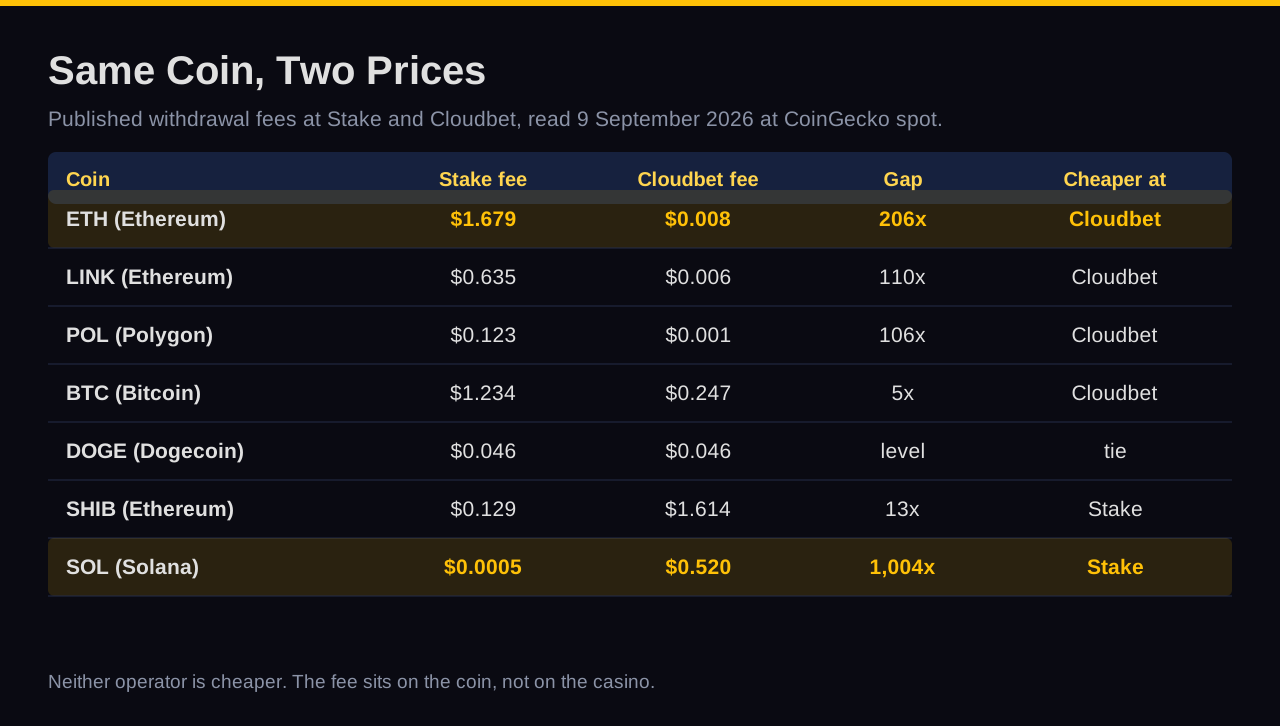
- Neither operator is cheaper — the fee sits on the coin, not the casino. Stake charges $1.68 to withdraw ETH where Cloudbet charges $0.008, a factor of 206. Cloudbet charges $0.52 to withdraw SOL where Stake charges $0.0005, a factor of 1,004 the other way.
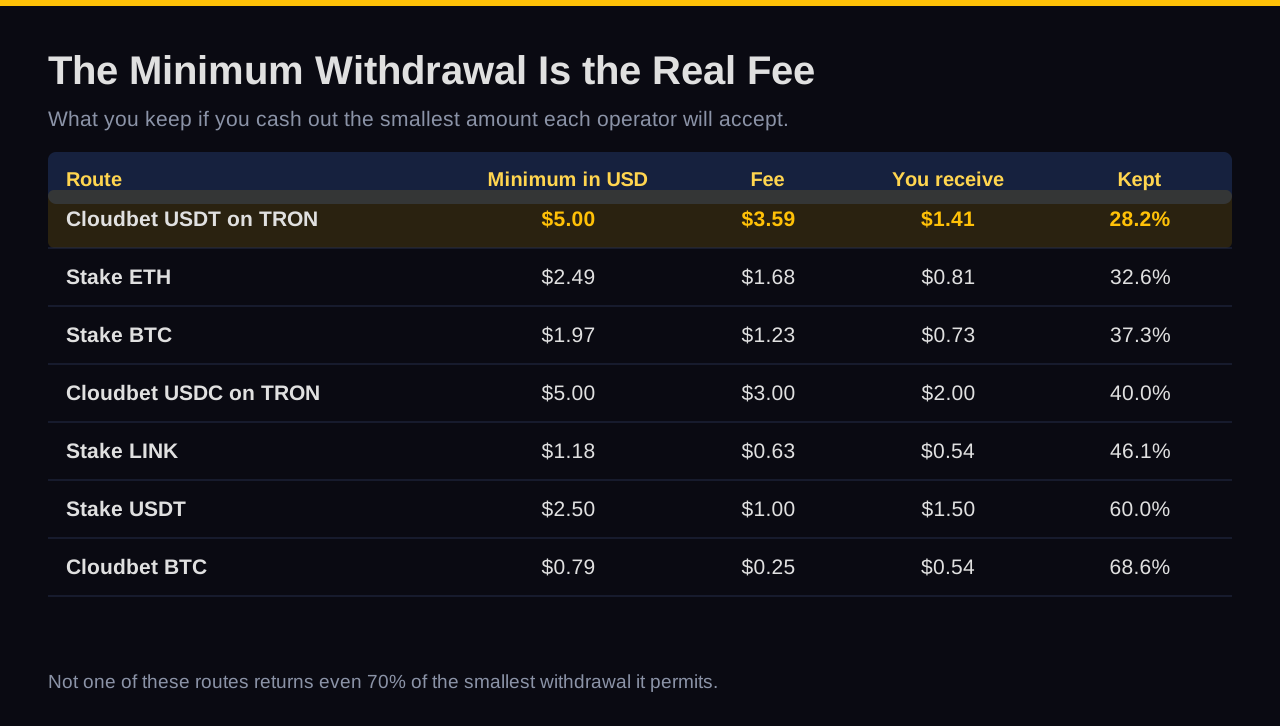
- Cash out the smallest amount Stake allows in ETH and you keep 32.6% of it. The fee is 0.00067447 ETH against a 0.001 ETH floor. Bitcoin is nearly as bad at 37.3%.
- Six of Cloudbet's 57 routes have a fee equal to or larger than the minimum withdrawal. Its stETH fee is 50 times its own stETH floor, so the minimum cannot be executed at all.
- A 0.1% fee beats Stake's flat $1 USDT fee below a $1,000 cashout and loses above it. BC.Game charges the percentage; Stake and Cloudbet charge the flat rate. Your withdrawal size picks the winner.
- The cheapest real route we found was USDT on TON at Cloudbet: $0.002. The most expensive on the same asset was USDT on TRON at the same casino: $3.59, or 1,768 times more.

On this page
Ask what crypto casino withdrawal fees cost and every guide gives you the same shrug: the casino usually charges nothing, the network charges something, and the something depends on congestion. That answer is useless at the cashier, and it is also wrong often enough to be expensive.
The stakes are not trivial. A player cashing out $50 a week loses about $187 a year on the wrong route and about ten cents on the right one, and at the small end the fee can take more than half of what you are trying to move. On a minimum-sized Ethereum withdrawal at Stake you receive 32.6% of the money and the fee keeps the rest.
So we stopped reading roundups. Two of the largest operators publish their entire withdrawal schedule in public, and on 9 September 2026 we read both: Stake's 21 coins and Cloudbet's 57 coin-and-network pairs. That is 78 published rates, priced at spot, and not one page ranking for this keyword quotes a single one of them.
Everything below is a snapshot of one day, and every row says so. Read it as a method rather than a price list: the ranking will have moved by the time you cash out, but the way these fees are built will not.
The schedules nobody quotes
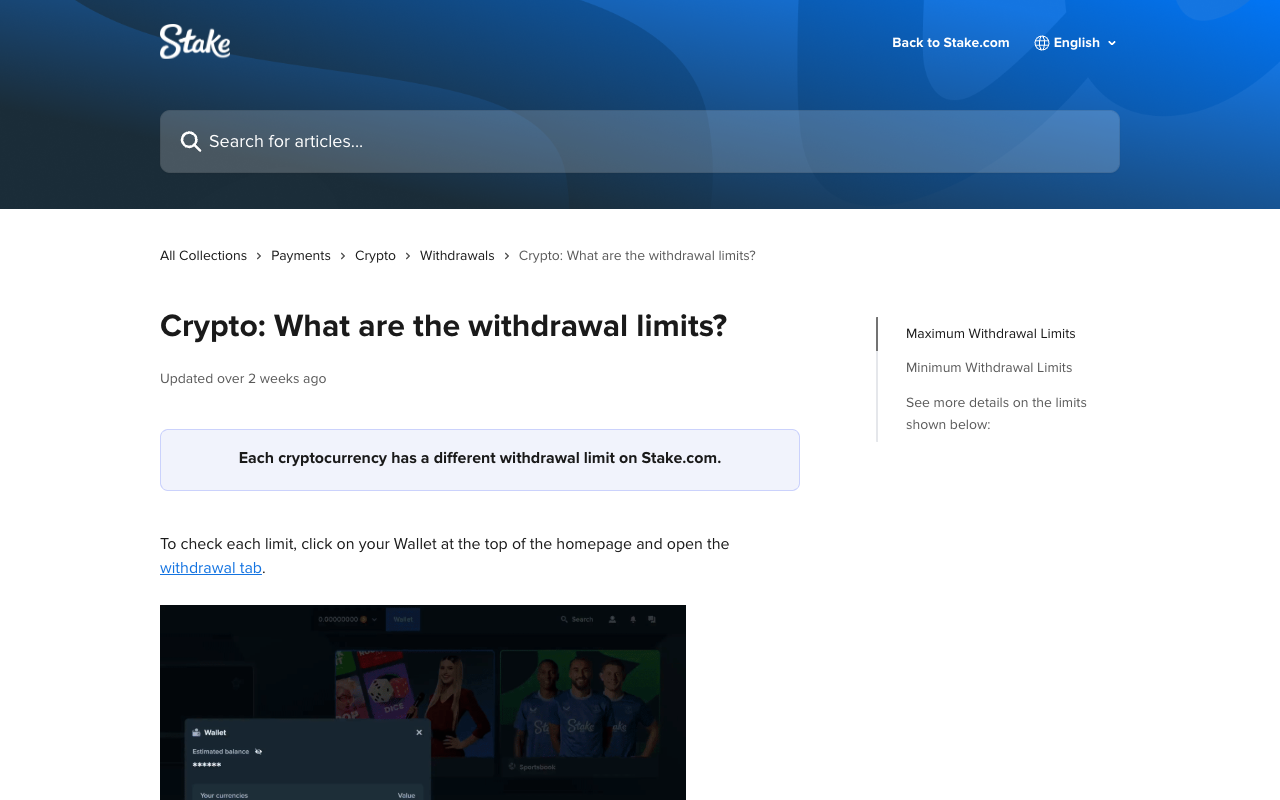
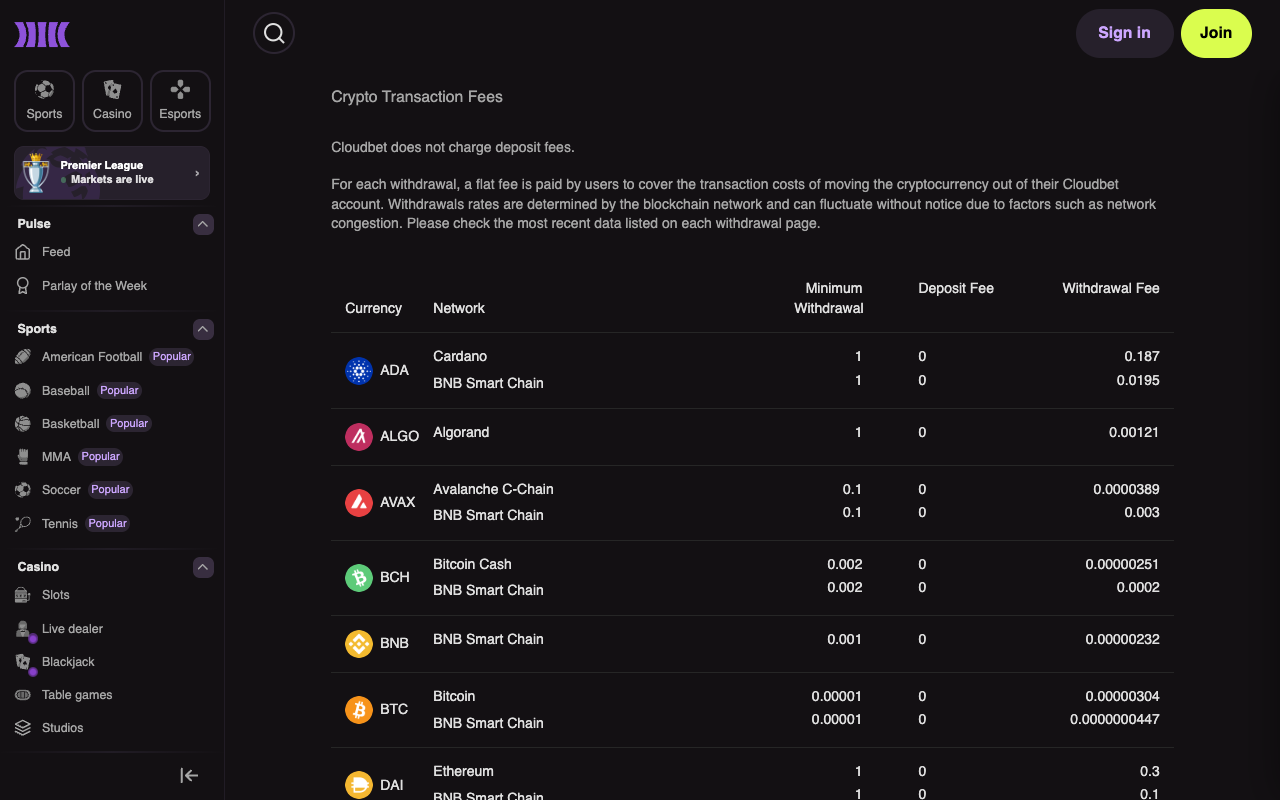
Stake publishes a flat fee per coin, with no network choice attached. Cloudbet publishes a flat fee per coin and per network, which matters enormously, and states its policy plainly: "Cloudbet does not charge deposit fees. For each withdrawal, a flat fee is paid by users to cover the transaction costs of moving the cryptocurrency out of their Cloudbet account."
Here is Stake's schedule in full, exactly as published, with our conversion at spot on 9 September 2026. The last column is the one that decides whether a small cashout is worth making: the fee as a share of the smallest withdrawal the operator will accept.
Sort that table by the last column and the shape of the pricing appears: Stake sets its minimum at roughly 1.5 to 2.5 times its own fee. That is a deliberate design, and a defensible one — it stops players requesting withdrawals the network cannot economically carry. It also means the smallest permitted cashout is always a bad one.
The same coin, two prices
The obvious next question is which operator is cheaper. The answer is neither, and the size of the disagreement is the finding.
Solana is the row worth pausing on. Stake's SOL fee is 0.000005 SOL, which is exactly the Solana base fee of 5,000 lamports per signature published in the Solana core documentation. Stake passes it through at cost, to the lamport. Cloudbet charges 0.00502 SOL for the same transfer, about a thousand times the chain's own price.
Bitcoin runs the other way. Cloudbet's 0.00000314 BTC is 314 satoshis; a standard single-input transfer at the 1 to 2 sat/vB rates showing on mempool.space at block 966,256 costs roughly 141 to 282 satoshis, so Cloudbet is charging close to cost with a small buffer. Stake's 1,571 satoshis is around five times the same transaction. Neither book is systematically greedy. Both have routes they price at cost and routes they do not.
The minimum withdrawal is the real fee
Every guide reports the fee. Almost none report the minimum, and the minimum is what turns a fee into a percentage. A dollar is nothing on a $500 cashout and a catastrophe on a $2.50 one.
Not one of those routes returns even 70% of the smallest withdrawal it permits. The practical rule falls straight out of the arithmetic: the minimum withdrawal is never the withdrawal you should make. Treat it as a floor the cashier enforces, not a target, and let the balance build until the fee is under 1% of it.
Six routes where the fee is bigger than the minimum
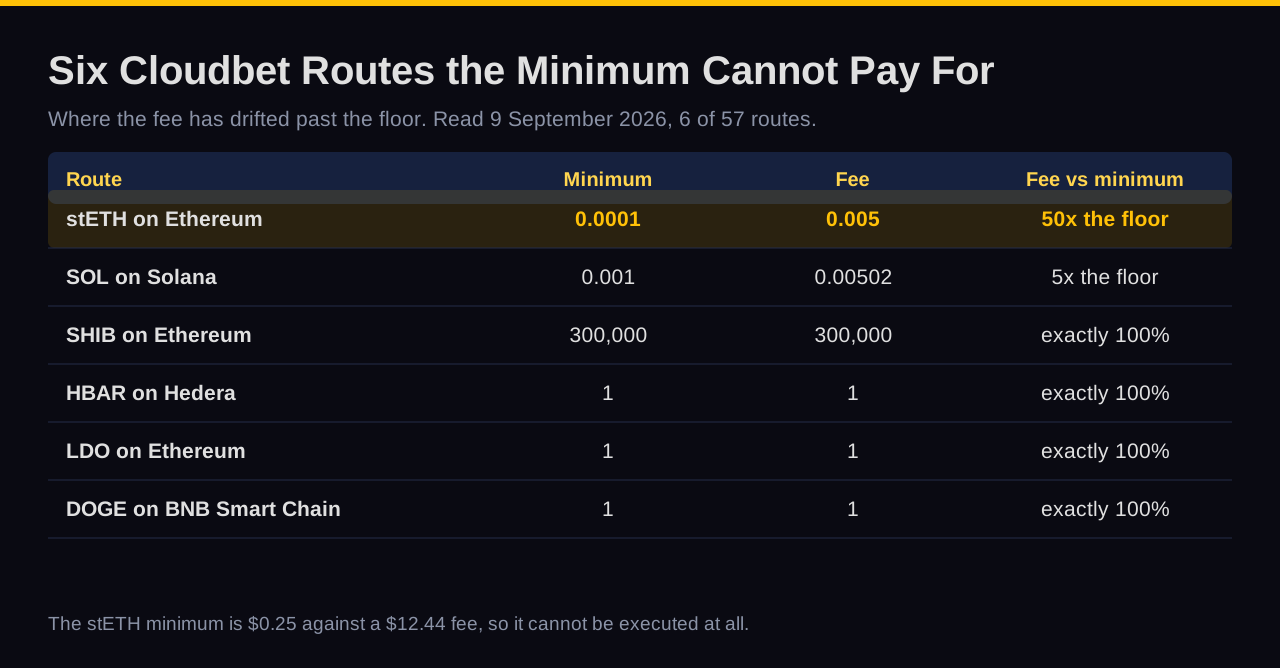
Cloudbet's minimums are round numbers, set independently of its fees, and on six of its 57 routes the two have drifted past each other. The fee is now equal to or larger than the smallest withdrawal the site will accept.
Routes where the minimum cannot pay its own fee (Cloudbet, 9 September 2026)
- stETH on Ethereum — minimum 0.0001, fee 0.005. The fee is 50 times the floor, or $12.44 against a $0.25 minimum.
- SOL on Solana — minimum 0.001, fee 0.00502. Five times the floor.
- SHIB on Ethereum — minimum 300,000, fee 300,000. Exactly 100%.
- HBAR on Hedera — minimum 1, fee 1. Exactly 100%.
- LDO on Ethereum — minimum 1, fee 1. Exactly 100%.
- DOGE on BNB Smart Chain — minimum 1, fee 1. Exactly 100%.
None of this is hidden. It is on Cloudbet's public fee page, which is more than most operators offer, and the cashier shows the fee before you confirm. But a player who reads only the minimum and assumes it is a usable amount is going to have a bad afternoon. Cloudbet itself warns that rates "can fluctuate without notice due to factors such as network congestion" and tells you to check the withdrawal page for current data — which is the correct advice and also an admission that the published table drifts.
Flat fee or percentage: where the lines cross
Stake and Cloudbet both charge flat fees. A third model is a percentage of the amount withdrawn, and BC.Game is the visible example: its own withdrawal guidebook puts the standard crypto withdrawal fee at 0.1%, dropping to 0% at VIP Platinum level 38 and above, with blockchain network costs separate and a minimum withdrawal set at the equivalent of 20 USDT.
A percentage sounds worse and usually is not, because the flat fee does not care how small your cashout is. The two models cross at a specific withdrawal size, and below that size the percentage wins.
Read the third column as a break-even. A recreational player taking out $100 at a time is better served by 0.1% on every one of those rows. A player moving four figures is better served by the flat fee, and the gap widens without limit: 0.1% of a $50,000 withdrawal is $50, where Cloudbet's Bitcoin fee stays at 25 cents.
Note also what the VIP waiver is worth. Dropping 0.1% to zero saves a $100 player ten cents and a $50,000 player fifty dollars, which tells you exactly which player the tier was designed for. Our guide to crypto casino VIP programs works through what else those tiers actually move.
The fees nobody calls fees
Three costs never appear in a fee table and all three can cost more than the fee does.
The wagering requirement on your own deposit. Roobet's help centre states that to withdraw a crypto balance "you will need to wager at least 100% of your cryptocurrency deposit amount before you can withdraw or tip", and separately confirms in its fee article that it adds no withdrawal fee of its own. That is not a bonus condition — it applies to plain deposited funds. Deposit $200, change your mind, and you cannot take it back out until $200 has passed through the games. At a 2% house edge that is an expected $4 cost, sixteen times Cloudbet's Bitcoin fee.
The address your withdrawal will not go to. Roobet also documents that it "doesn't currently offer support for smart contract addresses" on Ethereum. If your receiving wallet is a smart-contract wallet — a Safe, or most account-abstraction wallets — the withdrawal simply will not process, and you need a second, plain wallet to route through. That is an extra transfer and an extra network fee, plus the time to work out why nothing arrived.
Confirmation depth before the clock starts. Roobet is unusually specific here too, requiring one confirmation for BTC, LTC, XRP, TRX and DOGE, and three for ETH, USDT and USDC, before a deposit unlocks. Most operators do not publish this at all, and we will not quote numbers for the ones that do not. Ask support in writing if it matters to you.
Those three, plus the fee itself, are what separate a payout that feels instant from one that does not. We timed the actual clock at nine operators in our fast withdrawal casino guide, and the pattern holds: the sites with the fewest gates on the way out are rarely the ones advertising the loudest.
Cashing out $50 today
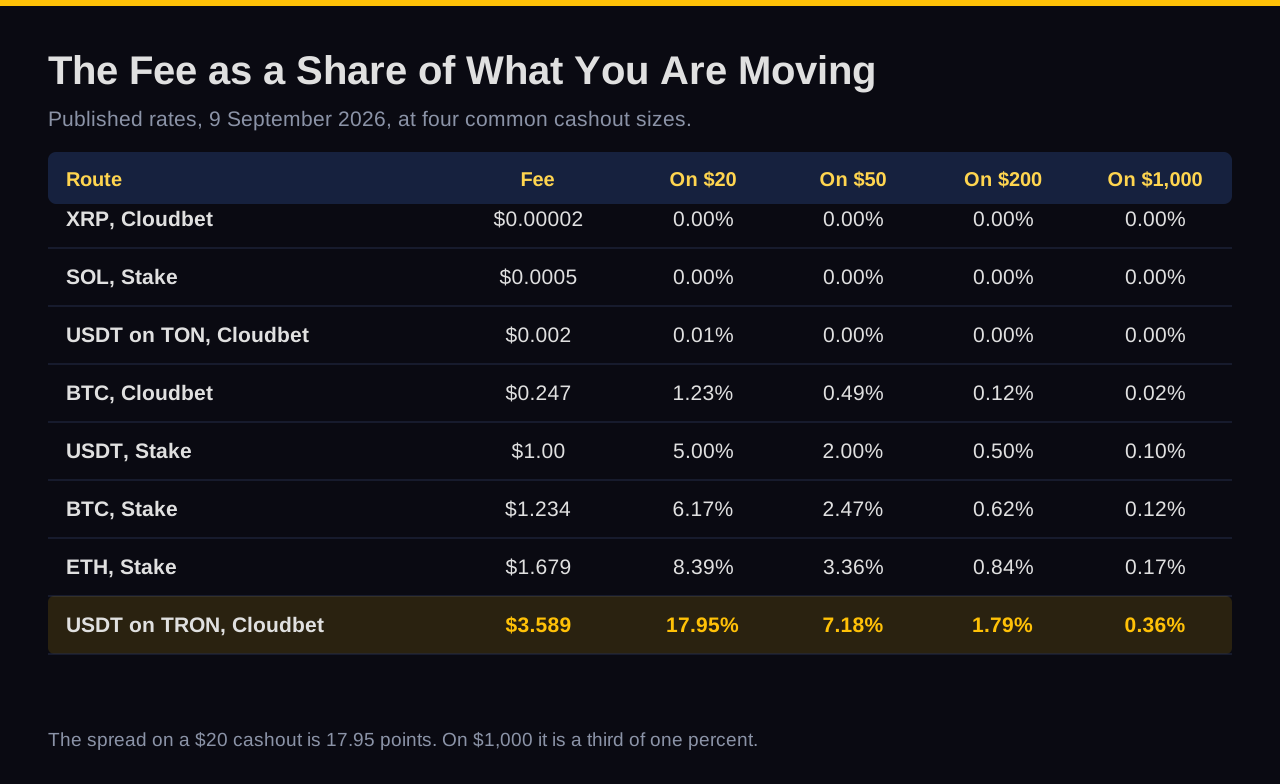
Here is the whole article as one decision. This is the fee as a share of the money you are moving, at four common cashout sizes, using the published rates from 9 September 2026.
The $20 column is the one that should change behaviour. The spread between the best and worst route on a $20 cashout is 17.95 percentage points, which is several times the house edge on the game you played to win it. The same spread on $1,000 is a third of one percent, at which point it stops being worth a minute of your attention.
TRON deserves a specific warning, because it is still the network most guides recommend by reflex. It was the most expensive deposit rail we priced in our crypto casino deposit fees breakdown two days earlier, and it is the most expensive withdrawal rail here. Cloudbet's 3.59 USDT charge is not a markup — TRON's on-chain energy price of 100 sun, read from the network's own chain parameters, makes a TRC-20 transfer genuinely cost several dollars. The casino is passing on a real number. The number is just bad.
Frequently asked questions
Do crypto casinos charge withdrawal fees, or is it just the network?
Both models exist. Cloudbet and Roobet state they add nothing of their own and pass on a flat charge to cover the transfer. BC.Game's guidebook publishes a 0.1% platform fee on top of network costs, waived at VIP Platinum 38. Stake publishes a flat per-coin fee without saying how it is composed. In every case the amount is shown in the cashier before you confirm.
Which crypto is cheapest to withdraw from a casino in 2026?
On the rates published on 9 September 2026, XRP and Litecoin at Cloudbet cost a fraction of a cent, and Solana at Stake costs $0.0005 because Stake charges exactly the chain's 5,000-lamport base fee. For stablecoins, USDT on TON at Cloudbet was $0.002. Avoid TRON for stablecoins: the same USDT costs $3.59 on that route.
Why is the same coin cheaper at one casino than another?
Because each operator prices each coin-and-network pair separately, and they batch and buffer differently. Stake charged $1.68 to send ETH on the day we checked while Cloudbet charged $0.008; on Solana the positions reversed, with Cloudbet at $0.52 and Stake at $0.0005. There is no operator that is cheaper across the board.
What is the minimum withdrawal at a crypto casino?
It is set per coin and is usually tiny in dollar terms: $2.49 for ETH and $1.97 for BTC at Stake, $5 for stablecoins on TRON at Cloudbet, and the equivalent of 20 USDT at BC.Game. The trap is that the fee is often a large fraction of that floor, so withdrawing the minimum can hand over 30% to 70% of it.
Can the withdrawal fee ever be larger than the minimum withdrawal?
Yes, and it currently is on six of Cloudbet's 57 published routes. Its stETH fee is 0.005 against a 0.0001 minimum, fifty times the floor, and SHIB, HBAR, LDO and DOGE on BNB Smart Chain all sit at exactly 100%. The minimum in those cases is a number the cashier accepts but cannot actually pay out.
Is a 0.1% withdrawal fee better than a flat fee?
Below roughly $1,000 it usually is. A 0.1% charge matches Stake's flat $1 stablecoin fee at exactly a $1,000 withdrawal and beats it under that. Above it the flat fee wins, and keeps winning: 0.1% of $50,000 is $50, while Cloudbet's Bitcoin fee stays at about 25 cents whatever you send.
Do I have to wager my deposit before I can withdraw it?
At some sites, yes, even without a bonus. Roobet's help centre requires you to wager at least 100% of your crypto deposit before withdrawing or tipping. That is a genuine cost — at a 2% house edge, turning over $200 has an expected cost of about $4 — and it is far larger than any fee in this article.
Will these fees be the same when I read this?
No. Cloudbet says its rates fluctuate without notice with network congestion, and Stake's schedule moves with coin prices too. Use the ranking and the method here, then read the number in the cashier before you confirm. Any article that gives you a fixed fee without a date attached is guessing.
The verdict
There is no cheap casino and no expensive one. There are cheap routes and expensive routes, and both of the operators that publish their numbers have plenty of each. Picking the site first and the coin second is the wrong order, and it is the order almost every guide teaches.
Two habits capture nearly all of the available saving. Never withdraw the minimum, because on every route we priced the minimum hands back between 30% and 70% of itself. And check the fee for the specific coin and network in the cashier, not the operator's reputation, because the spread within a single casino is larger than the spread between casinos.
If you cash out under about $1,000 at a time, a percentage-fee operator is quietly the better deal. Above that, flat fees win and go on winning. That is the whole decision, and it takes ten seconds once you know which number to look at.
Read the fee before you play
Play where the payout price is published
Cloudbet is one of the very few operators that puts every withdrawal fee and minimum on a public page instead of behind a login, across 57 coin and network combinations. Multi-network support means you can take the cheap rail out as well as in.
Visit Cloudbet →Affiliate link. 18+ only. Gamble responsibly.
Related guides
Crypto casino deposit fees
The other half of the round trip, priced on seven networks.
Fast withdrawal casinos
Speed rather than cost, timed instead of promised.
Best casinos for small stakes
Where the fee percentages in this article hurt most.
Crypto casino VIP programs
What a waived withdrawal fee is really worth per tier.
Cloudbet review
The operator with the most readable fee page in the market.
Stake casino review
The other book that publishes a full withdrawal schedule.
18+ only. Gambling can be addictive — see BeGambleAware.org. All fees quoted are the operators' published rates as read on 9 September 2026, converted at CoinGecko spot on the same date, and will have moved by the time you read this. Check the figure shown in the cashier before you confirm a withdrawal. Affiliate links earn us a commission at no cost to you.