How Does Polymarket Work? Explained for 2026
How Polymarket works, from its own docs: shares and prices, orders, deposits, fees by category, who settles results, and Polymarket.com vs Polymarket US.
Affiliate disclosure: this page contains affiliate links; we may earn a commission at no extra cost to you. 18+ only. Polymarket.com is not open to US residents or to people in Polymarket's restricted countries, the UK included — see who can use which. Gamble responsibly — see BeGambleAware.org. Last updated 10 October 2026.
Want to follow the odds without an account? Sister site MacroOdds shows live Polymarket odds on the Fed, inflation, recession and Treasury yields, GeoOdds aggregates Polymarket and Kalshi odds on geopolitics and US politics, and Predictor.tips covers prediction markets more broadly.
Key takeaways
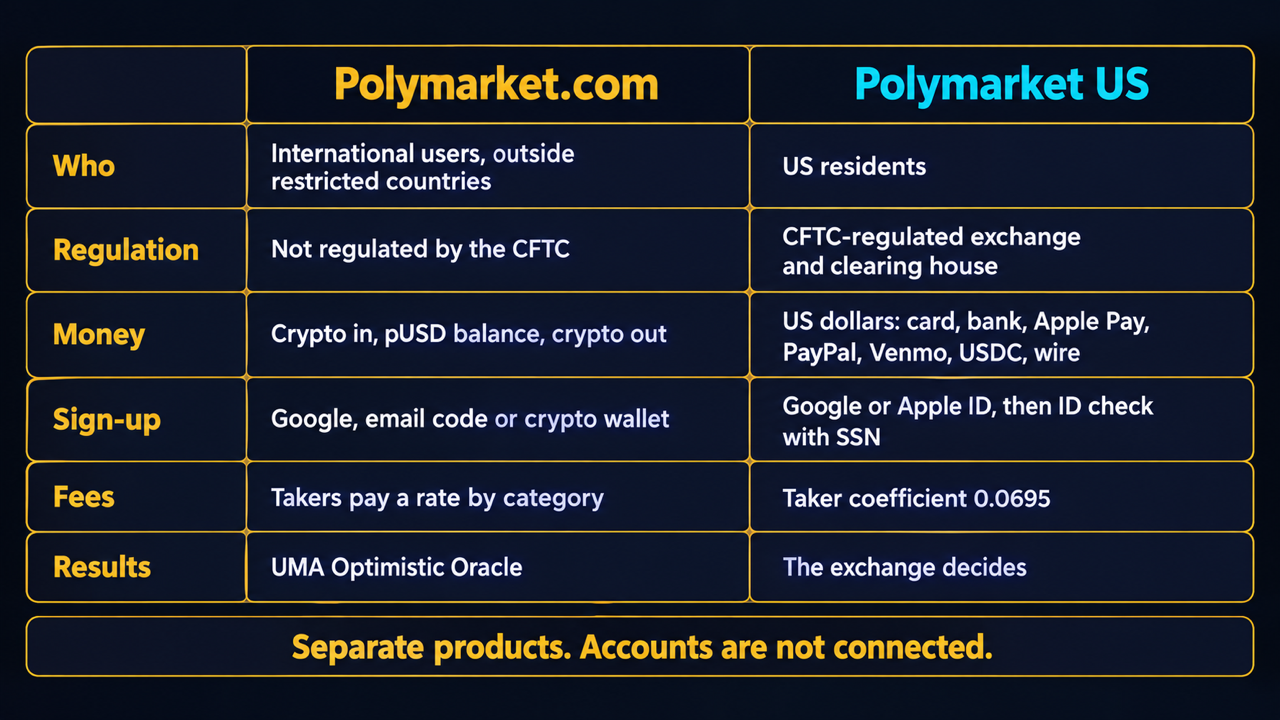
- There are two Polymarkets. Polymarket.com is international and crypto-based, and its own footer says it "is not regulated by the CFTC". Polymarket US is a separate, CFTC-regulated exchange that trades in US dollars. The accounts are not connected, and US residents must use Polymarket US.
- A share costs between $0.00 and $1.00 and pays $1 if it wins. Buy Yes at 40¢ and you make $0.60 per share if it happens, or lose your $0.40 if it doesn't.
- You buy at the ask, not at the price on screen. The displayed price is the midpoint between the best buy and sell offers.
- On Polymarket.com only takers pay, at a rate set by category. 100 shares at 50¢ cost $1.75 in fees on a crypto market and $0 on a geopolitics market. Makers are never charged.
- Read the rules, not just the title. Results on Polymarket.com go through the UMA Optimistic Oracle: about 2 hours if nobody disputes, 4–6 days in total if someone does.
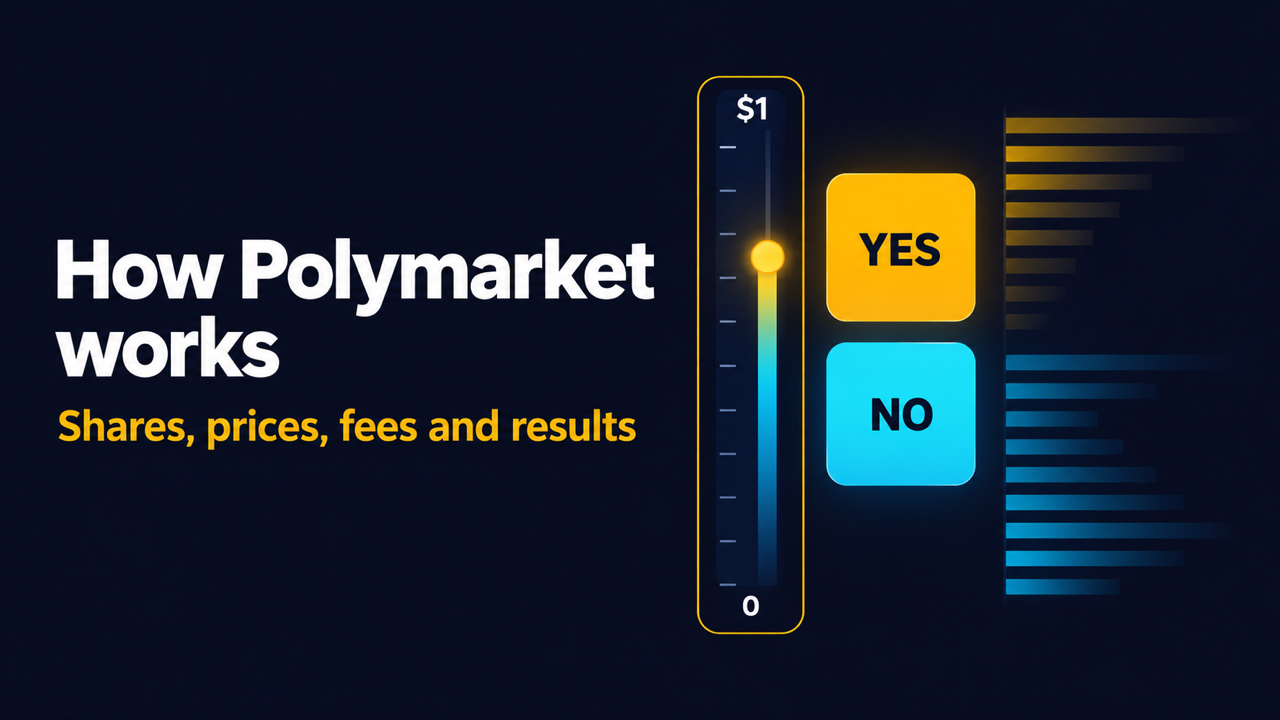
Polymarket calls itself "the world's largest prediction market". This guide explains how it actually works, using only Polymarket's own docs, help centre and terms, plus the Polymarket US docs, all read on 10 October 2026. It covers the same ground as the VictoryBet video How Does Polymarket Work? Beginner's Guide (2026), with every figure from the video and a link to each source page.
On this page
What Polymarket is
In Polymarket's own words: "Polymarket is a prediction market platform where users trade on the outcomes of real-world events. Instead of betting against a house, you trade shares with other users in an open, peer-to-peer market. Prices reflect the market's collective belief in the probability of an event occurring." (Polymarket 101)
The same page says the platform is non-custodial, "meaning you always control your funds", and "is built on Polygon, a blockchain network", where your shares exist as tokens. Orders are matched off the blockchain and settled on it through smart contracts, which Polymarket calls "hybrid-decentralized".
Users "cannot directly create their own markets" but "are encouraged to suggest ideas for new markets". The fee schedule sorts markets into eleven categories: Crypto, Sports, Finance, Politics, Economics, Culture, Weather, Mentions, Tech, Geopolitics and Other.
Polymarket.com vs Polymarket US
Polymarket's help centre: "Polymarket.com is for international users, while US residents must use the Polymarket US app. These are separate products with separate support teams." The US app is "Entirely separate from Polymarket.com - accounts are not connected".
Polymarket US describes itself as "a fiat-based, US-regulated platform operating as a designated contract market (DCM) and derivatives clearing organization (DCO) under CFTC oversight" (Polymarket US docs): a regulated exchange and its clearing house, trading in US dollars. It is operated by QCX LLC d/b/a Polymarket US and runs on iPhone, Android and the web. Polymarket.com's footer says of itself: "This international platform is not regulated by the CFTC and operates independently."
Outside the US and the restricted list?
Browse Polymarket.com's live markets and read a market's rules before you trade anything.
Visit Polymarket.com →In the US? Polymarket.com is not open to US residents; use the separate Polymarket US app. In the UK or another restricted country? Polymarket.com is not available to you.
Affiliate link: it pays us, not you. 18+ only. Trading involves substantial risk of loss.
Shares and prices: what you are actually buying
Every market is a Yes-or-No question, and you buy shares in one side. Polymarket's 101 page: "Every share on Polymarket is priced between $0.00 and $1.00. The price represents the market's belief in the probability of that outcome occurring." Its example: if Yes is trading at $0.65, "the market believes there's approximately a 65% chance the event will happen."
"$1 pUSD creates one Yes share and one No share" (pUSD is Polymarket.com's dollar token), and only one pays out: "Winning shares are redeemable for $1.00", while "Losing shares are worth $0.00".
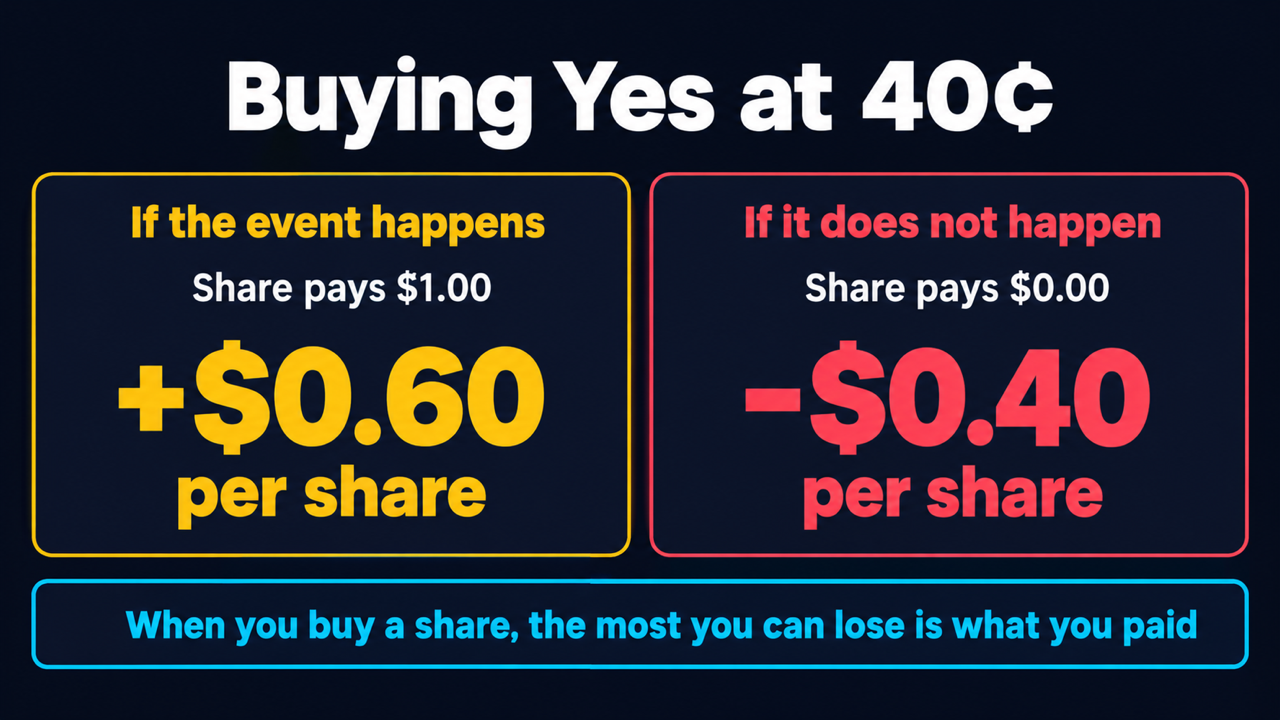
Polymarket's worked example (positions and tokens): buy Yes at $0.40 and you gain $0.60 per share (150%) if the event happens, or lose $0.40 per share (−100%) if it doesn't. When you buy a share, the most you can lose is what you paid. The table applies the same arithmetic to other prices, before fees.
Our arithmetic from Polymarket's $1-or-$0 payout. Decimal odds are 1 ÷ price, rounded to two places.
Two exceptions to "$1 or nothing". A market can resolve to a split payout, such as 50-50, when "each token redeems for $0.50". And in events with several outcomes, "Exactly one market in the group resolves Yes, while every other market resolves No."
Polymarket US works the same way ("A contract priced at 62¢ means the market thinks there is roughly a 62% chance the event occurs"; contracts settle at $1 or $0), with two differences: "There are no separate "No" shares to trade" (selling Yes you don't own is recorded as a short position), and most markets trade in steps of 0.01 contracts.
The price you see isn't the price you pay
From Polymarket's prices and order book page: "The displayed price is the midpoint of the bid-ask spread. If the spread is wider than $0.10, the last traded price is shown instead." The bid is the best offer to buy; the ask is the best offer to sell.
Polymarket's example shows a market displayed at 37¢: "You won't necessarily trade at $0.37—you'll pay the ask ($0.40) when buying or receive the bid ($0.34) when selling." Use the 40¢ you pay, not the 37¢ on screen, in the table above.
How trades happen: no house, just an order book
The other side of your trade is another user: "No, Polymarket is not the house. All trades happen peer-to-peer (p2p)." Orders meet in a central limit order book, and "Prices aren't set by Polymarket—they emerge from supply and demand as users trade with each other."
- Market order: "Execute immediately at the best available price."
- Limit order: "Execute only at your specified price or better." (Technically, every Polymarket order is a limit order.)
- Maker: your order rests on the book until it is matched.
- Taker: your order matches immediately against resting orders. That difference decides who pays fees.
You can sell before the result. "You may sell shares at any point before the market is resolved", by market order at the current bid or by limit order, but only "provided there is a willing buyer of your shares."
Every market has a minimum order size. The market details docs: "Every market enforces a minimum price increment, also known as the tick size, and a minimum order size", and smaller orders "are rejected". There is no upper cap, but "large orders may move the price significantly".
Sports markets have two extra rules: "any outstanding limit orders are automatically cancelled once the game begins", and there is "a 3-second delay on the placement of marketable orders."
On Polymarket US it's the same model: "The platform does not take the other side of your trades and does not set prices." You can close a position at any time, and "the proceeds are added immediately to your cash balance." A single market buy in the app or on the web is limited to $1,000,000.
Money in and out
Polymarket.com: crypto in, crypto out
Deposits are crypto transfers. You pick a method such as "Transfer Crypto" in the deposit guide, and the bridge docs accept assets "from Ethereum, Solana, Bitcoin, and other chains", "automatically converted to pUSD on Polygon."
Your trading balance is pUSD. The pUSD page: "pUSD (Polymarket USD) is the collateral token used for all trading on Polymarket. It's a standard ERC-20 token on Polygon, backed by USDC." It replaced USDC.e in Polymarket's exchange upgrade of 28 April 2026 ("Day to day, nothing changes"), and USDC or USDC.e you send "is wrapped into pUSD".
Minimums vary by network. Polymarket's help centre, docs and live bridge disagree on the figures, so check the deposit screen when you deposit. Our deposit fees guide measures what each route costs.
Mistakes are permanent. Polymarket warns: "Transactions sent to the wrong chain or address cannot be reversed."
Withdrawals go to a crypto address you enter. The withdrawal guide has you "Enter the recipient address" and "Select the token, amount, and network (chain)". Turning that into your local currency is a separate step outside Polymarket, for example at a crypto exchange.
Polymarket itself charges nothing to move money. The fees page: "There are also no Polymarket fees to deposit or withdraw USDC (though intermediaries like Coinbase or MoonPay may charge their own fees)." On gas, the wallet docs say smart wallets act "without paying gas", while a plain self-managed wallet "requires POL for gas".
Polymarket US: dollars in, dollars out
Polymarket US deposit methods: debit card, bank transfer (ACH), Apple Pay (iPhone), PayPal, Venmo, USDC (iPhone, where available) and wire transfer. Published limits:
Non-wire deposits "may be credited with instant buying power while the deposit is processing", but "Withdrawals are available once the deposit has fully cleared." Withdrawals are free and "must return to the original funding source used for deposit"; wire withdrawals aren't available in the app. Customer funds sit in "a dedicated customer account that is separate from Polymarket US's operating funds."
Fees: only takers pay, and the rate depends on the category
On Polymarket.com, "Polymarket charges a small taker fee on certain markets. Fees are set by the protocol and applied at match time" (fee docs). The formula is:
fee = C × feeRate × p × (1 − p)
C is the number of shares and p the price, so the fee peaks at 50¢ and shrinks toward 0¢ and $1: "a trade at 30¢ incurs the same dollar fee as a trade at 70¢." Two rules: "Makers are never charged fees. Only takers pay fees." And "Geopolitical and world events markets are fee-free. Polymarket does not charge fees or profit from trading activity on these markets."
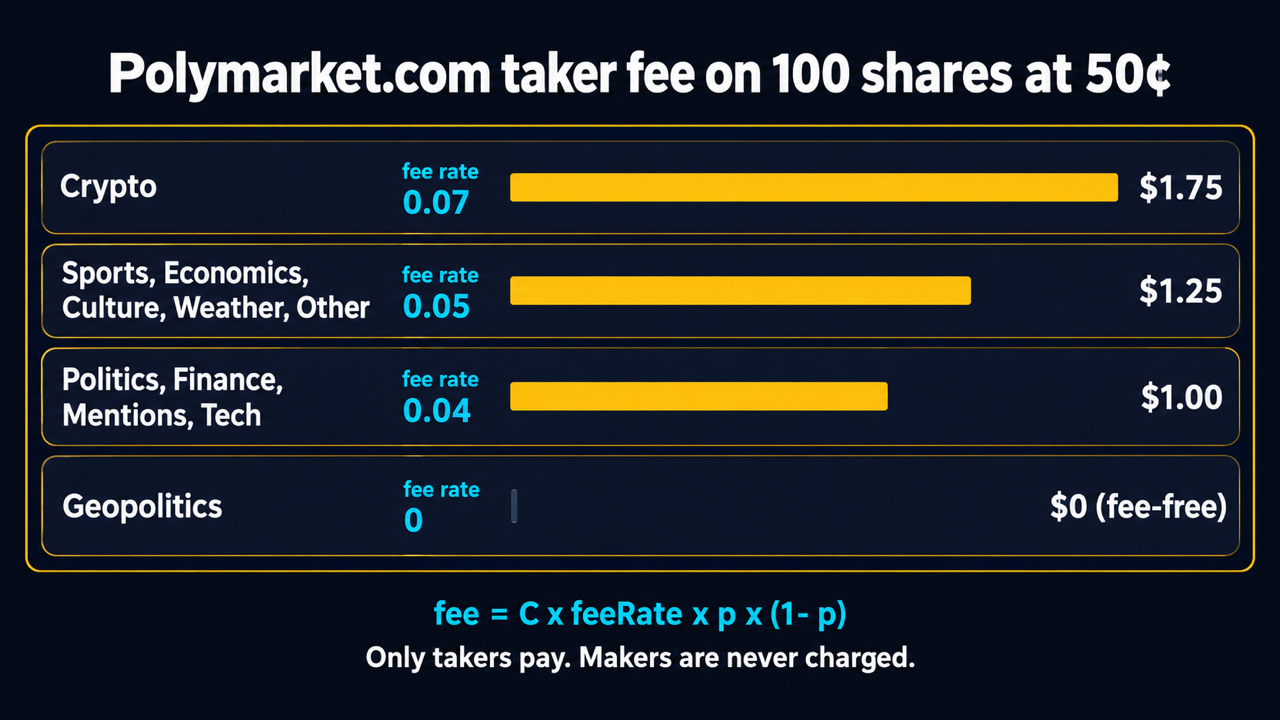
Rates and dollar figures from Polymarket's fee docs. Worked check for crypto: 100 × 0.07 × 0.50 × 0.50 = $1.75.
Where Polymarket's money comes from. Polymarket doesn't set prices or take the other side of your trade, so the bid-ask gap is not its margin; its charge on Polymarket.com is the taker fee. A limit order that rests on the book makes you a maker, and makers pay nothing.
Polymarket US uses one coefficient. Its fee schedule, "Effective exchange-wide from 10 AM ET, Wednesday October 7, 2026", is "Fee = Θ × C × p × (1 - p)": a taker coefficient of 0.0695 ($1.74 on 100 contracts at 50¢), or 0.10 for Table Tennis ($2.50). Makers receive a rebate of 0.0125 ($0.31 on 100 contracts at 50¢) on straight trades, but "Combo fills carry no maker rebate". Our fees guide works through both schedules at every price.
Eligible for Polymarket.com?
Makers are never charged, geopolitics markets carry no taker fee, and Polymarket charges nothing to deposit or withdraw USDC.
Visit Polymarket.com →Only for readers outside the US and Polymarket's other restricted countries, the UK included. US residents must use the separate Polymarket US app.
Affiliate link: it pays us, not you. 18+ only. Trading involves substantial risk of loss.
Who decides the result
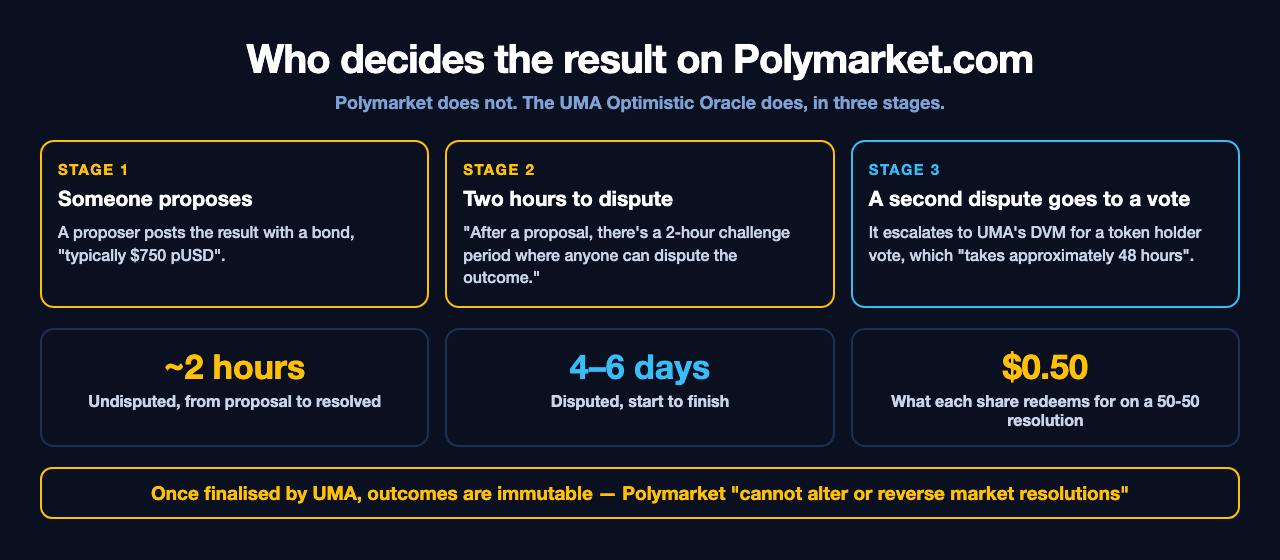
Polymarket.com doesn't decide results itself. Its resolution docs: "Polymarket uses two Resolution Sources, UMA for prediction markets and Chainlink TWAP for up-down markets." For prediction markets, the UMA Optimistic Oracle, an outside settlement system, works like this:
- Someone proposes the result and posts a bond, "typically $750 pUSD".
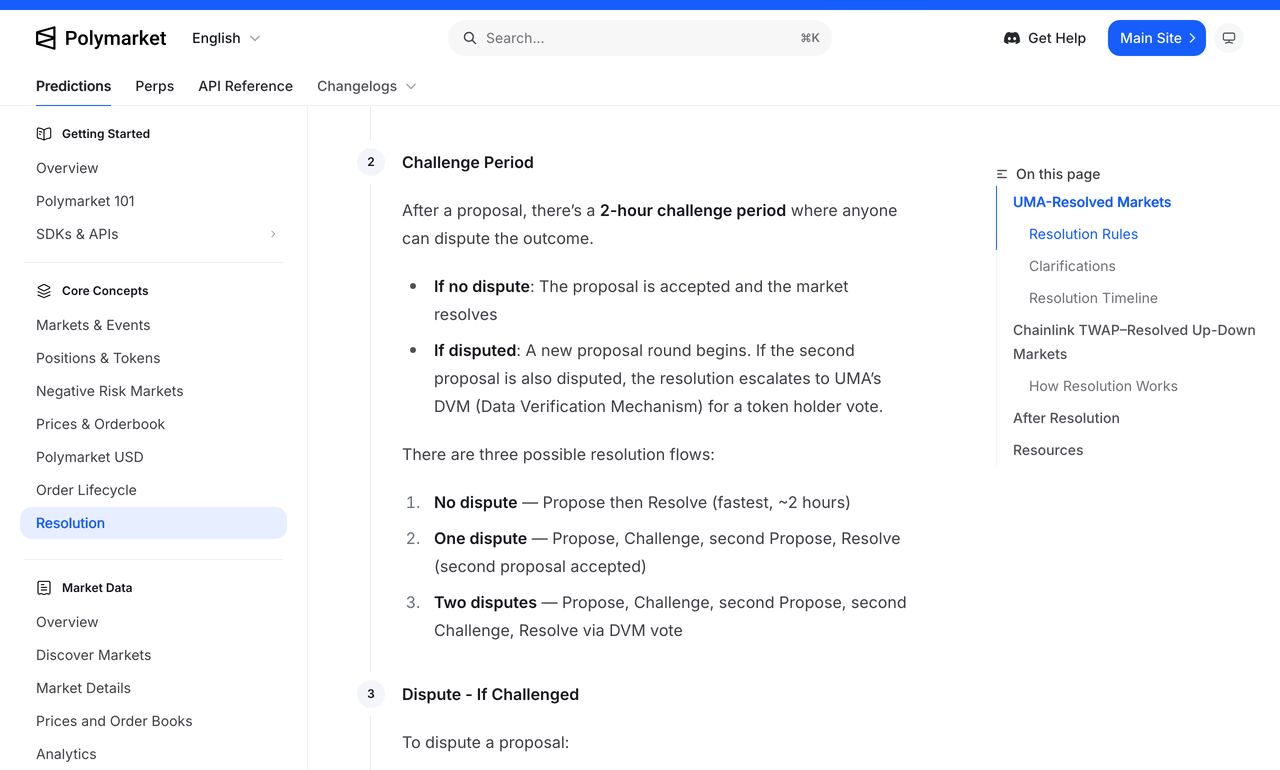
- Anyone can challenge it. "After a proposal, there's a 2-hour challenge period where anyone can dispute the outcome."
- A second dispute goes to a vote. A disputed proposal is replaced by a new one, and "If the second proposal is also disputed, the resolution escalates to UMA's DVM (Data Verification Mechanism) for a token holder vote." Polymarket says "The voting process takes approximately 48 hours."
Undisputed, a market resolves about 2 hours after the proposal. Disputed, it takes 4–6 days in total. A market can also resolve 50-50, each share redeeming for $0.50. Once final, Polymarket says it "cannot alter or reverse market resolutions. Once finalized by UMA, outcomes are immutable." Our Polymarket resolution guide follows the process step by step.
"Always read the resolution rules before trading. The market title describes the question, but the rules define how it resolves." — Polymarket's resolution docs
When a market's rules are clarified, "the order book is cleared and all resting orders cancelled", so re-check any limit order you had waiting.
Polymarket US works differently. From its market resolution page: "Once the outcome becomes publicly known, the Exchange determines the result using publicly verifiable information." Markets "resolve using the specific sources listed in the rules", and "All resolutions are final in accordance with the Polymarket US Exchange Rulebook." Its rules also allow situations where a market "settles at $0.50 or at the last fair market price."
Signing up
Polymarket.com offers three ways to sign up: with Google, with your email (you "Enter the 6-digit code sent to your email"), or by connecting a crypto wallet "such as MetaMask, Rabby, or Phantom". Polymarket's warning about that code: "Never share your 6-digit login code - not even with Polymarket staff."
Your account comes with a crypto wallet: "You can export your private key at any time", but "If you lose your private key, you lose access to your funds." The sign-up guide lists no identity check, but the terms say Polymarket "may, from time to time, request additional information from you, including, but not limited to, information to confirm that you are not a Restricted Person." The site is for users 18 or over.
Polymarket US uses a different process. You sign up "with Google or Apple ID", then complete an identity check (KYC, "know your customer"): date of birth, phone number, legal name, residential address and Social Security number. You "may be asked to upload a government-issued ID and complete a selfie check", and "You must complete KYC before you can deposit funds or trade." You must be at least 18, or older where your state requires it.
Who can use which
Polymarket.com is closed to the US. Polymarket's help centre: "Polymarket.com is not accessible for US residents. US users cannot deposit funds or place trades on the website." The site itself shows US visitors a banner: "Trading is blocked in the United States on polymarket.com. Switch to polymarket.us to trade prediction markets."
It is also closed to the UK and dozens of other countries. Polymarket's geographic restrictions page heads its list "The following 39 countries are completely restricted from accessing Polymarket", and the United States is on that list too. It includes the United Kingdom, France, Germany, Italy, the Netherlands, Ireland, Belgium, Poland, Australia, New Zealand, Japan, Singapore, Taiwan, Thailand, Brazil and Russia, plus the Canadian provinces of Alberta, British Columbia, Ontario and Quebec, and Crimea, Donetsk and Luhansk. Singapore, Poland, Thailand and Taiwan are listed as close-only: users there can close existing positions but not open new ones. Polymarket's developer docs group some countries differently, putting both the UK and the US under "Regulatory-Restricted Jurisdictions (Close-Only on Frontend and API)", so check the current list for your country.
The terms bar anyone "residing in, a citizen of, organized in or located in any jurisdiction identified as a restricted jurisdiction", and "Polymarket strictly prohibits the use of VPNs or similar tools to bypass geographic restrictions. Such actions are considered violations of the platform's Terms of Service (Section 2.1.4)." If you are in the UK, our Polymarket UK guide covers the legal position in full.
Polymarket US is for US users aged 18 or over. Its App Store listing carries the footnote "Trading currently unavailable in NV", meaning Nevada, and no page in the Polymarket US docs lists eligible states.
Five things to know before your first trade
- Which Polymarket you're on, and whether either is open to you where you live.
- The price is a probability, and when you buy a share, the most you can lose is what you paid.
- You buy at the ask, not at the price on screen.
- Takers pay a fee that depends on the category; makers don't.
- Read the rules, not just the title.
And the line Polymarket prints in the footer of both sites: "Trading involves substantial risk of loss." Polymarket.com's terms add that "participation in Contracts could result in the loss of the full amount supplied." Only put in what you can afford to lose entirely.
Where to go next
Outside the US and the restricted list?
Sign up to Polymarket.com with Google, email or a crypto wallet, browse the markets, and read a market's rules before you trade.
Visit Polymarket.com →In the US: use the separate Polymarket US app. In the UK or another restricted country: Polymarket.com is not available to you, and Polymarket prohibits using a VPN to get around that.
Affiliate link: it pays us, not you. 18+ only.
Frequently asked questions
Can I use Polymarket where I live?
Polymarket.com is closed to US residents, the UK and dozens of other countries on Polymarket's restricted list. US residents must use the separate Polymarket US app, which is for users aged 18 or over; its App Store listing says trading is currently unavailable in Nevada. Polymarket strictly prohibits using a VPN to get around its geographic restrictions.
What is the difference between Polymarket.com and Polymarket US?
Polymarket.com is the international, crypto-based site, and its footer says it is not regulated by the CFTC. Polymarket US is a separate, CFTC-regulated exchange and clearing house that trades in US dollars. The accounts are not connected.
How do Polymarket shares turn into money?
A winning share pays $1 and a losing share $0; on Polymarket.com that is pUSD, a dollar token backed by USDC. You can also sell early if someone is willing to buy. Polymarket.com withdrawals go to a crypto address you enter; Polymarket US withdrawals are free and go back to the original funding source.
What does Polymarket charge?
On Polymarket.com only takers pay, using fee = C × feeRate × p × (1 − p): 0.07 for Crypto, 0.05 or 0.04 for the other categories, and Geopolitics is fee-free. Makers are never charged, and there is no Polymarket fee to deposit or withdraw USDC. Polymarket US uses a taker coefficient of 0.0695 and pays makers a rebate on straight trades.
Is there a minimum trade on Polymarket?
Yes. Every Polymarket.com market has a minimum order size, and smaller orders are rejected. Crypto deposit minimums vary by network, so check the deposit screen.
Can I lose more than I put in?
When you buy a share, the most you can lose is what you paid for it. Polymarket Perps, a separate product, offers leveraged positions with liquidation, which carry different risks. As Polymarket's footer says, trading involves substantial risk of loss.
How long does a Polymarket market take to resolve?
On Polymarket.com, an undisputed result is final about 2 hours after it is proposed. If it is disputed twice, UMA token holders vote, which takes about 48 hours, and a disputed market takes 4–6 days in total. On Polymarket US, the exchange decides using publicly verifiable information.
Do I need crypto experience to use Polymarket?
For Polymarket.com, some: you can sign up with Google or email, but deposits and withdrawals are crypto transfers, and a transfer to the wrong chain or address cannot be reversed. Polymarket US takes debit card, bank transfer, Apple Pay, PayPal, Venmo, USDC or wire.
Sources (all read 10 October 2026)
- Polymarket 101: definition, share prices, $1 pairs, Polygon, private keys.
- Prices and order book: displayed price, the $0.37/$0.40/$0.34 example, order types.
- Positions and tokens: the buy-Yes-at-40¢ example and split payouts.
- Order lifecycle: makers and takers.
- pUSD and bridge withdrawals.
- Polymarket.com fees and Polymarket US fees.
- Polymarket.com resolution and Polymarket US market resolution.
- Polymarket US debit card limits and trading limits.
- Geographic restrictions and Polymarket.com terms of service.
Related reading
- Polymarket Fees 2026: What You Actually Pay — both fee schedules, worked at every price.
- Polymarket Deposit Fees 2026: The Real Cost — what each deposit route costs on the way in.
- Polymarket Resolution 2026: When UMA Decides — proposals, bonds, disputes and votes.
- Polymarket vs Kalshi 2026 — fees, access and who settles.
- Polymarket UK 2026: Is It Legal? — the position for UK readers.
- The Polymarket hub — every Polymarket guide on this site.
18+ only. Trading involves substantial risk of loss, and prediction-market trading can be addictive; decide your limit before you deposit. See BeGambleAware.org. Affiliate links earn us a commission at no cost to you.