Kalshi Contract Parameters 2026: 1,030 Names
Kalshi contract parameters are the blanks the exchange fills in. We read all 3,428 contract documents: 1,030 parameter names, and 82% defer to Kalshi.
Affiliate disclosure: contains affiliate links; we may earn a commission at no extra cost to you. We have no commercial relationship with Kalshi and earn nothing from it. 18+ only — see BeGambleAware.org. Last checked November 2026.
Key takeaways
- Kalshi contract parameters are the operative terms of your contract, and there are 1,030 of them. We pulled every contract-terms document on the board — 3,428 readable files covering 17,118 series — and counted 1,030 distinct parameter names used 114,883 times. They appear in 98.2% of documents.
- 82.4% of the definitions point back at Kalshi. Of 9,589 parameter definitions, 7,902 say the value is specified, determined or designated by the Exchange or by Kalshi. Only 350 (3.7%) point to something you could check without asking the exchange.
- 2,054 parameters are used and never defined. That is 17.9% of all document–parameter pairs, and it touches 1,187 documents and 6,998 series — 40.7% of the board. Fifty-eight documents use parameters and define none at all.
- Economics is the worst category at 82.5% of its series carrying an undefined parameter, against 6.2% for Mentions. Same board, thirteen times the exposure.
- This is deliberate, not a bug. Kalshi self-certified a contract to the CFTC titled “How long will <event> last?” and listed the brackets as its strike conditions. The template is the product.
On this page
- What a parameter actually is
- 1,030 names, 114,883 times
- 82% point back at Kalshi
- The 3.7% you can check
- 2,054 never defined at all
- Which categories are worst
- One market is no excuse
- Where the brackets escape
- The CFTC filing
- Reading one before you size
- My verdict
- Related guides
- FAQ
- Method and sources
Open the contract-terms PDF behind almost any Kalshi market and you will hit a word in angle brackets. “The Payout Criterion for the Contract encompasses the Expiration Values that TikTok is available to download by the American general public on the iOS app store after Issuance and before <date>.” That bracket is not a typo and it is not a rendering fault. It is a Kalshi contract parameter, and it is where the term that decides whether you get paid is supposed to go.
The stakes are the whole position, because the brackets are not in the footnotes. They sit in the Payout Criterion, the Expiration Date and the Underlying — the clauses that define what you bought. If a reader cannot resolve them, the document does not answer the only question they have.
So I counted them all. I pulled Kalshi's public series list, fetched every contract-terms document it points at, extracted the text of all 3,428 readable files, and built the full parameter vocabulary: every name, every instance, every definition, and every place a parameter is used with no definition anywhere in the document that uses it.
Two things came out of it. The brackets are defined far more often than I expected — and the definitions, 82.4% of the time, say that Kalshi decides.

What a Kalshi contract parameter actually is
Kalshi does not write one document per market. It writes a template per contract family and lists many markets off it, which is why one file can serve hundreds of series. We took that apart in Kalshi Contract Terms 2026.
The parameters are what makes the sharing possible. A template says “before <date>” and the listing supplies the date. The good templates add a definition block, like this one from the TikTok app-store contract:
<date>: <date> refers to a calendar date specified by the Exchange. The Exchange may list iterations of the Contract corresponding to variations of <date>.
Board-wide the parameters fall into three shapes, and only one of them is ambiguous in practice.
| Kind | Example | Names | Documents | Instances |
|---|---|---|---|---|
| Merge field | <date>, <entity>, <time period> | 860 | 3,363 | 108,521 |
| Alternation | <above/below/exactly> | 151 | 1,112 | 6,022 |
| Literal number | <1>, <0.01> | 19 | 264 | 340 |
Alternations are self-contained: “above or below” is a menu, and the listing picks an item from it. Literal numbers are increments, usually the tick on a ladder of strikes. It is the 860 merge fields, 94.5% of every instance on the board, where the reader is being asked to trust a value they cannot see.
1,030 names, used 114,883 times
The vocabulary is both bigger and more lopsided than I expected. 1,030 distinct parameter names, 114,883 instances, present in 3,365 of 3,428 documents (98.2%) and 17,011 of 17,194 series (98.9%). A contract document with no parameters in it is the exception, not the rule.
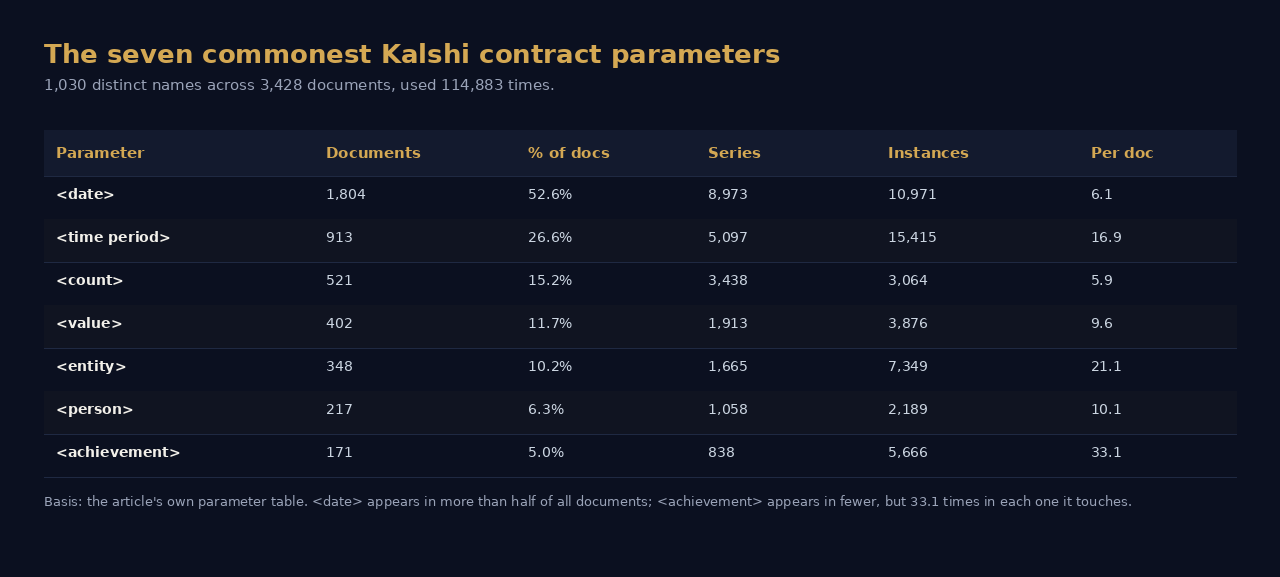
The lopsidedness is the interesting part. The ten commonest names account for 51.0% of every instance, while 562 of the 1,030 names — 54.6% — appear in exactly one document: a small shared core and a long tail of one-offs like <Alaska legislative election>.
| Parameter | Documents | % of docs | Series | Instances | Per doc |
|---|---|---|---|---|---|
| <date> | 1,804 | 52.6% | 8,973 | 10,971 | 6.1 |
| <time period> | 913 | 26.6% | 5,097 | 15,415 | 16.9 |
| <count> | 521 | 15.2% | 3,438 | 3,064 | 5.9 |
| <value> | 402 | 11.7% | 1,913 | 3,876 | 9.6 |
| <entity> | 348 | 10.2% | 1,665 | 7,349 | 21.1 |
| <person> | 217 | 6.3% | 1,058 | 2,189 | 10.1 |
| <achievement> | 171 | 5.0% | 838 | 5,666 | 33.1 |
Read the last column. <date> is the widest parameter and one of the least dense — six mentions in a document that otherwise reads normally. <time period> fires 16.9 times per document, <achievement> 33.1, and <word> 50.0 across the 22 documents using it. At that density the document is not prose with a gap in it; it is a form.
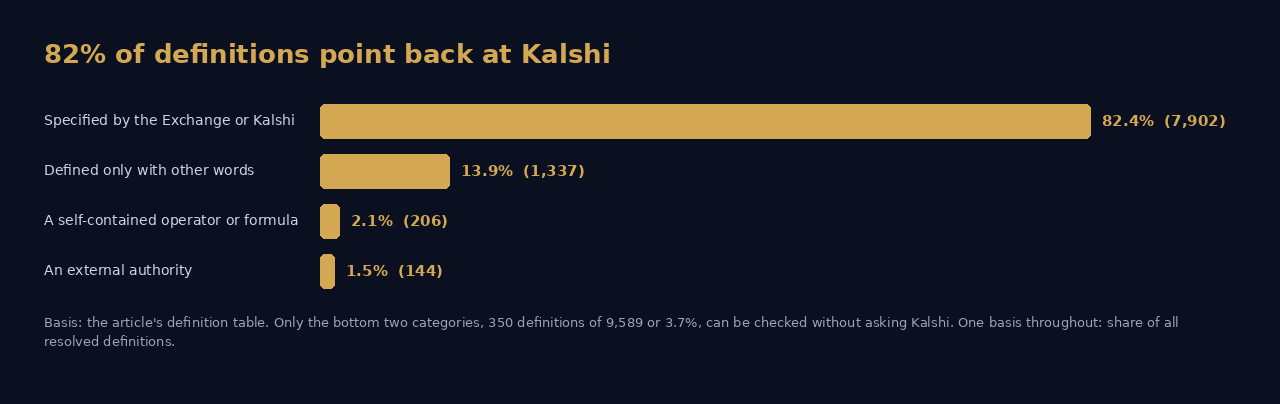
82% of Kalshi contract parameter definitions point back at Kalshi
Here is where I expected sloppiness and found something more awkward. The parameters are mostly defined: 9,589 definition blocks across 3,307 documents, each a named parameter, a colon and a paragraph. So I read where every one of them points. Does it hand you an authority you could check, or hand you back to the exchange?
| What the definition resolves to | Definitions | Share | Checkable without asking Kalshi? |
|---|---|---|---|
| Specified, determined or designated by the Exchange or Kalshi | 7,902 | 82.4% | No |
| An external authority (governing body, Source Agency, certified results) | 144 | 1.5% | Yes |
| A self-contained operator or formula | 206 | 2.1% | Yes |
| Neither — the word is defined with other words | 1,337 | 13.9% | No |
7,902 of 9,589 definitions, 82.4%, name the Exchange or Kalshi as the thing that decides what the parameter means. That language reaches 3,092 documents (90.2%) and 15,924 series (92.6%). Just 350 definitions (3.7%) give a reader anything they could verify on their own.
The 13.9% bucket deserves naming, because it is the one that looks like a definition and is not. “<participant> refers to a group, an entity, individuals, or individual participating in a sport” is the most-repeated example, in 168 documents. It names no decider and no source. 963 definitions — 10.0% of the total — are sixteen words or shorter, and most of those are this shape: a restatement with the brackets removed.
I want to be fair about what that 82.4% means. “Specified by the Exchange” is how a listing venue says “this is the strike we published on the market page”, and for <date> on a dated market that is both true and harmless. It is the parameters where the published value is a judgement rather than a number — <entity>, <achievement>, <event> — where the same phrase stops being administrative.
The 3.7% you can actually check
The good definitions exist and they show what the rest could look like. The basketball template defines its central parameter like this:
<entity> refers to either a basketball team or a basketball player officially entered in a <basketball game> as recognized by the governing body of the competition (e.g., NBA, NCAA, FIBA) and specified by the Exchange.
That one does both jobs: it names who publishes the fact and says Kalshi picks which one is in play. 1,067 of the 7,902 discretion definitions — 13.5% — also name an external anchor like this. It costs one clause, and it is the difference between a term and an assurance. The state-legislature templates go further and point at “the certified results”, a document a reader can go and find.
Polymarket pushes the same problem into a different shape: terse terms, with the ambiguity resolved afterwards by a bonded dispute. We set the two mechanisms side by side in Kalshi vs Polymarket Rules 2026. Neither venue hands you a fully checkable term up front.
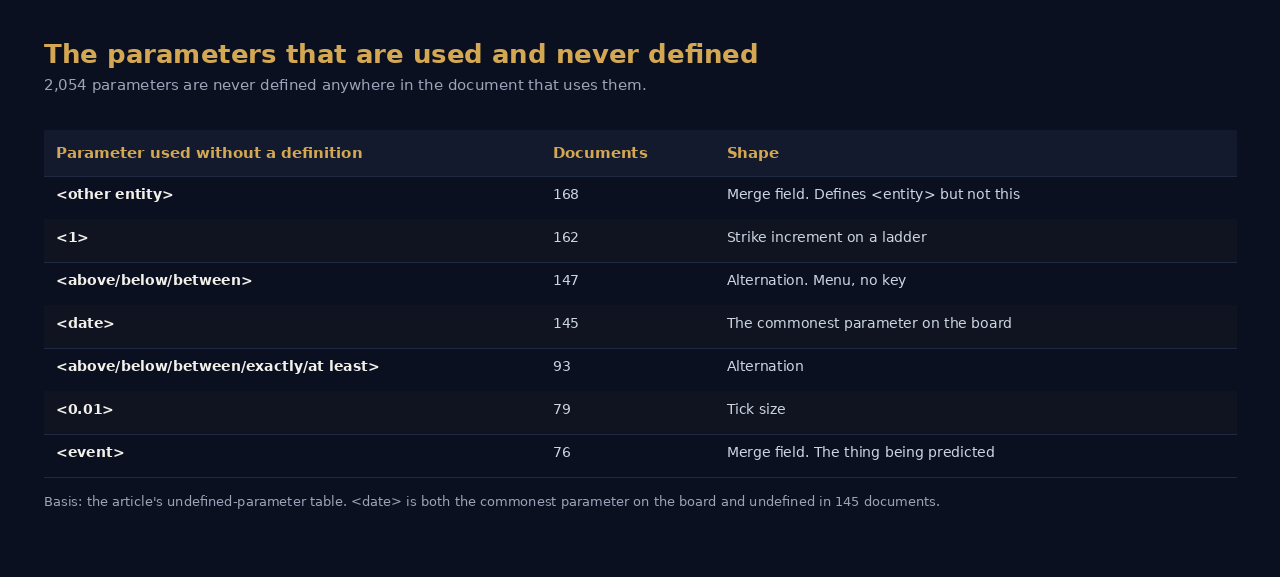
2,054 parameters are never defined at all
Now the straightforward defect. For every document I listed the parameters it uses and the ones it defines, and subtracted.
There are 11,444 document–parameter pairs on the board. 2,054 of them — 17.9% — are a parameter used in a document that never defines it. That reaches 1,187 documents (34.6%) and 6,998 series (40.7%). Two in five series on the board are listed against a document that uses at least one term it does not explain.
| Parameter used without a definition | Documents | Shape |
|---|---|---|
| <other entity> | 168 | Merge field — defines <entity> but not this |
| <1> | 162 | Strike increment on a ladder |
| <above/below/between> | 147 | Alternation — menu, no key |
| <date> | 145 | The commonest parameter on the board |
| <above/below/between/exactly/at least> | 93 | Alternation |
| <0.01> | 79 | Tick size |
| <event> | 76 | Merge field — the thing being predicted |
<other entity> is the most telling. 168 documents define <entity> at length — the college football template spends eleven lines on it — then use <other entity> in the Payout Criterion without a word on what makes an entity “other”. A drafting omission with a settlement consequence, on a template covering 398 series.
And 58 documents use parameters and define none of them at all, covering 112 series. Those are the files where the brackets really are just blanks.
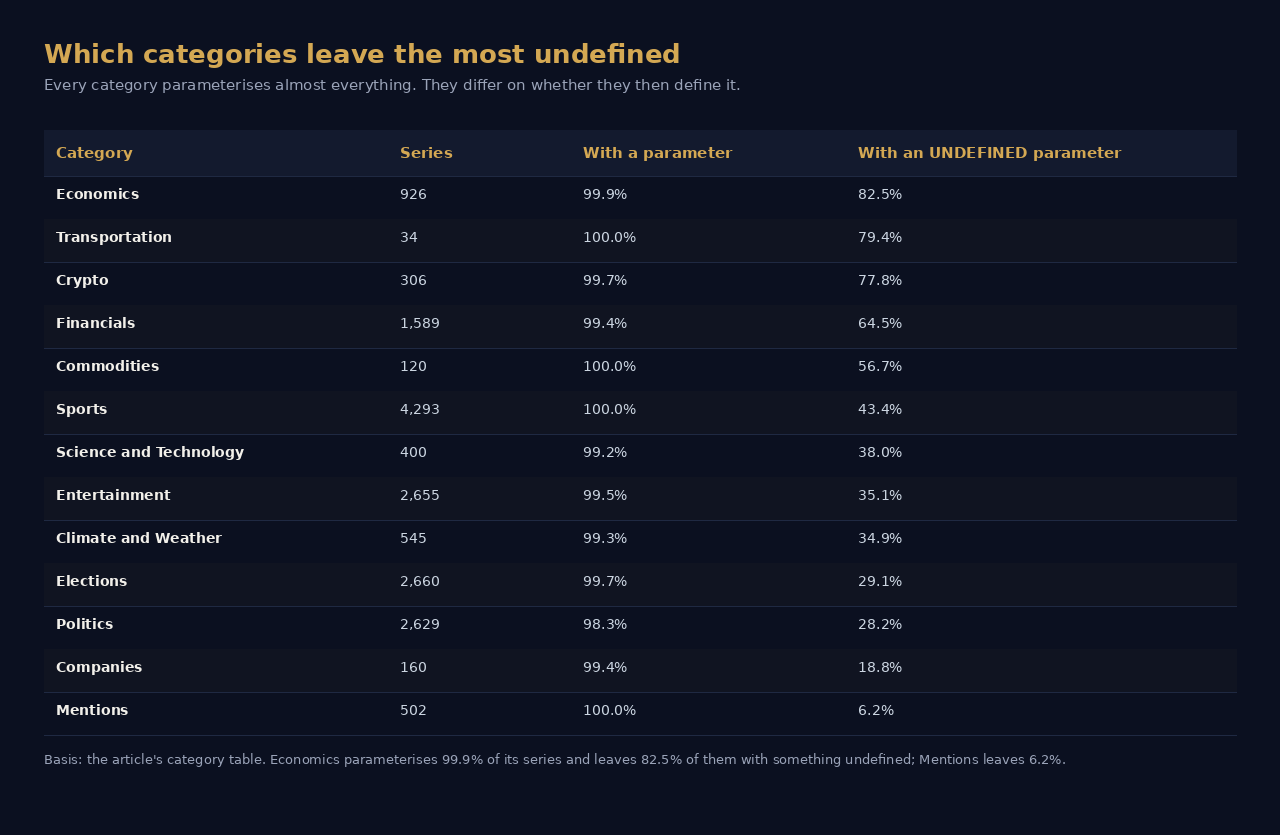
Which categories leave the most undefined
I expected sport to be the worst, because sport has the most bespoke language. It is not. The spread across categories is enormous and the small, quiet categories are the bad ones.
| Category | Series | With a parameter | With an UNDEFINED parameter |
|---|---|---|---|
| Economics | 926 | 99.9% | 82.5% |
| Transportation | 34 | 100.0% | 79.4% |
| Crypto | 306 | 99.7% | 77.8% |
| Financials | 1,589 | 99.4% | 64.5% |
| Commodities | 120 | 100.0% | 56.7% |
| Sports | 4,293 | 100.0% | 43.4% |
| Science and Technology | 400 | 99.2% | 38.0% |
| Entertainment | 2,655 | 99.5% | 35.1% |
| Climate and Weather | 545 | 99.3% | 34.9% |
| Elections | 2,660 | 99.7% | 29.1% |
| Politics | 2,629 | 98.3% | 28.2% |
| Companies | 160 | 99.4% | 18.8% |
| Mentions | 502 | 100.0% | 6.2% |
Economics is at 82.5% and Mentions at 6.2% — a thirteenfold gap inside one exchange. The cause is the ladder templates: an economics or crypto contract is usually a row of strikes, and the strike ladder is written with <count> and an increment like <1> or <0.01> that the document never defines. The reader is expected to infer the increment from the strikes on the market page.
Survivable on a CPI print where the increments are obvious. Less comfortable on the Crypto board, where 77.8% of series carry an undefined parameter and the thing being laddered is a price. The fee side there is worth reading too — we broke it down in Kalshi Fees by Market 2026.
One market per document is no excuse
The obvious defence is genericity: a template serving 500 markets has to speak in parameters. Fair enough — so I split the corpus and tested it. 1,845 of the 3,428 documents serve exactly one series. If the brackets were a cost of sharing, those files should be the clean ones. They are not.
| Measure | Sole-use docs (1,845) | Shared docs (1,583) |
|---|---|---|
| Uses at least one parameter | 98.6% | 97.6% |
| Uses <entity> | 12.6% | 7.3% |
| Uses <value> | 13.8% | 9.3% |
| Uses <time period> | 29.8% | 22.9% |
| Uses <date> | 50.3% | 55.3% |
| Uses an alternation | 28.9% | 36.5% |
A document that serves one market and nothing else is more likely to leave <entity>, <value> and <time period> in the text than a document serving hundreds. The genericity defence fails on its own numbers.
The last two rows invert, which is the check that tells me the taxonomy is sound rather than an artefact: <date> and the alternations really are commoner on shared ladder templates, exactly where menus and dated iterations belong. The vague merge fields go the other way.
Where the brackets escape the PDF
Everything above is inside a document that most traders never open. Three places the parameters reach further:
Two series titles still carry one. Out of 17,194 series, exactly two have a bracket in the title the API serves: KXPAYROLLSREV, “Previous jobs numbers revised above <X> in the next jobs report?”, and KXRANKLISTKG, “Will Ken Griffin be the top donator on <date>?”. Two out of 17,194 is a good rate; it is not zero.
Twenty-three series name a settlement source that still contains a parameter. This is the one I would fix first. The API's settlement-source list for nine entertainment series includes a source whose URL is literally google.com/search?q=official+broadcaster+of+<event>, with a display name of “official broadcaster of ” and nothing after it. Others point at searches for <performer>, <foreign+leader>, <company> and <team>. Eleven distinct URLs across 23 series — 0.13% of the board, and the field it is in is the field that decides the outcome. Which bodies get named where is the subject of Kalshi Source Agency 2026.
And a Google search is a settlement source 132 times over, across 71 series, placeholder or not — a separate argument, but the same instinct: resolve it later.
One more thing if you go looking: spelling is not consistent. 39 concepts are spelled more than one way — <date> in 1,804 documents and <Date> in one, <time period> in 913 and <time_period> in five, plus <person>/<Person> and a stray < time > with spaces inside the brackets. 70 names use snake_case. Search for one spelling and you will miss the others.
The template is deliberate, and the CFTC filing proves it
It would be easy to write this up as Kalshi shipping unfinished paperwork. The regulatory record says otherwise, and it was the most useful document I read tonight. On 12 August 2025 Xavier Sottile, Head of Markets at KalshiEX LLC, filed a self-certification with the CFTC under Regulation 40.2(a). The letter names the contract being certified like this:
Re: KalshiEX LLC – CFTC Regulation 40.2(a) Notification Regarding the Initial Listing of the “How long will <event> last?” Contract
The letter then lists the contract's “strike conditions” as five bullets: <date>, <event>, <time increments>, <above/below/between/exactly/at least>, and <count>. The parameters are the certified product. Kalshi told its regulator that the thing being listed is a template with five slots, and the regulator accepted it.
That reframes the finding. These are not merge failures; nobody forgot to run a mail merge. They are a design that lets one certification cover an unbounded family of markets, and lets Kalshi list a new dated iteration without filing again. The criticism that survives is narrower and harder to argue with: a deliberate parameter should have a definition, and 2,054 of them do not.
Reading a Kalshi contract parameter before you size a position
Two minutes per market, worth it on anything you are sizing seriously.
- Open the contract-terms PDF, not the rules summary on the card. It is at
assets.kalshi.com/contract_terms/<TICKER>.pdffor the family, and the family name is often not your market's ticker. - Search the document for the “<” character and list every hit. Do it before you read the prose. On a median document you will find four or five distinct names.
- For each one, look for a definition block — the name, a colon, a paragraph. If there is none, you are in the 17.9%, and whatever that term means lives only on the market page.
- Read what the definition resolves to. “Specified by the Exchange” is the 82.4% answer and it means the market page is authoritative, so screenshot the strike. A named governing body or Source Agency is the 3.7% answer and it means you can check the fact yourself.
- Treat the Payout Criterion's parameters as the only ones that matter. A bracket in the Issuance clause is housekeeping. A bracket in the Payout Criterion is your payout.
- Check the spelling both ways. If <time period> finds nothing, try <time_period>.
Read the blanks before you read the price
Every venue leaves something to be filled in later. Ten seconds with the contract document tells you whether the term you are trading is a fact or a decision.
Visit Polymarket.com →Affiliate link to Polymarket; we have no commercial relationship with Kalshi and earn nothing from it. 18+ only.
My verdict
The parameter system is good engineering and mediocre disclosure, and those two judgements sit together more easily than they look.
Good engineering, because one certified template per family is how a venue lists 17,194 series without filing 17,194 times, and the CFTC letter shows the brackets were declared rather than leaked. Mediocre disclosure, because 82.4% of definitions resolve to the exchange's own say-so, 13.9% define the word with other words, and 2,054 parameters on 40.7% of the board carry no definition at all. The 1,067 definitions naming a governing body and the exchange prove the better pattern costs one clause.
What I would actually change in my own trading: treat the market page as the contract for any parameter whose definition says “specified by the Exchange”, and screenshot it, because the PDF will not help you later. Be more careful on Economics and Crypto than on Sports, which is the opposite of the instinct. And if a Payout Criterion contains a bracket the document never defines, size it as though the term is unsettled, because for you it is.
Related guides
- Kalshi Contract Terms 2026 — why one document serves many markets, and what the sharing costs the reader.
- Kalshi Source Agency 2026 — which body each contract consults first, and how often the field is blank.
- Kalshi Outcome Review Committee 2026 — the three people who decide when the facts fail.
- Kalshi Last Fair Price 2026 — the fallback ladder that sets your payout when nothing else can.
- Kalshi Prohibited Traders 2026 — the per-market prohibition lists nobody reads.
- Kalshi Payout Time 2026 — the published settlement timer against the measured wait.
Kalshi contract parameters FAQ
What does <date> mean in a Kalshi contract?
It is a parameter: a slot the exchange fills in when it lists a particular market. The commonest definition on the board reads “<date> refers to a calendar date specified by the Exchange”, and the actual date for your market is on the market page rather than in the PDF. <date> is the most widespread parameter of all, appearing in 1,804 of 3,428 contract documents.
Is a bracket in a Kalshi contract a mistake?
Usually not. Kalshi self-certified a contract to the CFTC under the title “How long will <event> last?” and listed five bracketed parameters as its strike conditions, so the template is the certified product. What is arguably a mistake is the 17.9% of document–parameter pairs where a parameter is used and the document never defines it.
How many parameters are there across Kalshi's contracts?
We counted 1,030 distinct names used 114,883 times across all 3,428 readable contract documents, measured on 28 November 2026. They are heavily concentrated: the ten commonest names account for 51.0% of all instances, while 562 names appear in exactly one document.
Where do I find the real value of a parameter?
On the market page, in almost every case. 7,902 of 9,589 definitions say the value is specified, determined or designated by the Exchange or by Kalshi, which makes the published listing the authoritative source rather than the contract document. Only 350 definitions, 3.7%, point to something external like a governing body or certified results that you could check independently.
Which Kalshi markets have the most undefined parameters?
Economics, at 82.5% of its 926 series carrying at least one parameter the document never defines, followed by Transportation at 79.4% and Crypto at 77.8%. The cleanest is Mentions at 6.2%. Sports sits in the middle at 43.4% despite having the most bespoke vocabulary.
Can Kalshi change a parameter after I buy?
The contract specifications can change. Rule 7.2(a) of the KalshiEX rulebook lets the exchange designate a new Source Agency and Underlying and change associated contract specifications after the first day of trading, where a circumstance materially affects the original source's reliability. Any replacement must be objective and verifiable and is announced on Kalshi's website rather than emailed to holders.
Why does my search for a parameter find nothing?
Probably spelling. We found 39 concepts spelled more than one way, including <time period> against <time_period>, <date> against <Date>, and one instance of < time > with spaces inside the brackets. 70 names use snake_case and 158 contain a capital letter. Search for the bracket character itself and read the hits.
Method and sources
Everything counted here was measured on 28 November 2026. I pulled the full series list from Kalshi's public series endpoint in one unauthenticated request, documented in the Kalshi API reference, and followed every contract-terms URL it points at. Text came from pdftotext.
| Pipeline step | Count |
|---|---|
| Series returned by the endpoint (21.9 MB, HTTP 200) | 17,194 |
| Distinct contract-terms URLs on assets.kalshi.com | 3,456 |
| Returned HTTP 200 / returned 404 | 3,428 / 28 |
| Readable documents analysed (131 MB) | 3,428 |
| Series covered by those documents | 17,118 |
Two normalisation steps matter and I got one of them wrong first. Whitespace was collapsed before matching, so a parameter broken across a line break still counts. Ligatures were also normalised: pdftotext emits “specified” with a single fi ligature character, which is not the same string as “specified” — before I fixed that, the discretion figure read 72.9% instead of 82.4%. If you reproduce this, normalise both.
The regulatory evidence is the 12 August 2025 KalshiEX self-certification filed with the CFTC, which names the contract and lists its bracketed strike conditions. Rule 7.2 is cited from the KalshiEX rulebook on file with the Commission. Kalshi's own rulebook page returned HTTP 429 to this container on every attempt, as it has on our last five runs, so rule text is cited from the CFTC filings rather than from kalshi.com. For context on how other writers handle the rules stack, OddsShopper's piece on summary versus full rules is the best of them and does not go near the parameters.
Three limits. First, the denominator is URLs, not unique files: the 3,428 documents hold only 2,747 distinct texts, because 825 URLs serve a text byte-identical to another's and 741 carry an internal title that does not match their own URL. Per-document percentages are per-URL, which is what a reader following a market link actually meets. Second, “undefined” means undefined in that document — a market page may define a term the PDF does not, and for the 82.4% the market page is explicitly where the value lives. Third, the classification is pattern-matched, not hand-read; I sampled every bucket, and the boundary between “defined with other words” and “external authority” is where a human would most often disagree with me, which is why those rows are shown separately rather than summed.
Nothing here is financial advice. Event contracts can lose their full value. 18+ only.