Kalshi Same-Game Parlays 2026: 96 Priced
The Kalshi same-game parlay board has no open collection since October. We priced 96 of the combos you can still build: multiplying the legs is 12x off.
Affiliate disclosure: contains affiliate links; we may earn a commission at no extra cost to you. We have no commercial relationship with Kalshi. 18+ only — see BeGambleAware.org. Last checked November 2026.
Key takeaways
- The dedicated same-game board is dormant. Kalshi has 1,336 single-game combo collections on file — 1,113 NBA, 223 NFL — and not one is open. The newest NBA one closed 8 October 2026, the newest NFL one 7 August 2026, and tonight's Denver–New Orleans collection returns a 404.
- You can still build one, through a different door. Of 1,406 collections exactly 3 are open, and the cross-category board takes two legs from one game without complaint: 96 of the 289 combos we priced did that.
- Multiplying the legs is wrong by a factor of 12. On same-game combos the independence product sat a median 11.7x from the assumption-free ceiling. Every guide on page one teaches multiplication anyway.
- One check always works: a parlay cannot be worth more than its weakest leg. The median same-game quote was 13.6% of that ceiling. One of the 289 asked 113.1% of it — 69c for a ten-leg contract whose own Miles Russell leg was 61c.
- There is no way out. All 289 had no bid at all, 210 had never traded, and 287 showed an ask of $1.00 half an hour later.
On this page
Ask the internet whether you can build a Kalshi same-game parlay and you get two answers: most guides walk you through it in five steps, while at least one comparison table says the feature does not exist. Both describe something real, which is the interesting part. The product Kalshi launched for Monday Night Football in September 2025 has a board of its own, and that board has been shut since October.
That matters because of what it costs to get wrong. A same-game ticket stakes money on legs that move together — a quarterback's yards and his team covering are not independent events — and the method every page-one guide teaches, multiplying the legs, assumes exactly the independence a same-game ticket lacks. So we measured it: a complete read of Kalshi's 1,406 combo collections, then 289 live combo quotes priced against the 1,370 leg markets they are built from, inside one 42-second window.
The useful finding is not a margin number. It is that one check survives the correlation problem and nothing else does, and it takes ten seconds.
The dedicated same-game board went dark in October
Kalshi organises combos into multivariate event collections. A collection is the menu: it lists the events whose markets you may staple together. Two are built for single-game tickets — KXMVENBASINGLEGAME and KXMVENFLSINGLEGAME — holding 1,336 collections between them, one per game.
Every one is closed — and not in the way a finished game closes, because no replacement opened. The most recent NBA collection on the board closed 8 October 2026, the day after the season began; the most recent NFL one closed 7 August 2026, in pre-season. Filtering the endpoint for open status returns three of 1,406, and neither single-game series is among them.
| Series | Collections | Open now | Newest close date |
|---|---|---|---|
| NBA single game | 1,113 | 0 | 8 Oct 2026 |
| NFL single game | 223 | 0 | 7 Aug 2026 |
| Cities weather | 35 | 0 | 4 Mar 2025 |
| Mentions (single) | 13 | 0 | 12 Dec 2025 |
| NFL multi-game (both series) | 10 | 0 | 18 Nov 2025 |
| Sports multi-game extended | 3 | 1 | 3 Nov 2027 |
| Cross-category (both shards) | 2 | 2 | 3 Nov 2027 |
| Awards, championship, NBA multi (6 series) | 6 | 0 | — |
| Total | 1,406 | 3 | — |
The legs themselves are healthy — tonight's NBA props are open and quoted, Nikola Jokić 1+ assists at 80c, Zion Williamson 20+ points at 61c. Only the single-game menu is gone: ask the API for KXMVENBASINGLEGAME-26NOV14DENNOP and it answers 404. So the honest answer to "does Kalshi still do same-game parlays" is: not on the board built for them.
Where a Kalshi same-game parlay still gets built
The three open collections are the cross-category board, its shard, and sports multi-game extended. These are the catch-all menus, and the cross-category one is enormous — over 3,000 events the day we read it, which is how you get the party trick of stapling an NFL game to a tennis match.
Nothing stops you pointing it at one game. The menu lists every market in a game family — moneyline, spread, total, each player prop — as separate events, so two picks from one fixture is a legal combination on a board never labelled "same game". Plenty of people do it: 96 of our 289 combos drew two or more legs from one event, and 8 drew every leg from one.
Two mechanics are worth knowing first, both from Kalshi's own API documentation. One: a combo market does not exist until somebody creates it — the endpoint "must be hit at least once before a combo market can be quoted or traded", which is why the board is littered with contracts nobody has priced. Two: a hard cap of 5,000 new markets per user per rolling 7 days, across all collections and within each one, after which creation returns a 429 until older ones age out.
Selections are also validated, which is where same-game tickets get refused. Kalshi documents three rejection codes: conflicting_leg_outcomes, duplicated_legs and invalid_market_combination. Same-game legs trip the first most easily, since mutually exclusive outcomes from one game are what a validator hunts for. We hold no account there, so these are the documented rules, not our test results.
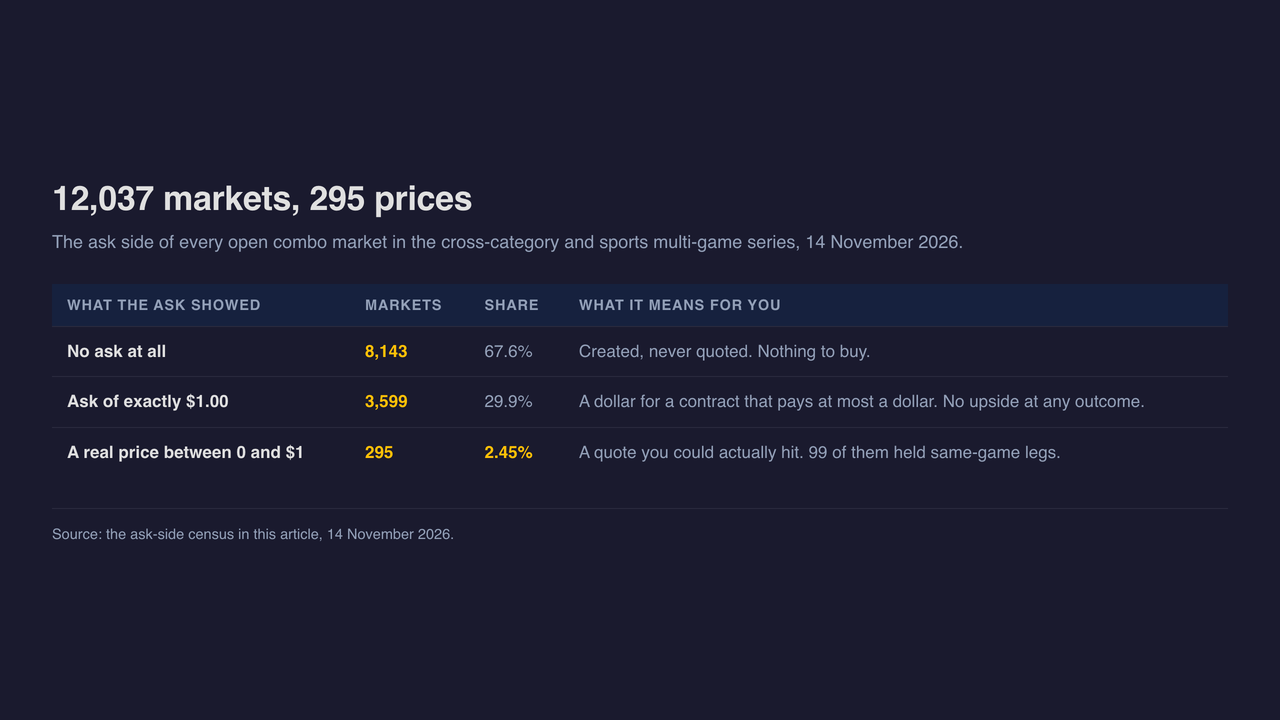
12,037 markets, 295 prices
The next thing to calibrate is how little of the board is for sale. We paged the first 12,037 open combo markets the cursor returned and read one field: the yes ask, the price you could buy at.
| What the ask showed | Markets | Share | What it means for you |
|---|---|---|---|
| No ask at all | 8,143 | 67.6% | Created, never quoted. Nothing to buy. |
| Ask of exactly $1.00 | 3,599 | 29.9% | A dollar for a contract that pays at most a dollar. No upside at any outcome. |
| A real price between 0 and $1 | 295 | 2.45% | A quote you could actually hit. 99 of them held same-game legs. |
Two things follow. The listing count is close to meaningless — 97.5% of what is "open" is scaffolding. And the $1.00 row is no rounding artefact: it is a resting offer to sell you a contract for the most it can ever pay. The board's way of saying no, and it looks identical to a price until you read it.
Why multiplying the legs is the wrong tool here
Here is the method every page-one guide teaches, and the one we used ourselves on independent-leg combos: fair value is the product of the legs' prices, and whatever the quote adds is the house's margin. Two legs at 50c are worth 25c. Clean, checkable, correct — when the legs are independent.
Same-game legs are not independent, and this is not a quibble about precision — it breaks the method in both directions. Jared Goff throwing for 175+ yards and Detroit covering tend to happen together, so true joint probability sits above the product. Ten golfers all finishing top 20 compete for the same twenty places, so it sits below. Multiplication cannot tell you which case you are in, and it does not warn you.
We can put a size on the damage. For each combo, compare the independence product against the highest value the contract could possibly be worth given its legs. On the 96 same-game combos the two numbers differed by a median factor of 11.7x, with the middle half spread between 5.2x and 47.5x. A method whose answer sits somewhere inside a twelve-fold band is not a pricing method. It is why our last piece excluded every same-event combo instead of averaging them in.
So the honest version of the question is not "what is the margin on a Kalshi same-game parlay". From outside, with no model of how a quarterback's yards co-move with his team's winning margin, that number is not recoverable. Anyone quoting you one has assumed the correlation away.
The ceiling that holds no matter how the legs move
One thing survives. A parlay pays only if every leg lands, so in every state where your ten-leg ticket pays $1, each individual leg pays $1 too — and there are plenty of states where a leg pays and the ticket does not. The leg's payoff is at least as good as the parlay's, always, whatever the correlations.
Which gives you a rule with no assumptions in it at all:
Never pay more for the combo than the cheapest of its own legs is asking.
If the combo costs the same as a leg or more, buy that leg instead. You pay no more, you win in every case the combo would have won, and you also win in cases where it would have lost. No correlation model, no probability estimate, no multiplication — just the price of the legs on the screen next to it.
The formal version is the Fréchet–Hoeffding upper bound: a joint probability can never exceed the smallest of its individual probabilities. A lower bound exists too, but it only bites when the legs are expensive enough that they cannot all fail — above zero for just 25 of our 289. The ceiling is the half that earns its keep, and it applied to all 289.
Two same-game combos, priced both ways
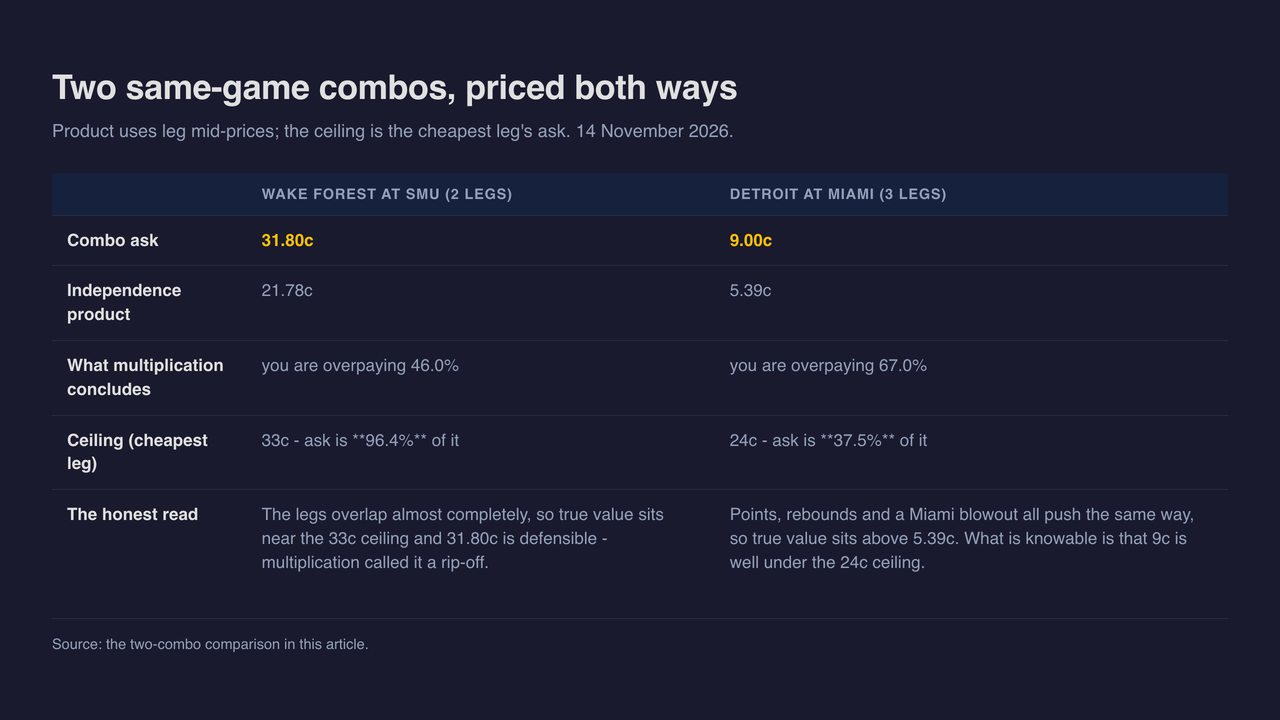
Abstractions are easy to nod along to, so here are two real tickets, every leg price as quoted.
| Wake Forest at SMU (2 legs) | Detroit at Miami (3 legs) | |
|---|---|---|
| Legs, as quoted | NO on "Wake Forest wins 1H by over 3.5" — 69c YES on "SMU wins by over 6.5" — 33c |
Bam Adebayo 20+ points — 38c Bam Adebayo 8+ rebounds — 68c Miami wins by over 5.5 — 24c |
| Combo ask | 31.80c | 9.00c |
| Independence product | 21.78c | 5.39c |
| What multiplication concludes | you are overpaying 46.0% | you are overpaying 67.0% |
| Ceiling (cheapest leg) | 33c — ask is 96.4% of it | 24c — ask is 37.5% of it |
| The honest read | The legs overlap almost completely: if SMU wins by 7+, Wake almost certainly did not lead the first half by 4+. True value sits near the 33c ceiling, so 31.80c is defensible — and multiplication called it a rip-off. | Points, rebounds and a Miami blowout all push the same way, so true value sits above 5.39c. How far above is unknowable from outside. What is knowable: 9c is well under the 24c ceiling. |
The SMU ticket is the one to sit with. By the standard method it is a 46% overpay and you walk away. By the only reasoning that holds, it is priced just under the most it could ever be worth — roughly where two legs overlapping this heavily belong. Multiplication did not lose precision there; it pointed at the wrong answer.
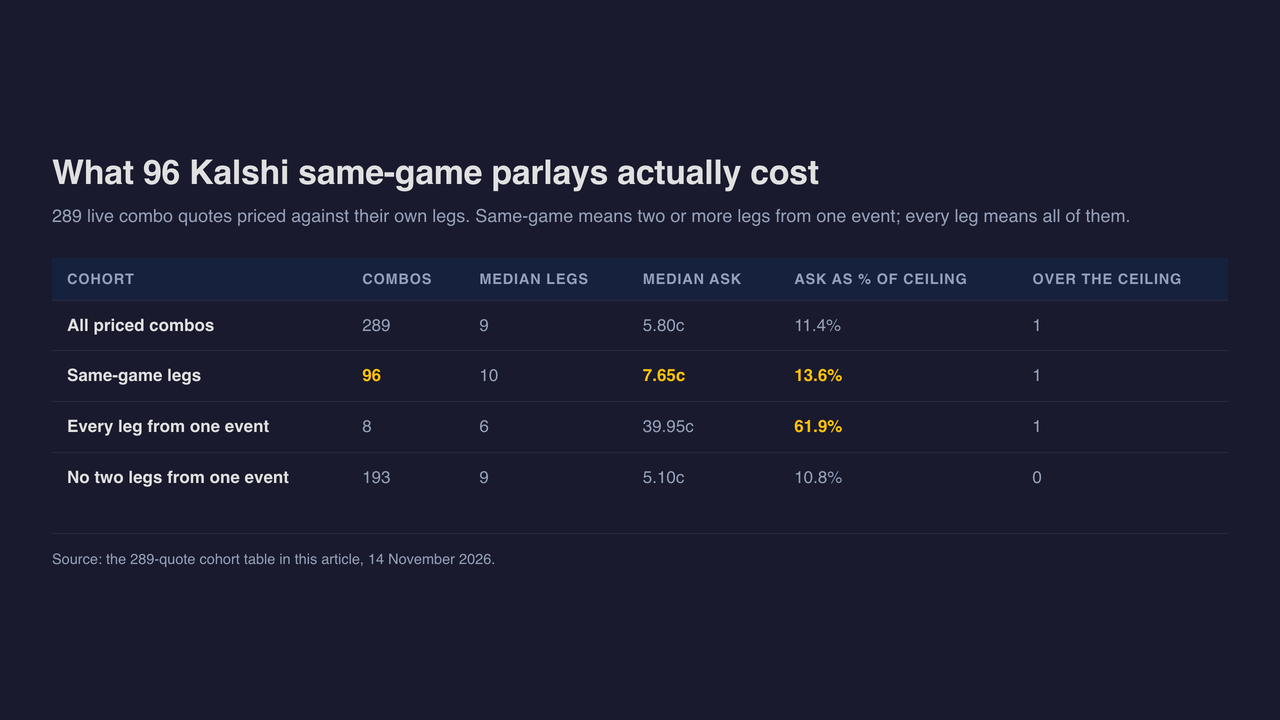
What 96 Kalshi same-game parlays actually cost
Across the whole cohort, the ceiling test is mostly reassuring, with one loud exception.
| Cohort | Combos | Median legs | Median ask | Ask as % of ceiling | Over the ceiling |
|---|---|---|---|---|---|
| All priced combos | 289 | 9 | 5.80c | 11.4% | 1 |
| Same-game legs | 96 | 10 | 7.65c | 13.6% | 1 |
| Every leg from one event | 8 | 6 | 39.95c | 61.9% | 1 |
| No two legs from one event | 193 | 9 | 5.10c | 10.8% | 0 |
Read the fifth column as headroom. A same-game combo asking 13.6% of its ceiling is nowhere near the boundary, and that is the normal case. Tickets drawn entirely from one event ask a much higher share, 61.9% — what you would expect when legs reinforce each other, and a reminder that a high share is not itself a bad price.
Then the exception, which is the best argument for running the check. A ten-leg contract on the 2026 Austin Championship — ten named golfers, all to finish top 20 — was offered at 69c while its own Miles Russell leg asked 61c. Four of the ten legs were cheaper than the parlay built from all ten. Buying Russell alone cost 8c less and won in strictly more cases, and you needed to know nothing about golf to see it.
Two caveats. The offer was never taken — trades there had gone through near 7.4c, a sane price for the event, and by the time we looked again the ask was $1.00. And it was one combo in 289. The lesson is not that the board is rigged; on this evidence it is not. It is that a resting combo offer can be nonsense, nothing flags it, and the check takes ten seconds.
Then the fee, and it is worst on exactly these tickets
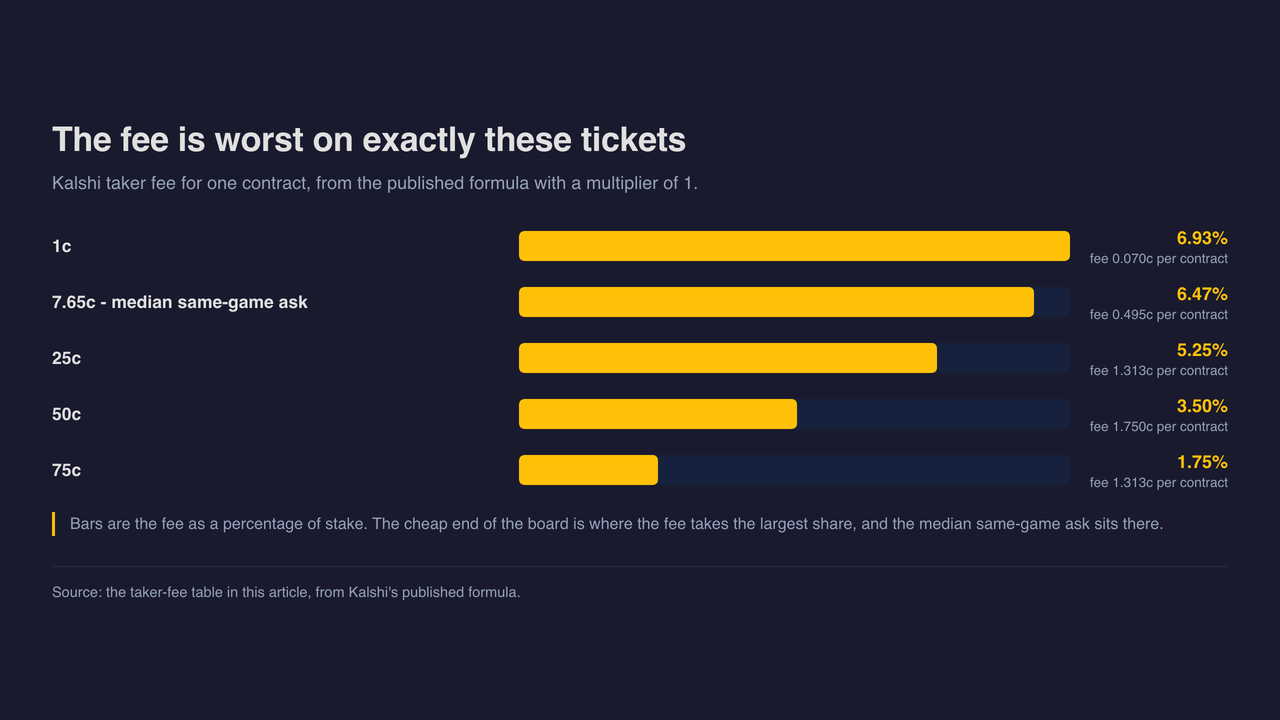
Kalshi's taker fee is quadratic in the price: 0.07 × P × (1 − P) per contract, rounded up to the nearest hundredth of a cent. The exchange's own documentation works an example at a 5.5c fill and gets $0.00363825, which is that formula to the last digit. All three open combo series carry the fee type quadratic_with_combo_maker_fees with a multiplier of 1, so no combo series is surcharged.
The sting is what that does as a share of what you put in. Divide the fee by the stake and the price cancels: you are paying 0.07 × (1 − P). The cheaper the contract, the bigger the bite — and parlays are cheap by construction.
| Contract price | Fee per contract | Fee as % of stake |
|---|---|---|
| 1c | 0.070c | 6.93% |
| 7.65c (median same-game ask) | 0.495c | 6.47% |
| 25c | 1.313c | 5.25% |
| 50c | 1.750c | 3.50% |
| 75c | 1.313c | 1.75% |
At the median same-game ask of 7.65c you hand over 6.47% of stake before kick-off — the one part of the ticket you can compute exactly, which is a strange thing to say about the cost you control least. Our read of the same coefficient across every single-contract series has the exceptions.
No bid, no exit, and the quote is gone in seconds
Pricing is the interesting part. Liquidity is the part that should decide whether you use the product at all.
Of the 289 combos we priced, the number carrying a bid was zero. Not a thin bid — none at all, on every one. There is nobody to sell to, so a combo is a position you hold to settlement whatever the game does, and 210 of the 289 had never traded a contract. If you are used to cashing out a sportsbook parlay with three legs home, that option does not exist here.
The quotes are fleeting. Of the 289 asks captured, only 35 were still live when we re-read the same tickers ten seconds later, and half an hour on 287 showed an ask of $1.00 — the board withdrawing. That is how the 69c golf offer vanished, and the consequence is practical: the price is a quote on request, not a market, and the ten seconds you spend checking it may be ten seconds it does not survive. Check anyway. An expired quote costs nothing; a bad one you accepted costs the difference.
By contrast, the single-contract books on the same exchange are a different world: the legs in our worked examples quoted two-sided, a cent or two wide, with real volume behind them.
What to check before you buy one
In the order the money is at risk.
- Open every leg in another tab and note its ask. This is the whole method, and it takes longer to read than to do.
- Compare the combo ask to the cheapest leg ask. If the combo is not clearly below it, buy the leg. One of our 289 failed this, by 8c on a 69c ticket.
- Do not treat the product of the legs as fair value. On same-game legs it sat a median 11.7x from the ceiling. A rough floor, never a verdict.
- Ignore an ask of $1.00. Nearly 30% of the open board shows one. It is not a price.
- Assume you cannot sell. Nothing in our cohort had a bid, so size it as money you can leave until settlement.
- Add 0.07 × (1 − P) to the cost. Roughly 6.5% of stake at typical parlay prices, and it is charged whether you win or lose.
- Check the legs are the ones you think. "Bam Adebayo: 8+" is rebounds in one series, points in another, and the ticket shows only the short label.
Price the legs before you accept the quote
Thirty seconds against the markets a combo is built from is the only check that survives correlated legs. Polymarket runs multi-leg positions on a different fee model, and comparing the two on one ticket is the cheapest edge in this niche.
Visit Polymarket.com →Affiliate link to Polymarket; we have no commercial relationship with Kalshi. 18+ only. Polymarket restricts access from the United States.
Related guides
- Kalshi Parlays 2026: 170 Combos Priced — the independent-leg half of this question, where multiplication does work.
- Kalshi Fees by Market 2026: 195 Exceptions — the same fee coefficient read across every single-contract series.
- Kalshi Maker Fees 2026: 163 Series Billed — what resting an order costs, and where.
- Polymarket Arbitrage 2026: 716 Fields Priced — the same multiplication applied to multi-outcome fields.
- Kalshi vs Polymarket Liquidity 2026 — whether the size behind a quote is real.
- Kalshi Payout Time 2026: 15,382 Timed — how long a winning leg takes.
Kalshi same-game parlay FAQ
Does Kalshi still offer same-game parlays in 2026?
Not on the board built for them. Of 1,336 single-game collections on file — 1,113 NBA, 223 NFL — none was open on 14 November 2026; the newest closed on 8 October 2026 (NBA) and 7 August 2026 (NFL). You can still combine two legs from one game through the open cross-category board, and 96 of our 289 priced combos did.
How do I work out whether a Kalshi same-game parlay is fairly priced?
Not exactly, from outside — that needs a model of how the legs move together. But you get a hard ceiling: a combo can never be worth more than the cheapest of its own legs, which pay out in every case the parlay does and more besides. Compare the combo ask with the lowest leg ask, and if the combo is not clearly below it, buy the leg.
Why can I not just multiply the leg prices together?
Multiplying assumes independence. Same-game legs are not independent: a quarterback's yards and his team covering rise together, while ten golfers chasing twenty top-20 places compete. On our 96 same-game combos the product sat a median 11.7x from the ceiling (middle half 5.2x–47.5x). One worked example looked like a 46% overpay by multiplication and was in fact priced just under its ceiling.
What fee does Kalshi charge on a combo?
The taker fee is 0.07 × P × (1 − P) per contract, rounded up to the nearest hundredth of a cent, with a multiplier of 1 on all three open combo series. As a share of stake that is 0.07 × (1 − P), so it grows as the contract cheapens: roughly 6.5% at parlay prices, 3.5% at 50c, win or lose.
Can I cash out or sell a Kalshi parlay before it settles?
On our evidence, no. All 289 combos had no bid at all and 210 had never traded a contract, so there was nobody to sell to. Treat a combo as a position held to settlement — a real difference from a sportsbook parlay with a cash-out button.
Why do so many Kalshi combo markets show no price?
A combo market must be created before anyone can quote it, and most never get a quote. Of 12,037 open combo markets, 8,143 had no ask and 3,599 asked exactly $1.00 — a dollar for a contract paying at most a dollar. Only 295, about 2.45%, carried a price you could hit.
How long does a Kalshi combo quote last?
Not long. Of 289 asks captured, 35 were still live about ten seconds later, and 287 showed $1.00 half an hour on. Treat a combo price as a quote on request, not a standing market, and expect it to vanish while you check it.
Can any combination of same-game legs be built?
No. Kalshi validates selections and documents three rejection codes — conflicting leg outcomes, duplicated legs, invalid market combination — so mutually exclusive outcomes from one game are refused. A cap of 5,000 new combo markets per user per rolling seven days also applies. We hold no trading account, so these are documented rules, not test results.
Method and sources
Measured on 14 November 2026. Collection figures are a complete read of Kalshi's public multivariate event collections endpoint — all 1,406 collections across 16 series, open status from the endpoint's own filter, and the missing NBA collection confirmed by a direct 404. One field we deliberately do not report: active_quoters is empty on every entry without authentication, so it is evidence of nothing.
The price measurement is a dated cohort, not a census. It is the first 12,037 open combo markets the cursor returned from the cross-category and sports multi-game series: the 295 carrying a real ask were kept, their 1,370 leg markets fetched immediately after, and 289 survived once six combos with a degenerate leg quote were dropped. Scan and leg fetch finished inside 42 seconds, and we tested that assumption by re-reading 766 of the legs two minutes later — 94.5% unchanged to the cent, median move zero. Combo asks are as quoted at scan time; they expire far faster than legs do, which is reported above rather than hidden. NO-side legs are priced at 1 − yes bid, an identity that held exactly on all 534 legs we could test. The product uses leg mid-prices; the ceiling uses the cheapest leg's ask, the conservative choice because it is what you would actually pay to replace the combo with that leg.
Fees are Kalshi's published quadratic formula with the multiplier of 1 we read off each series, cross-checked against the worked example in Kalshi's fee rounding documentation and its help-centre fee article. The creation requirement, the 5,000-market weekly cap and the three rejection codes are quoted from Kalshi's combo market creation reference. The September 2025 launch date and the original same-game-only restriction are Covers' contemporaneous report, which matches the earliest NFL single-game close date on the board. Kalshi is a CFTC-designated contract market; nothing here is betting or investment advice, and prices on a live exchange change by the minute.