Polymarket Minimum Bet 2026: 5 Shares, Not $5
The Polymarket minimum bet is 5 shares, not $5. We read 2 million markets: the median smallest legal order costs 17c, and Kalshi goes 500x lower.
Affiliate disclosure: contains affiliate links; we may earn a commission at no extra cost to you. We have no commercial relationship with Kalshi. 18+ only — see BeGambleAware.org. Last checked November 2026.
Key takeaways
- The Polymarket minimum bet is 5 shares, and a share is not a dollar. Polymarket's order book publishes the floor as
min_order_size, and its own docs define it as “the minimum number of shares the CLOB accepts for an order”. We read 2,001,000 markets on the exchange and 7,754 of the 7,780 still taking orders carried the same value: 5. Twenty-six carried 0, so read the field rather than assume it. - So the dollar floor moves with the price, from half a cent to $4.995. Five shares cost five times the price per share. At the cheapest legal price on the finer grid that is $0.005; at 99.9c it is $4.995.
- The median smallest legal bet is 17 cents. Across the 2,045 live markets we could price, 5 shares at the ask came to a median $0.165. 1,784 of them cost under $1, and 729 cost under 10c.
- Kalshi's floor is 500 times smaller, and nobody writes it down. Where fractional sizes are enabled, Kalshi's “minimum granularity is 0.01 contracts”. Against Polymarket's 5 units of the same $1 notional, that is exactly 500x lower at any price.
- The number that actually stops you is the deposit, and it inverts the ranking. Polymarket's bridge takes $2 on 14 of 16 chains tonight. Kalshi's own help centre says $10. The venue with the tiny trade floor has the higher door.
On this page
Search for the Polymarket minimum bet and you will be handed the minimum deposit instead. Every page on the first screen answers a funding question — $2, $3, $7, $9, “$2 to $10” — and not one of them states what the exchange will actually accept as an order. The two numbers are different, they move independently, and only one of them gets your bet rejected.
That substitution costs real money at the small end. A reader who concludes the minimum is $5 will skip markets they could have traded for a few cents, and a reader who concludes there is no minimum will have orders bounced without being told why. So we went and read it: a walk of 2,001,000 markets through Polymarket's order-book API, cross-checked against the 2,045 live markets its public market feed will serve, plus 901,000 markets read off Kalshi's open-market endpoint, in one window tonight.
The finding is not a single figure. It is that the floor is denominated in shares, so the cheapest legal bet on Polymarket is a moving target that mostly sits in pennies — and that the deposit screen, not the order ticket, is what really sets your entry price.
The floor is five shares, not five dollars
Polymarket runs a central limit order book, and each market in it publishes its own trading constraints. Two matter here. min_order_size is the smallest order the book will accept, and min_tick_size is the price increment it will accept. Polymarket's order-placement guide is explicit about the unit: min_order_size is “the minimum number of shares the CLOB accepts for an order”.
A share is a contract that pays $1 if the market resolves in its favour and nothing if it does not. That is the whole reason the dollar question has no single answer: five shares of a 2c outcome and five shares of a 90c outcome are both legal minimum orders, and one costs 10c while the other costs $4.50.
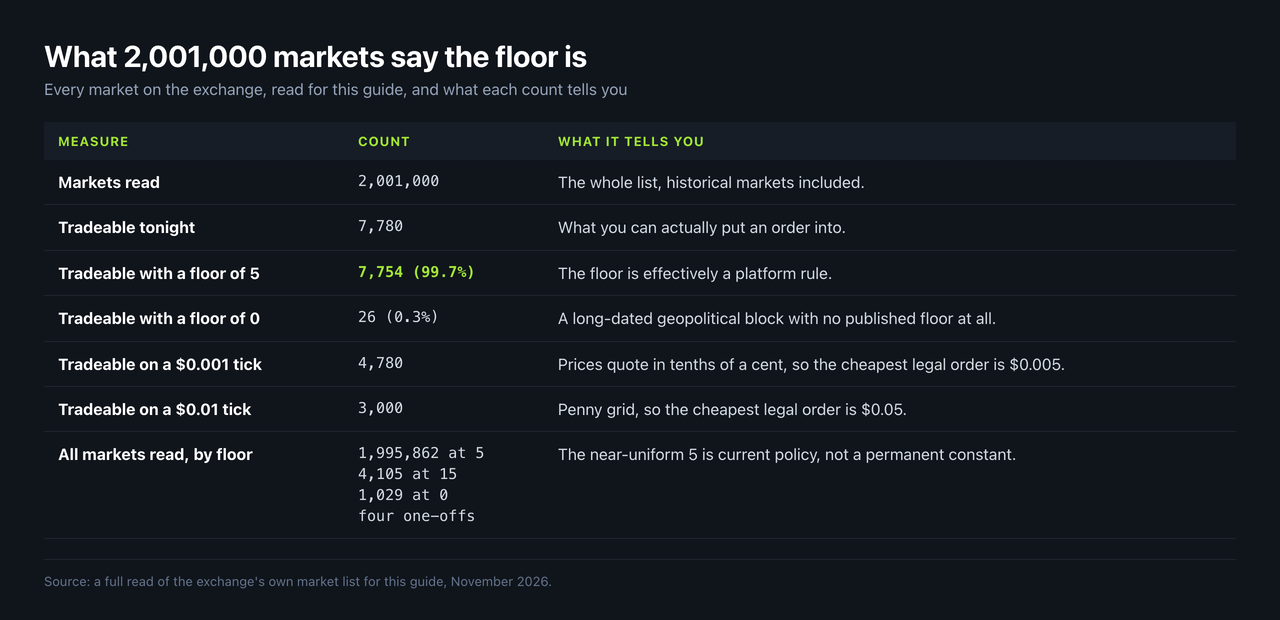
We walked the list in bulk rather than sampling it, because a uniform rule and a common default look identical in a sample — and that caution earned its keep. The first 401,000 markets were unanimous; it took the full 2,001,000-market walk to turn up the exceptions. Of the 7,780 markets still accepting orders with an order book enabled, 7,754 posted a min_order_size of 5 and 26 posted 0.
The twenty-six are not a random scatter. Twenty-five of them expire on 1 January 2027 and sixteen share the same tags — a block of long-dated geopolitical recognition markets, plus a Blue Origin launch market and one on how prediction markets will be taxed. If you are sizing by hand the exception is a curiosity; if you are coding against the API, it is the reason to read the field per market.
| Measure | Count | What it tells you |
|---|---|---|
| Markets read | 2,001,000 | The whole list, historical markets included. |
| Tradeable tonight | 7,780 | What you can actually put an order into. |
Tradeable with min_order_size of 5 | 7,754 (99.7%) | The floor is effectively a platform rule. |
Tradeable with min_order_size of 0 | 26 (0.3%) | A long-dated geopolitical block with no published floor at all. |
| Tradeable on a $0.001 tick | 4,780 | Prices quote in tenths of a cent, so the cheapest legal order is $0.005. |
| Tradeable on a $0.01 tick | 3,000 | Penny grid, so the cheapest legal order is $0.05. |
| All markets read, by floor | 1,995,862 at 5; 4,105 at 15; 1,029 at 0; four one-offs | The near-uniform 5 is current policy, not a permanent constant. |
That last row is the one worth remembering. The floor has been 15 shares on thousands of settled markets, zero on a thousand more, and four markets carried oddities like 14.96 and 25 — so treat 5 as tonight's rule rather than a constant. The next section turns it into money.
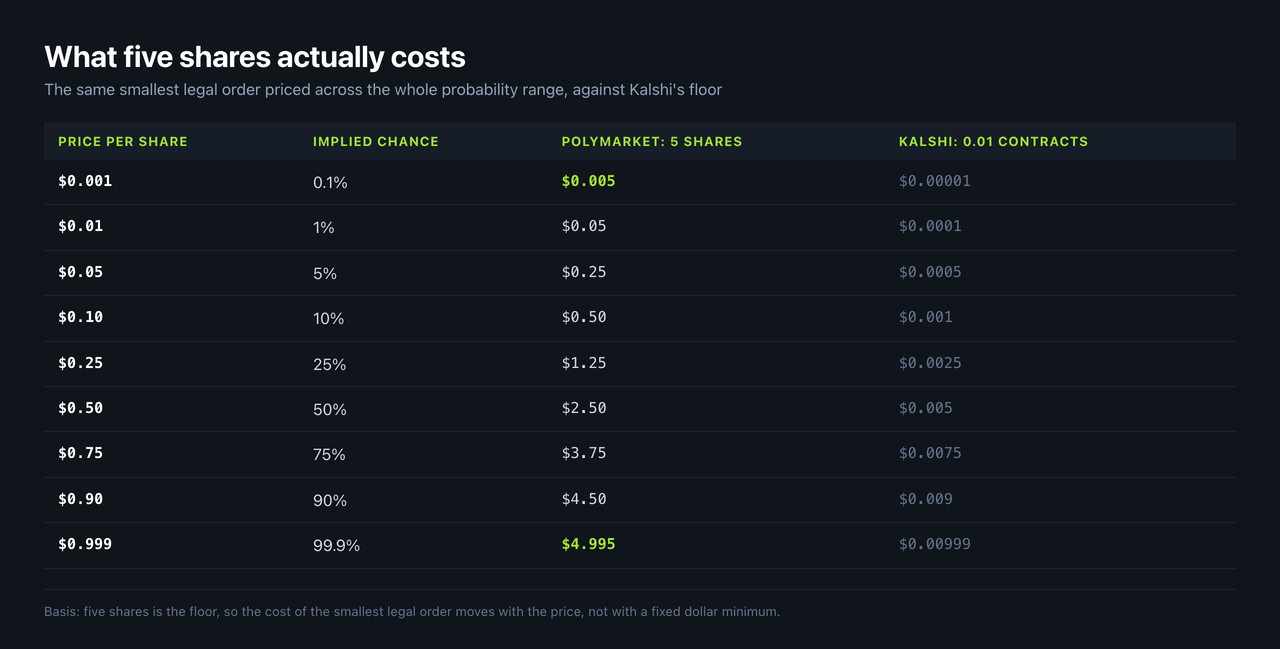
What five shares actually costs
Five shares at price p costs 5p dollars, and that is the entire formula. The useful consequence is the range. On the finer grid a market can legally quote $0.001, so the cheapest order the exchange will take is half a cent; at the other end, 99.9c puts the same five shares at $4.995.
Kalshi contracts carry the same $1 notional — every market in our census reported notional_value_dollars of exactly 1.0000 — so the two floors can be compared unit for unit. They differ by a constant.
| Price per share | Implied chance | Polymarket: 5 shares | Kalshi: 0.01 contracts |
|---|---|---|---|
| $0.001 | 0.1% | $0.005 | $0.00001 |
| $0.01 | 1% | $0.05 | $0.0001 |
| $0.05 | 5% | $0.25 | $0.0005 |
| $0.10 | 10% | $0.50 | $0.001 |
| $0.25 | 25% | $1.25 | $0.0025 |
| $0.50 | 50% | $2.50 | $0.005 |
| $0.75 | 75% | $3.75 | $0.0075 |
| $0.90 | 90% | $4.50 | $0.009 |
| $0.999 | 99.9% | $4.995 | $0.00999 |
Two readings fall out of that table. The first is that “the minimum is about $5” is only true at the very top of the price range, where you are buying near-certainties — and that is the one place a beginner is least likely to be. The second is the symmetry in bold: a minimum Kalshi order on a coin-flip costs the same half a cent as a minimum Polymarket order on its longest shot.
Then there is what the live board looks like rather than the arithmetic. Pricing the smallest legal order at the current ask in each of the 2,045 markets Polymarket's public feed will serve gives a median of $0.165. 1,784 of those markets — 87% — let you in for under a dollar, and 729 for under ten cents. The minimum bet is not $5. On the median market it is about the price of a stamp's worth of nothing.
Kalshi's floor is 500 times smaller
Kalshi used to be the straightforward one: whole contracts, priced in whole cents. Both halves of that have changed, and neither change has reached the affiliate pages.
On quantity, Kalshi's migration guide states that “minimum granularity is 0.01 contracts” and that order sizes “accept 0-2 decimal places on input”. It attaches a limit worth repeating: “fractional order sizes are supported only on markets that allow them; margin markets currently trade whole contracts.” So the floor is a hundredth of a contract where fractions are switched on, and one whole contract where they are not. Against Polymarket's five units that is 500x lower in the first case and 5x lower in the second.
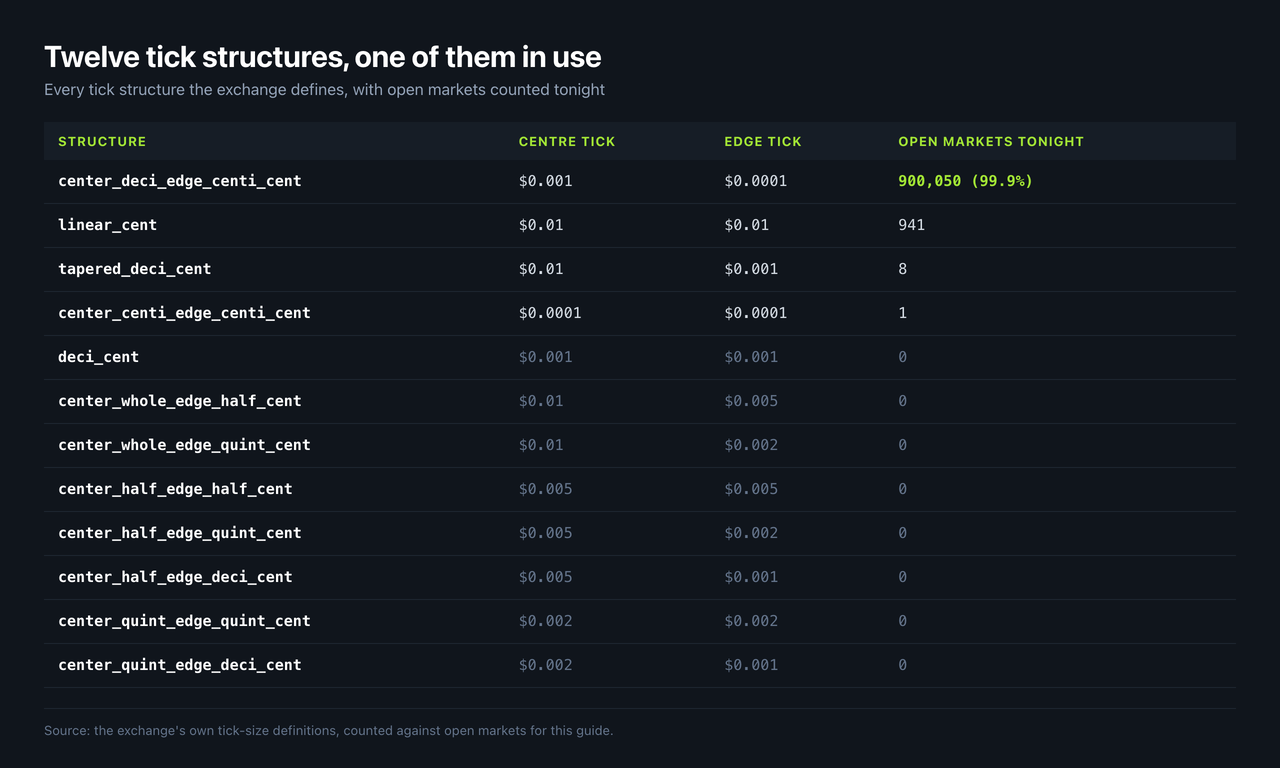
On price, Kalshi has gone sub-penny almost everywhere. It publishes twelve price-level structures, each a grid of bands with its own tick, and exposes the live one per market as price_level_structure with the exact grid in price_ranges. Reading 901,000 markets off its open-market endpoint found four of the twelve in use and the board overwhelmingly on one of them.
| Structure | Centre tick | Edge tick | Open markets tonight |
|---|---|---|---|
center_deci_edge_centi_cent | $0.001 | $0.0001 | 900,050 (99.9%) |
linear_cent | $0.01 | $0.01 | 941 |
deci_cent | $0.001 | $0.001 | 0 |
tapered_deci_cent | $0.01 | $0.001 | 8 |
center_whole_edge_half_cent | $0.01 | $0.005 | 0 |
center_whole_edge_quint_cent | $0.01 | $0.002 | 0 |
center_half_edge_half_cent | $0.005 | $0.005 | 0 |
center_half_edge_quint_cent | $0.005 | $0.002 | 0 |
center_half_edge_deci_cent | $0.005 | $0.001 | 0 |
center_quint_edge_quint_cent | $0.002 | $0.002 | 0 |
center_quint_edge_deci_cent | $0.002 | $0.001 | 0 |
center_centi_edge_centi_cent | $0.0001 | $0.0001 | 1 |
The live structure tapers: $0.0001 steps below 1c, $0.001 from 1c to 99c, then $0.0001 again above 99c. Kalshi's own reasoning for putting the fine grid at the edges is that near the boundaries “small absolute price differences represent large relative changes in implied probability” — which is the same problem our Polymarket slippage study measured from the cost side.
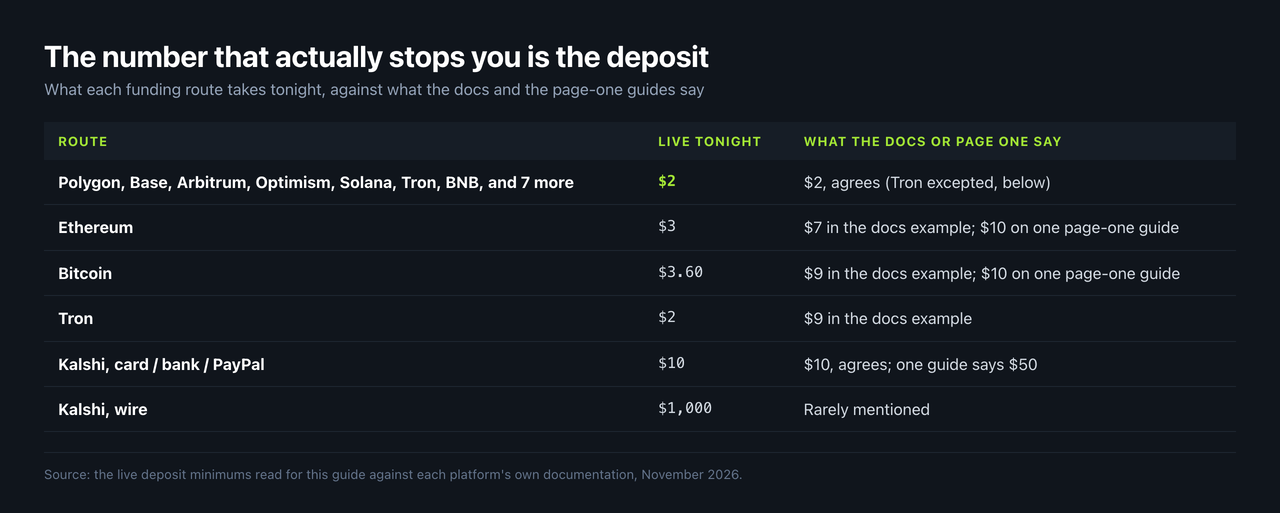
The number that actually stops you is the deposit
Everything above is about what the order book accepts. None of it matters if you cannot fund the account, and that is where the two venues swap places.
Polymarket's bridge publishes its funding minimums as minCheckoutUsd per asset. Read tonight, it lists 237 supported assets across 16 chains, and the floor is $2 on fourteen of them. Kalshi's help centre is blunter and higher: “the minimum deposit amount on Kalshi is $10”, with wires needing $1,000.
| Route | Live tonight | What the docs / page one say |
|---|---|---|
| Polygon, Base, Arbitrum, Optimism, Solana, Tron, BNB, and 7 more | $2 | $2 — agrees (Tron excepted, below) |
| Ethereum | $3 | $7 in the docs example; $10 on one page-one guide |
| Bitcoin | $3.60 | $9 in the docs example; $10 on one page-one guide |
| Tron | $2 | $9 in the docs example |
| Kalshi, card / bank / PayPal | $10 | $10 — agrees; one guide says $50 |
| Kalshi, wire | $1,000 | Rarely mentioned |
Note what happened in rows two to four: Polymarket's own documentation is out of date against Polymarket's own endpoint, and the affiliate pages have copied the documentation. That is why this table has a “live tonight” column at all, and why the endpoint is the thing to check before you move money.
So the practical answer to “how little can I start with?” is $2 on Polymarket and $10 on Kalshi — and the venue whose order book will take a hundredth of a contract is the one that wants five times as much to open the account. If you want to know what happens to that balance afterwards, our deposit-fee breakdown and payout-time study carry it forward.
Four things page one has wrong
We checked the claims that recur across the ranking pages. Four of them are wrong against the platforms' own sources, and all four push a reader the same way: towards thinking small bets are impossible.
- “Prices run from $0.01 to $0.99.” Not on most of the board. 4,780 tradeable markets quote on a tenth-of-a-cent tick, and tonight 525 live markets showed an ask under 1c and 597 a bid under 1c. The cheapest asks on the board sat at $0.001.
- “Expect a $1-$5 practical minimum because of Polygon gas fees.” You do not pay gas per order. Polymarket's order-lifecycle documentation says that when orders match, “the operator submits the trade to the blockchain” — the exchange sends the settlement transaction, not you. Funding the account is a separate on-chain step with its own network cost.
- “Kalshi needs a $50 minimum deposit to activate trading.” Kalshi's help centre says $10.
- “The minimum deposit is $2, $7 or $9.” Those are the documentation's example values. The live endpoint returns $2, $3 and $3.60 — and the page that publishes $2/$7/$9 contradicts itself in its own FAQ with “$2 to $10”.
None of this is exotic. Three of the four are settled by one request to an endpoint the platforms document publicly, which is roughly the amount of work that separates a comparison page from a rewrite of another comparison page.
At long odds the tick costs more than the minimum
Once you know the floor is pennies, the minimum stops being the binding constraint and the grid takes over. On a penny-tick market priced at 2c, the smallest price move available to you is 1c — half the value of your position. The order is legal and cheap; the exit is brutal.
The small-stake trap, in one line
A 5-share order at 2c costs 10c. One tick against you on a penny grid is 5c. The minimum you could stake was never the problem — the coarseness of the price was.
This is exactly why both venues put their finest ticks at the edges of the price range, and why 4,780 of Polymarket's tradeable markets and 99.9% of Kalshi's open ones now sit on sub-penny grids. We measured what that coarseness costs on the way out in the slippage study, and the taker fee that lands on top of it in the Polymarket fee breakdown; neither is re-derived here.
Betting small, in order
If the point of the exercise is to risk as little as possible while learning the mechanics, the order of operations matters more than the venue.
- Fund on the cheapest rail, not the familiar one. $2 on Polygon or Base beats $3.60 on Bitcoin for the same balance, and the endpoint tells you tonight's figure.
- Read the market's own tick before you size. A tenth-of-a-cent grid lets you in for half a cent and lets you out in small steps; a penny grid does neither.
- Size in shares, then convert. Five shares is the floor; multiply by the ask to see what it costs. Do not reason in dollars and hope the order clears.
- Use a limit order. Market buys are specified in dollars, limit orders in shares — and the floor is a share count, so a limit order is the one that lets you sit exactly on it.
- Check the exit before the entry. At 2c the spread and the tick, not the minimum, decide whether the position is tradeable at all.
That sequence costs nothing to follow and removes the two failure modes that bring people here: the rejected order, and the position that cannot be closed.
My verdict
The honest answer to “what is the minimum bet on Polymarket” is five shares, which tonight costs a median of 17 cents and never more than $4.995. The answer the first page of results gives you is a deposit minimum, which is a different number, frequently stale, and on three of the four routes we checked, too high.
Between the two venues: Kalshi's order book is the more generous by a factor of 500 and its front door is the more expensive by a factor of five. For a first $10 that resolves in Polymarket's favour on funding and Kalshi's on sizing — so pick on access and on the markets you actually want, not on a minimum that is smaller than the fee either way.
Check the tick before you size the order
The floor is five shares and the price grid decides what that costs. Both are published per market, and reading them takes ten seconds before an order rather than an afternoon after a rejection.
Visit Polymarket.com →Affiliate link to Polymarket; we have no commercial relationship with Kalshi. 18+ only. Every figure here is from the polymarket.com order book and bridge; the separate US-regulated app is a different venue with its own funding rules.
Related guides
- Polymarket Slippage 2026 — what a market order really costs once the tick and the book are counted.
- Polymarket Fees 2026 — the taker fee that lands on top of the minimum.
- Polymarket Deposit Fees 2026 — what the funding step itself takes.
- How Does Polymarket Work? — shares, resolution and payout from the beginning.
- Kalshi Fees by Market 2026 — the per-series fee coefficient, read across the board.
- Kalshi vs Polymarket Odds 2026 — which venue prices the same event better.
Polymarket minimum bet FAQ
What is the minimum bet on Polymarket?
Five shares. Polymarket's order book publishes it as min_order_size and its docs define it as the minimum number of shares the exchange accepts. We read 2,001,000 markets, and 7,754 of the 7,780 still accepting orders showed a floor of 5 — 26 showed 0. Because a share is priced between $0.001 and $0.999, five shares cost anywhere from half a cent to $4.995.
Is the Polymarket minimum 5 shares or $5?
Shares. The confusion is understandable, because five shares of a near-certain outcome costs about $5 — but that is the top of the range, not the rule. On the median live market tonight, the smallest legal order cost $0.165.
Can you bet $1 on Polymarket?
On most markets, yes, and for a good deal less. A dollar buys the five-share minimum on anything priced at or under 20c, and 1,784 of the 2,045 live markets we priced accepted their minimum order for under $1. Above 20c a dollar is not enough for five shares, so the order would be rejected.
Why was my small Polymarket order rejected?
Almost always one of two reasons. Either the order was under five shares, or its price did not sit on the market's tick — the book rejects a price that is not a multiple of the current increment. Both values are published per market, and the tick can change, so read them rather than assuming.
What is the minimum deposit on Polymarket?
Read from the bridge endpoint on 16 November 2026: $2 on fourteen of the sixteen supported chains, including Polygon, Base, Arbitrum, Optimism and Solana, $3 on Ethereum and $3.60 on Bitcoin. The documentation's own example still shows $7 and $9, so check the endpoint rather than a guide.
What is the minimum bet on Kalshi?
A hundredth of a contract on markets where fractional sizes are enabled — Kalshi's documentation states that minimum granularity is 0.01 contracts and that sizes take up to two decimal places. On markets without fractions, including margin markets, the floor is one whole contract. Both are below Polymarket's five shares, by 500x and 5x respectively.
Do you pay gas fees on every Polymarket trade?
No. Polymarket's order-lifecycle documentation says the operator submits the matched trade to the blockchain, so the settlement transaction is not yours to pay for. Moving money in and out is a separate on-chain step that does carry a network cost, which is where the “gas makes small bets impossible” claim comes from.
Which is cheaper to start with, Polymarket or Kalshi?
Polymarket, on funding: $2 against $10. Kalshi, on sizing: a hundredth of a contract against five shares. Since both floors are small enough that fees and the price tick dominate a tiny position, the deposit is the figure that decides your real entry price.
Method and sources
Every figure above was read on 16 November 2026. The Polymarket order-minimum figures come from a bulk walk of the exchange's market list, 2,001,000 markets, paged in order from the start; the list runs past that point and we stopped there, so the tradeable counts are a floor rather than a full census. The price distribution is narrower by necessity: Polymarket's public market feed stops paging at an offset of 2,100, so the median and the sub-dollar counts come from the 2,045 live markets it will serve, not from the full tradeable set. The Kalshi figures are a census of 901,000 open markets. Nothing here is modelled; where a platform does not publish a number, we say so rather than estimate it.
- Polymarket — Place orders: the definition of
min_order_sizeand the tick-conformance rule. - Polymarket — Order lifecycle: “the operator submits the trade to the blockchain”.
- Polymarket — Supported assets:
minCheckoutUsd, and the documented example values this run found stale. - Polymarket order-book market list: the endpoint walked for the census.
- Kalshi — Fixed-point migration: “minimum granularity is 0.01 contracts”, the fractional-market caveat, and the twelve price-level structures.
- Kalshi — Transfers FAQ: the $10 deposit minimum and the $1,000 wire minimum.
- Kalshi market endpoint:
price_level_structure,price_rangesandnotional_value_dollars.