Polymarket Postponed Games 2026: 627 Rules
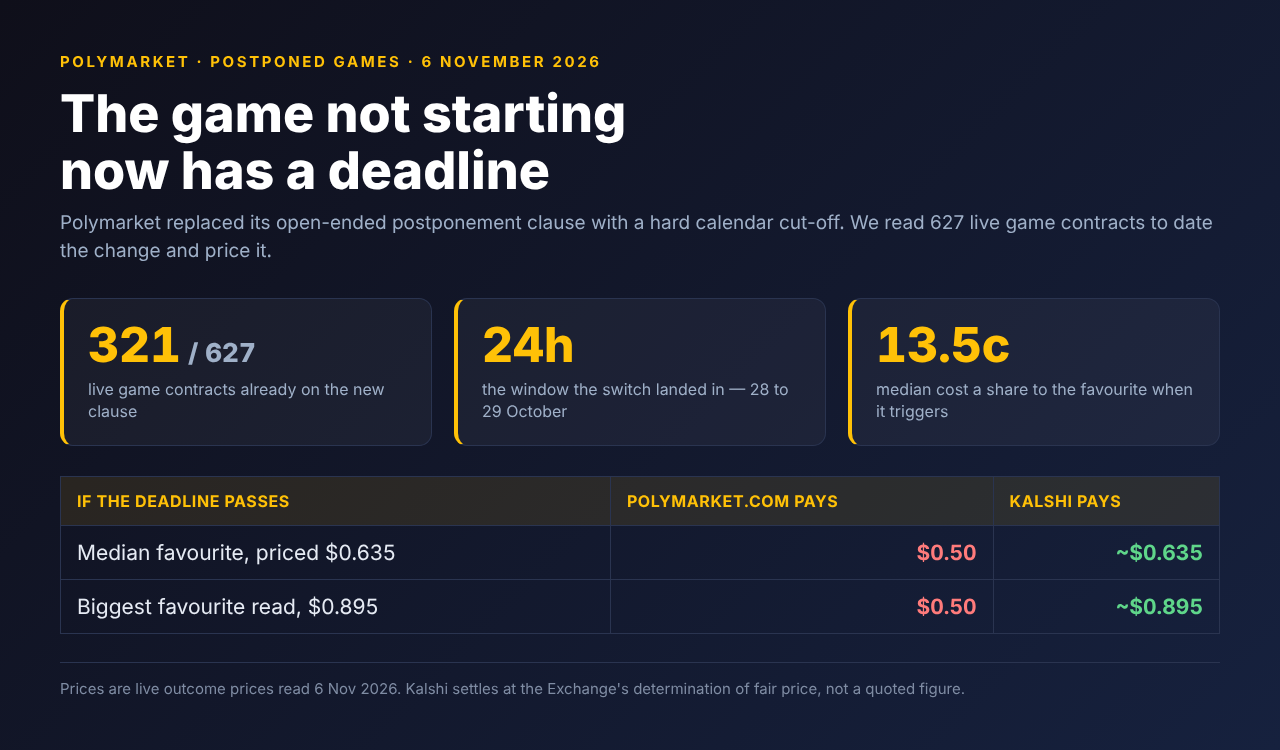
Polymarket postponed games now resolve 50-50 at a hard deadline. We read 627 live game rules: the clause changed on 29 October 2026, unannounced.
Affiliate disclosure: contains affiliate links; we may earn a commission at no extra cost to you. We have no commercial relationship with Kalshi. 18+ only — see BeGambleAware.org. Last updated 6 November 2026.
Key takeaways
- Polymarket postponed games no longer wait indefinitely. The old clause kept a market open "until the game has been completed". The new one resolves it 50-50 if the game has not started by 11:59 PM ET two days after the scheduled date.
- It was one switch, not a rollout. Of 627 live game contracts we read, 321 carry the new clause and 306 the old one — and the only thing that predicts which is when the market was created. The bracket is 24 hours wide: 28 October 15:30 UTC to 29 October 15:30 UTC. Zero counterexamples in 627.
- Every NBA market has already crossed over — 112 of 112. The NHL, NFL and college football boards are still half-and-half, and the last open old-clause contract is an NHL game on 24 November.
- The deadline costs the favourite real money. Across the 321 new-clause markets the median favourite trades at $0.635, so a 50-50 resolution takes 13.5c a share off it — up to 44.5c on the night's biggest price. Kalshi pays the last fair price instead, which is roughly what the position was worth.
- Polymarket's two apps disagree. On polymarket.com a cancelled game pays $0.50; on the regulated Polymarket US app the same cancellation settles at last fair market price, the same way Kalshi does.
On this page
If you are holding a position on a game that did not kick off, the only sentence that matters is the one in that market's own rules — and on Polymarket postponed games that sentence was rewritten eleven days ago without an announcement. The old wording let a postponed market sit open for as long as it took, so a 90c favourite eventually got paid on the real result. The new wording gives the game a hard calendar deadline and pays 50-50 if it is missed, which on tonight's board is worth up to 44.5c a share. We read the rules text of 1,091 live Polymarket markets and 834 Kalshi contracts on 6 November 2026, found the exact 24-hour window the change landed in, and tested it for counterexamples. Every guide currently ranking for this question describes the clause that Polymarket stopped using.
What changed in Polymarket's postponed-game rules
Both clauses are short, and the difference is one deadline. Here they are side by side, quoted from two NHL contracts whose games are one day apart.
| Old clause (to 28 Oct) | New clause (from 29 Oct) | |
|---|---|---|
| If postponed | "this market will remain open until the game has been completed" | no open-ended wait; the deadline below applies |
| Deadline | none | "does not start by [day], 11:59 PM ET" — two days after the scheduled date |
| If cancelled | "canceled entirely, with no make-up game" → 50-50 | cancelled, missed deadline, or "abandoned with no official result" → 50-50 |
| Result already decided | not addressed | "if this market's outcome was definitively determined … before abandonment, that outcome will stand" |
Read the two columns against each other and the change cuts both ways. The deadline is the expensive half: a postponed game that gets rescheduled for next week used to pay you on what actually happened, and now it pays you 50c if the make-up falls outside roughly 48 hours. The last row is a genuine improvement, and it is new — a game abandoned at 100-70 in the fourth quarter now settles on the result rather than being voided.
What it is not is an announcement. There is no blog post, no changelog entry, and no mention in Polymarket's own documentation; the wording simply differs between two markets created a day apart.
627 Polymarket postponed-game rules, counted
We pulled every open game market across the four North American team leagues and read the moneyline contract for each fixture. The split is almost even, and inside each league it is perfectly clean — there is not one date where both clauses appear.
| League | Markets | New clause | Old clause | Last old game date |
|---|---|---|---|---|
| NBA | 112 | 112 | 0 | none left open |
| NHL | 186 | 62 | 124 | 24 Nov 2026 |
| NFL | 46 | 17 | 29 | 17 Nov 2026 |
| College football | 283 | 130 | 153 | 7 Nov 2026 |
| Total | 627 | 321 | 306 | — |
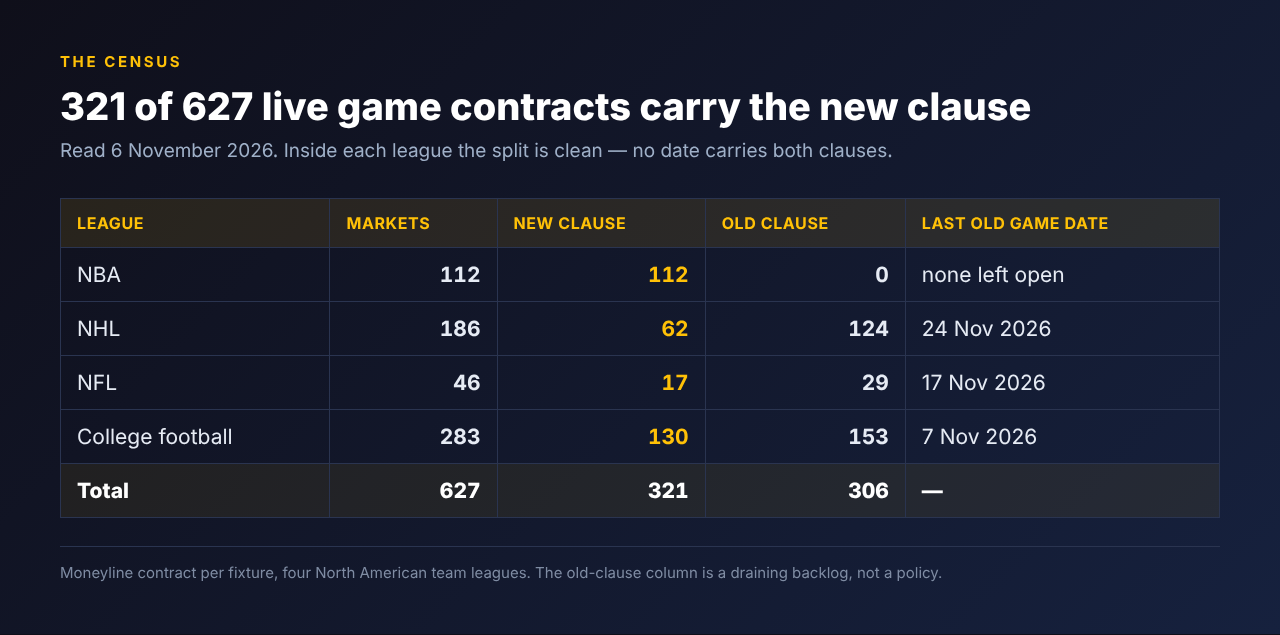
The NBA column is the headline: 112 of 112, the whole board out to 20 November. A week ago basketball was the only league with any new-clause markets at all, which is why this looked like an NBA experiment. It was not.
The right-hand column is the one to diary. Old-clause contracts are a draining backlog, not a policy — they are simply markets that were created before the switch and have not settled yet. College football clears on 7 November, the NFL on 17 November, and the NHL last of all on 24 November. From 25 November 2026, every open contract on these four leagues carries a deadline.
The switch was one moment, and we can bracket it to 24 hours
The clause does not track league, and it does not track game date. It tracks the timestamp on the market object, which means Polymarket flipped a template and let it apply to everything created afterwards.
The NHL proves it, because the NHL board is built in a daily batch at 15:30 UTC. Two consecutive batches sit either side of the change:
nhl-las-edm-2026-11-24 — created 2026-10-28 15:30:26 UTC: "If the game is postponed, this market will remain open until the game has been completed."
nhl-nj-cbj-2026-11-25 — created 2026-10-29 15:30:34 UTC: "If the game is canceled, does not start by Friday, November 27, 2026, 11:59 PM ET, or is abandoned with no official result by that time, this market will resolve 50-50."
Twenty-four hours and eight seconds apart, same league, same season, different rules. Every other league's boundary falls inside the same bracket once you look at creation times rather than fixtures:
| League | Last old-clause market created | First new-clause market created |
|---|---|---|
| NHL | 28 Oct 15:30 UTC | 29 Oct 15:30 UTC |
| NFL | 27 Oct 12:00 UTC | 30 Oct 12:00 UTC |
| NBA | none still open | 30 Oct 17:59 UTC |
| College football | 26 Oct 22:26 UTC | 2 Nov 23:01 UTC |
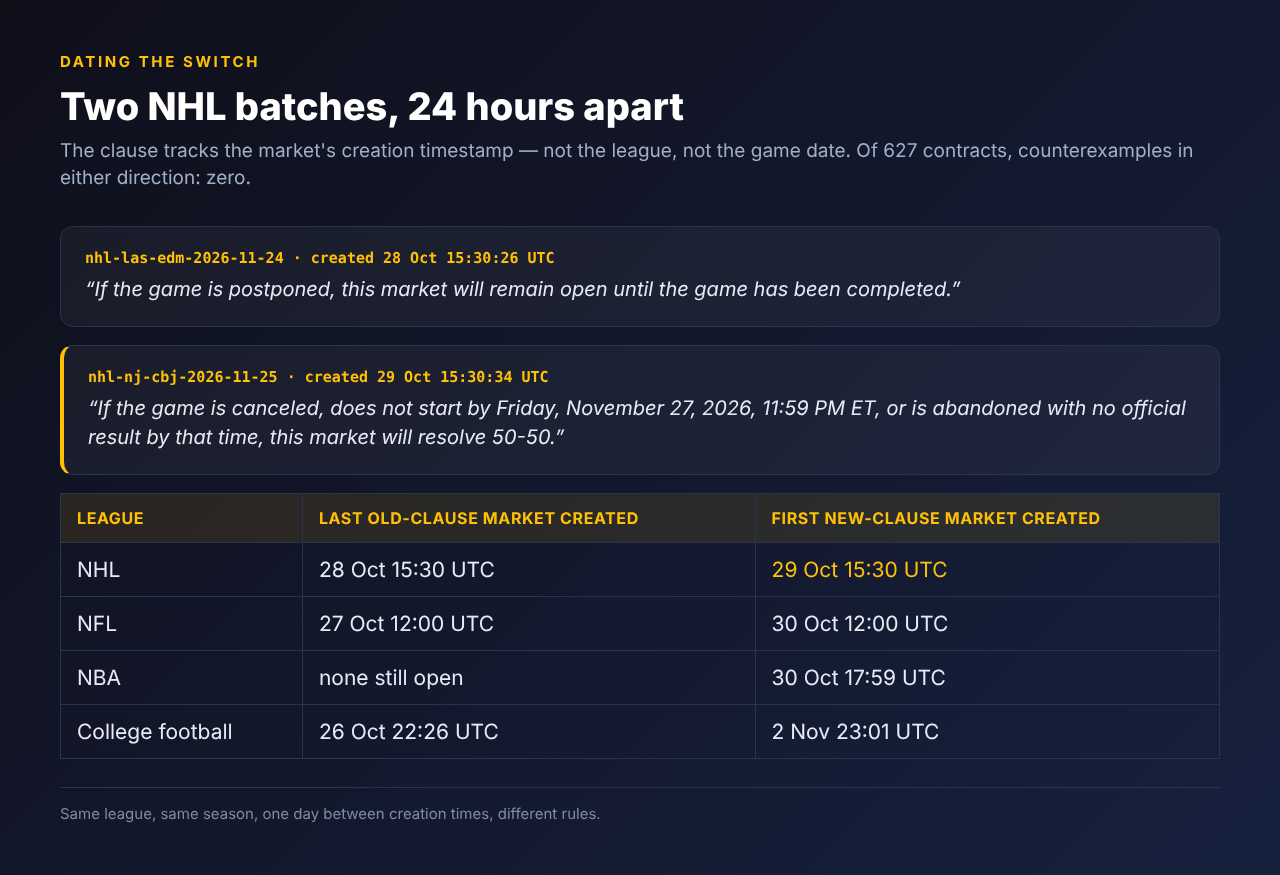
The test that matters is the counterexample, so we ran it: of the 627 contracts, the number carrying the old clause but created after the first new-clause market is zero, and the number carrying the new clause but created before the last old-clause market is also zero. One rule, one timestamp, no exceptions.
This is also a correction to our own earlier read. When we compared the two venues' rulebooks on 2 November, the split looked NBA-only and mid-flight. It was neither: basketball just had the shortest gap between creation and tip-off, so it crossed over first. The lesson is that a clean split by game date can be the shadow of a single instant.
How long the new deadline actually runs
"Two days after the scheduled date" is a calendar rule, not a stopwatch, so the real window depends on what time the game starts. A 1:00 PM kick-off gets nearly three full days; a 10:30 PM tip-off gets barely two. Measured across all 321 new-clause contracts:
| League | Markets | Shortest | Median | Longest |
|---|---|---|---|---|
| NBA | 112 | 49.0h | 52.0h | 59.0h |
| NHL | 62 | 50.0h | 53.0h | 59.0h |
| NFL | 17 | 51.7h | 55.9h | 59.0h |
| College football | 130 | 49.0h | 58.0h | 60.0h |
| All | 321 | 49.0h | 53.0h | 60.0h |
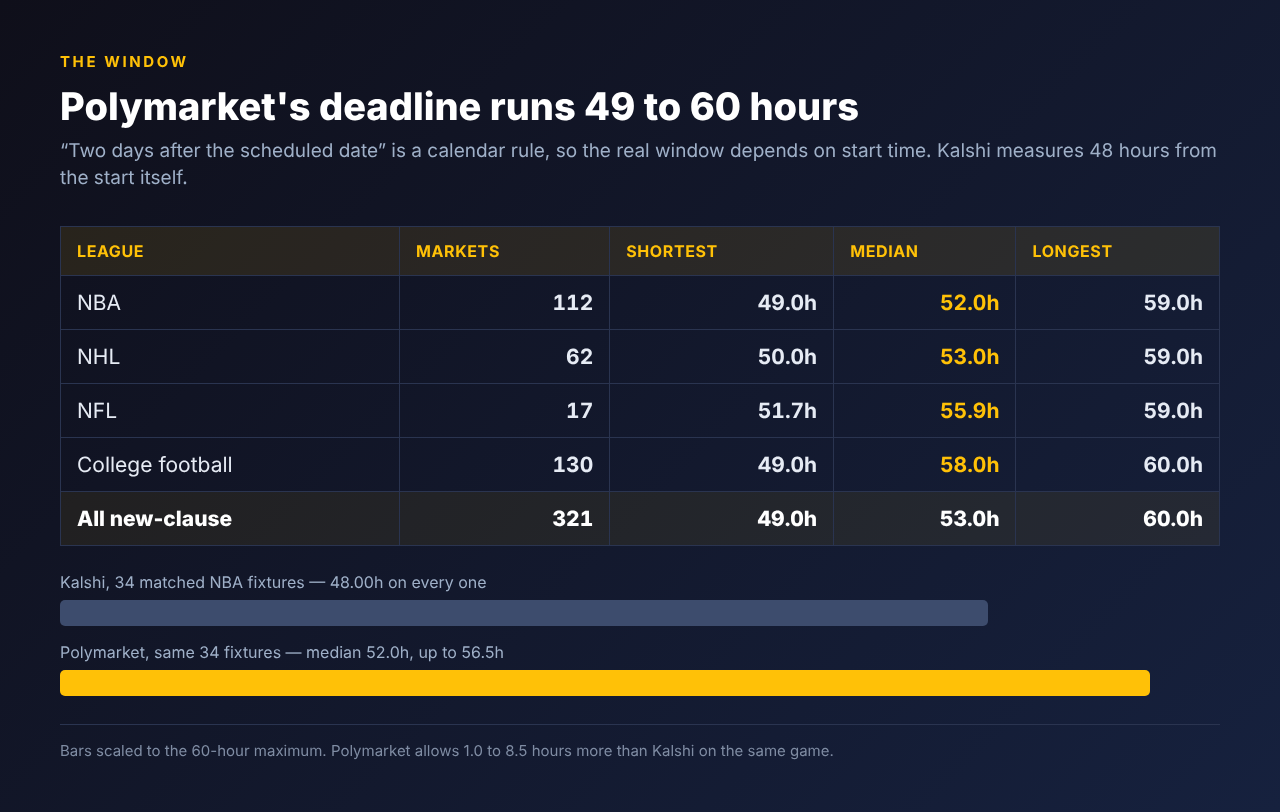
Note that the floor is just under 49 hours, never under 48. College football has the loosest windows because Saturday noon starts get until Monday midnight — almost 60 hours. So Polymarket's deadline is always a little longer than Kalshi's, which is the next thing worth measuring rather than assuming.
Kalshi's 48 hours, measured on 834 contracts
Every competing guide states Kalshi's 48-hour rule and none of them counts it, so we did. All 834 open game contracts across Kalshi's seven live game series carry the 48-hour clause — 68 NBA, 96 NHL, 56 NFL, 506 college football, 30 Premier League, 45 MLS and 33 La Liga. Not one exception.
There are two phrasings, and they split exactly by sport rather than by series. The 726 US-team-sport contracts say the market stays open "if the game is postponed but begins within 48 hours of its originally scheduled start time". The 108 soccer contracts say it resolves if the game is "cancelled or rescheduled to over 48 hours away". Same bound, different sentence.
Then we matched fixtures. Thirty-four NBA games are listed on both venues this week, which lets us compare the same event's deadline on each:
| Measured on 34 matched NBA fixtures | Shortest | Median | Longest |
|---|---|---|---|
| Kalshi window after tip-off | 48.00h | 48.00h | 48.00h |
| Polymarket window after tip-off | 49.0h | 52.0h | 56.5h |
| Extra time Polymarket allows | +1.0h | +4.0h | +8.5h |
Kalshi is 48.00 hours on 34 of 34, to the minute, because it measures from the scheduled start rather than from a calendar date. Polymarket now gives between one and eight and a half hours more. That sounds like Polymarket winning, and on the clock it is — but the clock is the smaller half of this comparison.
What 50-50 costs you when the deadline passes
Here is the part none of the competing pages reaches. The two venues do not just set different deadlines; they pay different amounts when the deadline passes. Polymarket resolves 50-50. Kalshi resolves to "the last fair price as determined by the Exchange in its sole discretion" — roughly what your contract was worth before the game fell through.
For a coin-flip market those are the same thing. For a favourite they are not, and the gap is the favourite's price minus 50c. Across all 321 new-clause contracts, every single one had a favourite trading at or above 50c:
| Fixture (new clause) | Favourite | Polymarket pays | Kalshi pays* | Cost per share |
|---|---|---|---|---|
| SAS v SAC, 6 Nov | $0.895 | $0.50 | ~$0.895 | 39.5c |
| PHI v CHI, 8 Nov | $0.815 | $0.50 | ~$0.815 | 31.5c |
| MIL v NYK, 10 Nov | $0.795 | $0.50 | ~$0.795 | 29.5c |
| WAS v OKC, 7 Nov | $0.765 | $0.50 | ~$0.765 | 26.5c |
| Median of all 321 | $0.635 | $0.50 | ~$0.635 | 13.5c |
*Kalshi's settlement is the Exchange's determination of fair price, not the last traded price, so treat the tilde as real. The comparison is the rule, not a quoted figure.
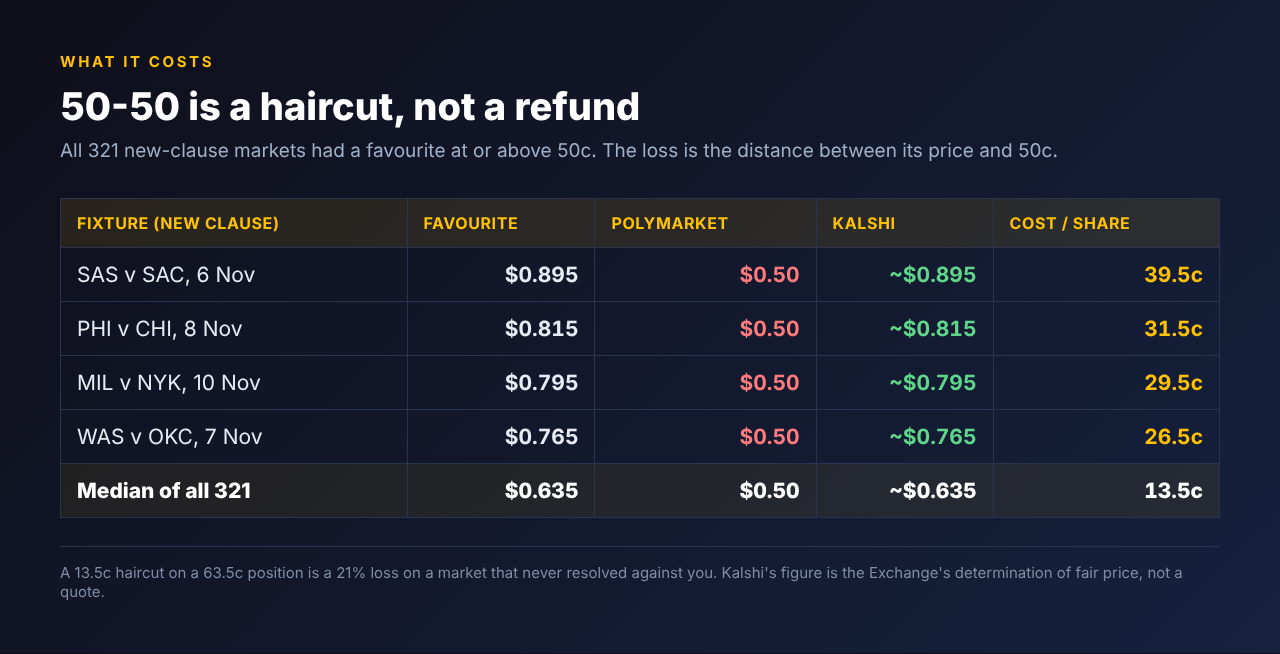
The median case is a 13.5c haircut on a 63.5c position — a 21% loss on a market that never resolved against you. On the night's biggest price it is 39.5c, and the widest gap anywhere in the 321 was 44.5c. Nineteen contracts were trading at 80c or more.
By league the exposure follows the favourites: the NFL has the steepest median haircut at 21.5c and the NHL the mildest at 7.0c, because hockey games price closer to even. That ordering is worth knowing if you are deciding where to carry weather risk, and it lines up with the price agreement we measured across 626 matched contracts — the venues agree on the odds and then differ on what happens when the game does not.
Read the rules box before the weather does it for you
The clause is in every market's own Rules section, and it now differs between two games in the same league. On a 90c favourite the wording is worth 39.5c a share.
Visit Polymarket.com →Affiliate link to Polymarket; we have no commercial relationship with Kalshi. 18+ only. Polymarket restricts access from the United States, Canada and other listed jurisdictions. Prediction markets carry a substantial risk of loss. Nothing here is financial advice.
Polymarket.com and Polymarket US do not agree
One brand, two apps, two different answers to the same cancelled game. The regulated US app documents its own settlement rules, and they are Kalshi's, not polymarket.com's.
| Venue | Deadline | Payout if missed | A 90c favourite gets |
|---|---|---|---|
| polymarket.com (new clause) | 11:59 PM ET, 2 days after | 50-50 | $0.50 |
| polymarket.com (old clause) | none — waits for the game | 50-50 only if cancelled outright | the real result |
| Polymarket US | the contract's expiration date | last fair market price | ~$0.90 |
| Kalshi | 48.00h after scheduled start | last fair price, Exchange's discretion | ~$0.90 |
Polymarket US puts it plainly: if the make-up game falls after expiration, "all Contracts on the original game settle at last fair market prices", and a cancellation settles "at last fair market prices as of the time the cancellation was officially announced". Its documentation also warns that last fair market price "is not the last traded price at market close" — it is the exchange's view of fair value, exactly like Kalshi's.
So the US app reserves 50c settlements for genuine ties: a tied game with no winner declared, a cricket no-result, a UFC draw, an ITF tennis walkover. On polymarket.com, 50c is also what you get for bad weather. If you can reach both, that difference is worth more than any fee on the published rate card.
Soccer is unresolved, and three sports always had deadlines
The new clause has reached four leagues. It has not reached soccer — but we are not going to tell you soccer is excluded, because the data cannot support that. All 248 open soccer markets we read carry the old clause, and all 248 were created on or before 26 October, which is before the switch. Every one of them would carry the old wording whether or not soccer is in scope. The next batch created after 29 October is what answers it.
What soccer does have is the strangest payout on the board, unchanged from our earlier read: a cancelled match pays "No" ($0) on all 165 team markets and "Yes" ($1.00) on all 83 draw markets. Back the draw and a cancellation pays in full; back either team and it pays nothing.
Meanwhile the individual sports have had calendar deadlines all along, and they are seven times longer than the new team-sport one:
| Sport | Markets read | Deadline | Payout if missed |
|---|---|---|---|
| NBA / NHL / NFL / CFB | 321 | ~2 days | 50-50 |
| Tennis | 151 | 14 days | 50-50 |
| UFC | 30 | 14 days | 50-50 |
| Boxing | 23 | 14 days | 50-50 |
| Soccer | 248 | none yet | $0 team / $1.00 draw |
Tennis is uniform to the word — 151 of 151 say the market resolves 50-50 if no winner is determined by a date "(14 days after the scheduled start)". UFC and boxing are 30 of 30 and 23 of 23 at exactly 14 days. So Polymarket did not invent the deadline in October; it took a convention that already governed 204 individual-sport markets and gave the team sports a version seven times shorter.
What to check before the next postponement
Read the Rules box, not a guide. That includes this one. Two markets in the same league a day apart currently carry different clauses, so the only authoritative text is the one on the market you are about to trade. Look for the phrase "does not start by" — if it is there, you have a deadline.
Treat a favourite as carrying weather risk. On the new clause, the thing you lose if a game is called off is not your stake, it is the distance between your price and 50c. The higher the price, the more a postponement costs, which is the opposite of the intuition that a big favourite is the safe side.
The one-line version. Polymarket postponed games used to wait for the game and now expire about two days after it; the payout is 50-50 either way, which is fine at even money and expensive on a favourite. Kalshi expires at a flat 48 hours and pays the position's fair value instead. If you hold favourites through winter weather, the venue matters more than the fee you paid to get in.
Related guides
- Kalshi vs Polymarket Rules 2026: 48 Hours — the full cross-venue rulebook census this article updates.
- Polymarket Resolution 2026: When UMA Decides — who actually settles a disputed market, and how long it takes.
- Polymarket Payout Time 2026: 37,659 Timed — how long your money is locked up after the result is in.
- Polymarket End Date 2026: 88% Close Late — why the date on the market is not the date it resolves.
- Kalshi vs Polymarket Odds 2026: 626 Prices — the two venues agree on price, then differ on everything else.
- Kalshi Payout Time 2026: 15,382 Timed — the same settlement question on the other exchange.
Polymarket postponed games FAQ
What happens on Polymarket if a game is postponed?
It now depends on when the market was created. On the clause used since 29 October 2026, the market resolves 50-50 if the game has not started by 11:59 PM ET two days after its scheduled date. On older markets there is no deadline at all and the market stays open until the game is played. We found 321 of 627 live game contracts on the new clause on 6 November 2026.
Does Polymarket refund a postponed game?
No. There is no refund mechanism on either clause. The market either waits for the game or resolves 50-50, which pays 50c a share regardless of what you paid. If you bought a favourite at 80c, a 50-50 resolution is a 30c loss, not a return of your stake.
How long does Polymarket wait before resolving a postponed game 50-50?
Between 49 and 60 hours after the scheduled start, median 53 hours, measured across all 321 new-clause markets. The rule is a calendar deadline of 11:59 PM ET two days later, so an early kick-off gets a longer window than a late one. College football games have the loosest windows at up to 60 hours.
When did Polymarket change its postponement rules?
Between 28 October 2026 15:30 UTC and 29 October 2026 15:30 UTC. We bracketed it with two consecutive NHL market batches: the one created at 15:30 on 28 October carries the old wording and the one created 24 hours later carries the new wording. Polymarket published no announcement.
Which Polymarket sports have a postponement deadline now?
The NBA has fully crossed over at 112 of 112 markets. The NHL, NFL and college football boards are mixed, because contracts created before the switch are still open. Tennis, UFC and boxing have always had a 14-day deadline. Soccer markets all still carry the old clause, but every open soccer market predates the switch, so its status is genuinely unknown.
What does Kalshi do when a game is postponed?
Kalshi keeps the market open if the game begins within 48 hours of its originally scheduled start, and otherwise resolves to the last fair price as determined by the Exchange in its sole discretion. We found the 48-hour clause on all 834 open game contracts across its seven live game series, and on 34 matched NBA fixtures the window was exactly 48.00 hours every time.
Is Polymarket or Kalshi better if a game gets called off?
Kalshi, if you hold a favourite. Polymarket pays 50c a share and Kalshi pays the position's fair value, so on the median new-clause market priced at 63.5c the difference is 13.5c a share, and on the night's biggest favourite at 89.5c it is 39.5c. Polymarket's deadline is the more generous one, by one to eight and a half hours, but the payout rule matters more than the clock.
Do Polymarket US and polymarket.com settle postponed games the same way?
No. Polymarket US settles postponed and cancelled games at last fair market price, the same approach as Kalshi, and reserves 50c settlements for ties, cricket no-results, UFC draws and ITF tennis walkovers. On polymarket.com a missed deadline pays 50-50 whatever the price was. Same brand, materially different outcome.
Method and sources
Read on 6 November 2026. On the Polymarket side we walked the public events endpoint for fifteen league tags, took every event whose slug ends in a fixture date, and read the full description — the binding rules text — of its moneyline contract: 627 across the four North American team leagues, 248 soccer markets including the draw leg, and 216 tennis, UFC, boxing and Formula 1 contracts, for 1,091 in total. Clause classification is a literal phrase match on "does not start by" plus "abandoned with no official result" for the new template and "remain open until the game has been completed" for the old one. Deadline windows are the parsed deadline minus the market's own gameStartTime, with ET read as UTC−5. Prices are the live outcome prices at the time of reading. On the Kalshi side we paged all 834 open contracts across its seven live game series and matched 34 NBA fixtures by date and team codes.
Four caveats. Soccer's status is undetermined, not excluded — every open soccer market predates the switch, so its old clause is evidence of nothing. Counts are of markets open on one evening and will differ on yours; the old-clause backlog is draining by the day. The Kalshi payout comparison is a rule, not a quoted number: "last fair price" is the Exchange's determination and we are not able to predict it for a specific contract. And kalshi.com, the web host, returned HTTP 429 to every request in this run, so the Kalshi wording is taken from its API, its documentation and the signed contract-terms PDF rather than its marketing pages.
- Polymarket: Devils v Blue Jackets, 25 November — the first new-clause market we found, created 29 October 15:30 UTC. Its Rules box carries the deadline wording verbatim.
- Polymarket US docs: Sports FAQs — the US app's own settlement rules, including last fair market price and the definition that it is not the last traded price.
- Kalshi contract terms: basketball game winner (PDF) — the binding document, which is where "the last fair price as determined by the Exchange in its sole discretion" appears; the API field carries only the short form "a fair price".
- Kalshi docs: fee rounding — used to confirm settlement arithmetic conventions on the Kalshi side.