What Is a Handicapper in Betting? UK Guide (2026)
Handicappers, handicap markets and betting exchanges explained for UK punters. Learn how the spread works, when to use it, and where to bet in 2026.
Affiliate disclosure: This page contains affiliate links. We may earn a commission at no extra cost to you. 18+ only. UK customers only for Betfred. Gamble responsibly — see BeGambleAware.org. Last updated 31 May 2026.

Featured UK Bookmaker
Betfred — strong handicap markets on Premier League & EFL
Solid Asian handicap depth, competitive European handicap lines, and Best Odds Guaranteed on UK & Irish racing. New customer offer subject to T&Cs.
If you've ever heard a mate say "I'm taking Arsenal -1.5" and nodded along without a clue what that meant, you're in the right place. A handicapper — and the handicap markets they create — is one of the most useful tools in betting once you understand it. It turns a one-sided match into a proper contest, gives you better odds on favourites, and gives outsiders a head-start that can sneak you a winner.
This guide walks through what a handicapper actually does, how the markets work in football, racing, rugby and tennis, where exchanges fit in, and how to find decent handicap odds in the UK in 2026. No jargon dump — just the bits you'll actually use.
What is a handicapper in betting?
A handicapper is the person (or, more often these days, the algorithm-plus-trader team) at a bookmaker who sets the line that levels the playing field between two teams or competitors. Their job is to look at form, injuries, home advantage, weather, motivation and the market itself, then decide how many goals, points, lengths or games one side should give up — or receive — so that the bet becomes roughly 50/50.
In horse racing, the term has a slightly different flavour. The official handicapper at the British Horseracing Authority assigns each horse a rating based on past performance, and that rating decides how much weight the horse carries in a handicap race. The heavier the weight, the harder the job. A high-rated horse running off top weight is doing it the hard way.
So depending on context, "handicapper" can mean:
- The trader/model at a sportsbook setting a points spread or goal line
- The official BHA handicapper assigning weights to racehorses
- A tipster who specialises in handicap markets (mostly a US term)
For most UK punters, you'll be dealing with definition one and two most of the time.
How handicap betting actually works
The simplest way to think about it: the handicapper gives one side a head-start (a plus) and the other a deficit (a minus). You then bet on the result after that virtual head-start has been applied.
Imagine Manchester City are playing Luton at home. The straight match-odds price on City might be something miserable like 1.18 — not worth your time. So the handicapper offers City -2 on the European handicap. Now City need to win by 3 clear goals for your bet to land. Suddenly the odds are closer to 2.10 and you've got a proper bet on your hands.
On the other side, Luton +2 means Luton can lose by 1, draw, or win, and you still cash. That's the trade — you give yourself a much better chance of winning, but the odds reflect that.
There are three main flavours of handicap you'll see at UK sportsbooks like Betfred:
- European (3-way) handicap — uses whole numbers, and a "draw after handicap" is possible. So City -2 vs Luton can land for City, Luton, or "handicap draw" if City win by exactly 2.
- Asian handicap — uses half-numbers and quarter-numbers (-0.5, -1.25, -1.75 etc) which eliminate the draw outcome entirely. Quarter handicaps split your stake across two lines, which is why some bets get "half-won" or "half-lost".
- Points/lengths handicap — used in rugby, basketball, NFL, cricket and racing. Same principle, different units.
Worked examples so it actually sticks
Theory's fine but it only clicks once you see real numbers. Here are three quick scenarios.
Example 1 — European handicap, football. Liverpool -1 vs Brentford. You stake £20 at odds of 1.95.
- Liverpool win 2-0 → you win (£19 profit)
- Liverpool win 1-0 → handicap draw, stake refunded
- Liverpool draw or lose → you lose your £20
Example 2 — Asian handicap, football. Arsenal -1.5 vs Everton at 2.10, £20 stake.
- Arsenal win by 2 or more → £22 profit
- Arsenal win by 1, draw, or lose → £20 down
No middle ground, no refund. Asian half-lines are nice and binary.
Example 3 — quarter handicap. Spurs -0.75 at 1.90, £20 stake. Your stake is split in half — £10 on Spurs -0.5 and £10 on Spurs -1.
- Spurs win by 2+ → both bets win → ~£18 profit
- Spurs win by exactly 1 → -0.5 wins (£9.50 profit), -1 is a push (£10 refunded) → £9.50 profit
- Spurs draw or lose → both lose → £20 down
Quarter lines are why you sometimes see returns that look weird — half a bet won, half pushed. It's deliberate, not a bookie cock-up.
The handicapper in horse racing — a different beast
In UK and Irish racing, the official BHA handicapper assigns each horse an official rating (OR) on a scale that runs from the lower 40s up to the 140s for elite Flat horses. After every race, the handicapper reassesses — a horse that wins easily off a mark of 75 might go up to 82 next time. A horse that runs poorly might come down.
Handicap races are designed so that, in theory, every horse has the same chance of winning if the handicapper has done their job. Top-weighted horses carry more lead in the saddle pad to equalise things. This is why following the official handicapper's moves matters — a horse that's been "well-treated" by the handicapper (in other words, dropped a few pounds after a slightly unlucky run) can be a smart bet next time out.
If you fancy a long-range punt on a big handicap like the Grand National, the Cesarewitch or the Lincoln, you're stepping into ante post betting territory — betting weeks or months ahead of the race, accepting that if your horse doesn't run, you usually lose the stake. The reward is much bigger prices than you'll get on the day. Our piece on Best Odds Guaranteed covers how to protect yourself when prices shift closer to the off.
Betting exchanges vs traditional bookies for handicaps
This is where a lot of punters get confused, so let's clear it up. What is a betting exchange? An exchange is a platform where you bet against other punters rather than against a bookmaker. Betfair is the obvious one, Smarkets and Matchbook are the other notable best exchange betting sites in the UK.
On an exchange, there's no in-house handicapper setting the line — the line emerges from what users are willing to back and lay. You'll find Asian handicap markets on the bigger exchanges, and the prices are often a touch better than a sportsbook because there's no built-in margin (just commission on winnings, typically 2-5%).
The trade-offs:
- Exchanges — better prices, smaller margins, but liquidity can be thin outside Premier League and major leagues. You also pay commission.
- Sportsbooks like Betfred — slightly worse raw prices but loads of markets, free bets, accumulators, Best Odds Guaranteed on racing, and you don't have to "match" your bet against another user.
Most punters I know use both. The exchange for big, high-liquidity handicap markets where the extra few pips matter, and a bookmaker like Betfred for everything else — accas, lower leagues, niche markets, and racing where BOG is the killer feature.
When handicap betting makes sense (and when it doesn't)
Handicaps aren't a magic edge. They're a tool. Here's when they actually earn their keep:
- Heavy favourites you fancy strongly. Backing Man City at 1.20 is dead money. Man City -2 at 2.00 gives you something worth winning.
- Outsiders you think will compete. If you reckon a mid-table side will keep things tight against a top-six club, the +1.5 line gives you a much better chance than a straight win.
- Asian handicaps to remove the draw. If you hate seeing a draw kill your bet, half-line Asian handicaps eliminate that outcome.
- Spotting weight drops in racing. A horse running off a 4lb lower mark than its last winning run is the bread-and-butter handicap angle.
When to leave them alone:
- Tightly-matched fixtures. If the match-odds are already 2.50 / 3.20 / 2.80, the handicap doesn't really add much.
- Markets with low liquidity. Obscure leagues, women's lower divisions, friendlies — the handicapper has less info, and the lines can be soft for the bookie's benefit, not yours.
- If you can't explain why the line is what it is. If you don't understand why the trader has set City -1.75 instead of -1.5 or -2, you're guessing. Don't bet to guess.
How to find the best handicap lines in the UK
Three habits that will save (and make) you money over a season:
- Line shop. Different bookmakers price handicaps slightly differently. One might have Liverpool -1.5 at 1.95, another at 2.05. Over a year that gap adds up. Open accounts at three or four shops minimum.
- Check the exchange before you bet. Even if you don't bet there, the exchange price is a useful sanity check. If Betfair has Arsenal -1 at 1.90 and your bookie has 2.10, that's a soft line worth taking.
- Watch the line move. If a handicap shifts from -1.5 to -1.75 on the morning of the match, something has changed — usually team news. Pay attention.
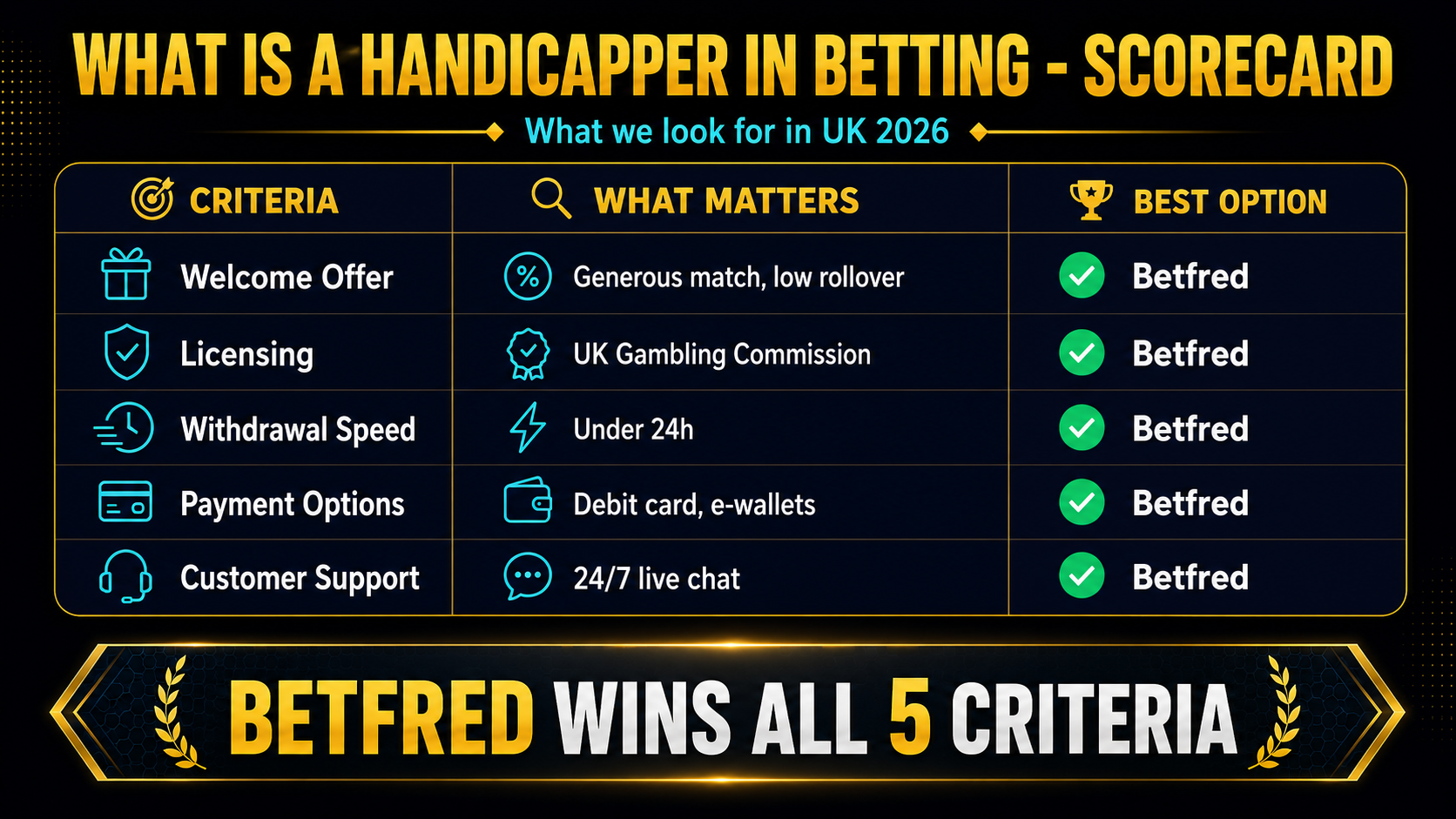
If you're shopping for a UK book that doesn't mess about with handicap markets, Betfred consistently posts competitive Asian and European lines on Premier League, EFL, and most European top divisions, plus a deep racing menu where the BHA handicapper's marks meet Best Odds Guaranteed. Have a look at their current sportsbook before you settle on where to place your next handicap bet.
Related reading
Once you've got handicaps sorted, broaden out: our guide to Best Odds Guaranteed shows you how to lock in price moves on racing, and if you're more of a casino player than a sportsbook punter, our best tactics for roulette piece covers bankroll discipline that applies just as well to sports betting. For crypto-friendly punters, the BC.Game review covers an alternative if you want a non-UK option with crypto rails.
FAQ
Is a handicapper the same as a tipster?
No. A handicapper at a bookmaker sets the spread; a tipster gives picks. In the US, "handicapper" is sometimes used loosely to mean a sports tipster who specialises in spread bets, but in the UK the two are distinct roles.
What's the difference between European and Asian handicaps?
European handicaps use whole numbers and allow a "handicap draw" as a third outcome. Asian handicaps use half and quarter lines, which eliminate the draw and sometimes split your stake across two lines. Asian is more efficient for pure win/lose betting.
Are handicap odds better on exchanges than bookmakers?
Usually marginally yes, because exchanges have no built-in overround — just commission on winnings. But sportsbooks like Betfred offer free bets, BOG, accumulators and easier UX, which often offsets the small price gap for casual punters.
What does ante post betting have to do with handicappers?
Ante post bets are placed weeks or months before an event — most often used for big handicap races like the Grand National. You're betting before the official handicapper has even assigned final weights in some cases, which is part of the risk and the value.
Can I lose more than my stake on a handicap bet?
Not at a UK sportsbook. Your maximum loss is your stake. On exchanges, if you lay a handicap bet you can be liable for the matched amount, but that's a different mechanic from backing.
Ready to bet smarter
Find your handicap edge at Betfred
Deep Asian and European handicap markets, Best Odds Guaranteed on UK & Irish racing, and a sportsbook UK punters actually trust.
Visit Betfred →18+ only. Betting can be addictive. Set a deposit limit before you sign up. See BeGambleAware.org. Affiliate links earn us a commission at no cost to you.